Quick Answer
Use leftover mashed potatoes for potato cakes, shepherd's pie topping, croquettes, soup thickening, or a quick gnocchi-style dough. Keep them refrigerated, choose a recipe that suits their moisture level, and reheat perishable leftovers until hot throughout.
Practical note
For using leftover mashed potatoes, this guide centers on Avoid the "Gummy" Trap, Temperature Matters, The "Salt Sink" Effect. Those are the checkpoints we would use first in a normal home kitchen before making a bigger change.
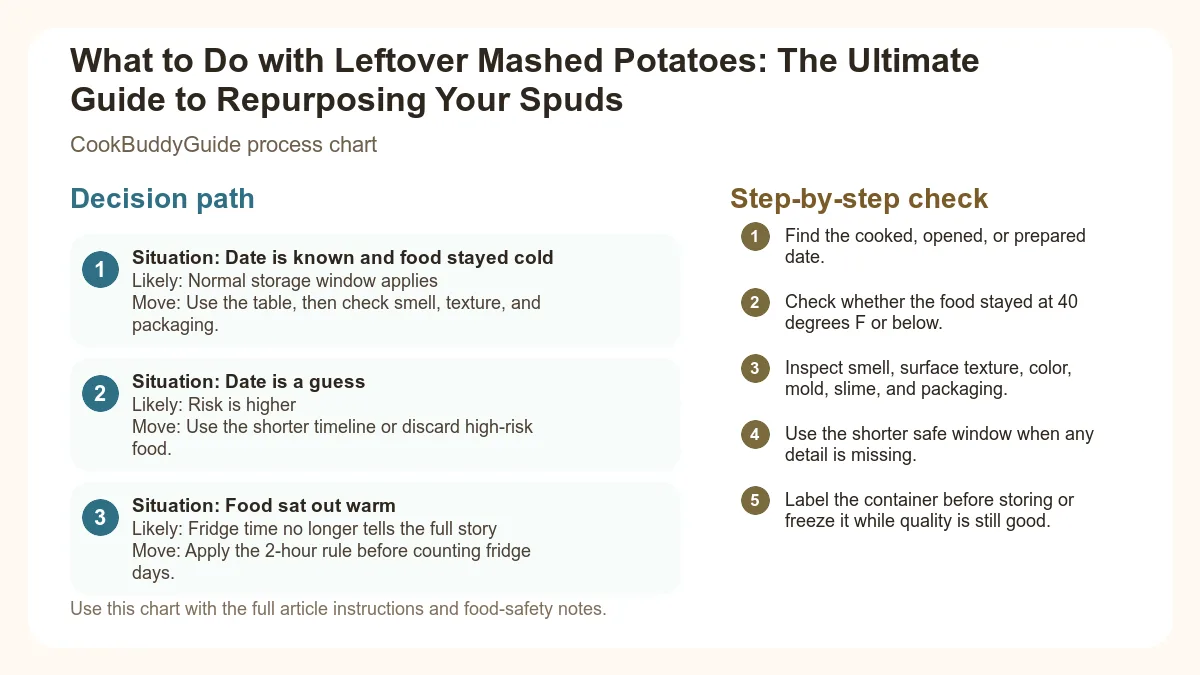
Decision table
| Situation | Likely cause or meaning | Best move |
|---|---|---|
| Date is known and food stayed cold | Normal storage window applies | Use the table, then check smell, texture, and packaging. |
| Date is a guess | Risk is higher | Use the shorter timeline or discard high-risk food. |
| Food sat out warm | Fridge time no longer tells the full story | Apply the 2-hour rule before counting fridge days. |
Step-by-step fix
- Find the cooked, opened, or prepared date.
- Check whether the food stayed at 40 degrees F or below.
- Inspect smell, surface texture, color, mold, slime, and packaging.
- Use the shorter safe window when any detail is missing.
- Label the container before storing or freeze it while quality is still good.
Common mistakes
- Counting fridge days from the day you noticed the container instead of the day it was made.
- Ignoring time spent on the counter, in a lunch bag, or on a serving table.
- Trusting smell alone when the date or temperature history is unknown.
- Putting warm food into a deep container that cools slowly.
Related topic hubs
We’ve all been there. It’s the day after a big holiday feast or a Sunday roast, and you open the refrigerator to find a cold, heavy, porcelain-white brick of mashed potatoes staring back at you. In its prime, that bowl was the star of the table—creamy, buttery, and cloud-like. Now? It’s a dense mass that feels more like spackle than a side dish. Most home cooks make the mistake of trying to simply microwave them back to life, only to end up with a grainy, unevenly heated mess that ends up in the bin.
Table of Contents
- The Science of Leftover Spuds: Why They Change Texture
- How to Store and Refresh Leftover Mashed Potatoes
- Classic Leftover Mashed Potato Recipes: The Fan Favorites
- Creative & Gourmet Ways to Use Leftover Mash
- Baking with Potatoes: Surprising Texture Boosters
- Practical Tips for Success and Common Mistakes
- Frequently Asked Questions
- Conclusion: Turning Waste into a Win
The Science of Leftover Spuds: Why They Change Texture
To master leftover mashed potato recipes, you first have to understand what happens to a potato at a molecular level once it hits the cold air of your refrigerator. If you’ve ever noticed that your potatoes feel "grainy" or "gritty" the next day, you aren't imagining it. This is a scientific process known as starch retrogradation.
Retrogradation: Why cold potatoes get grainy
The Importance of Moisture Management
The second challenge is moisture loss. Refrigerators are notoriously dry environments. Even in an airtight container, the potatoes lose that "emulsified" feel where the butter and cream were perfectly suspended in the starch. When you try to reheat them without intervention, the fat often separates, leaving you with a puddle of oil and a dry clump of starch. Understanding this is key: you cannot simply "reheat" them to get the original texture back. You must either re-emulsify them with new liquid or lean into their new, firmer structure to create something crispy.
How to Store and Refresh Leftover Mashed Potatoes
Before we get into the recipes, let’s talk logistics. Proper storage is the difference between a delicious second meal and a food safety hazard. According to official guidelines on the safe storage of leftovers, you have a specific window to work with.
Fridge Storage: The 4-Day Rule
Mashed potatoes should be placed in an airtight container as soon as they reach room temperature. Never put piping hot potatoes directly into the fridge, as the steam will create condensation, leading to a soggy mess and potential bacterial growth. Consider a glass container with a locking lid to prevent the potatoes from absorbing "fridge smells" like onions or garlic. Use them within 3 to 4 days for peak quality, and check our focused guide to how long mashed potatoes last in the fridge if the date or storage history is unclear.
Can You Freeze Mashed Potatoes?
Yes, but with a caveat. Potatoes with a high fat content (lots of butter and cream) freeze much better than "naked" mashed potatoes. The fat acts as a protective barrier for the starch cells. Consider freezing them in 1-cup portions using freezer bags. Flatten the bags to save space and allow for faster thawing. When you’re ready to use them, thaw in the fridge overnight rather than using the microwave, which can cause the texture to break down.
The Best Way to Rehydrate Dry Potatoes
If your goal is to serve them as a side dish again, stop! Don't just zap them. The best technique for reheating mashed potatoes involves a low-and-slow approach. Place the potatoes in a saucepan over low heat. Add a splash of heavy cream and a pat of butter. Use a stiff silicone spatula to "fold" the liquid back into the starch. This helps re-emulsify the fats. For a detailed breakdown of this technique, reheating mashed potatoes properly is essential to avoid the dreaded "gluey" consistency.
Classic Leftover Mashed Potato Recipes: The Fan Favorites
Now, let's get to the good stuff. These are the "Big Three" recipes that every home cook should have in their arsenal. They are designed to take advantage of the firm, cold texture of yesterday's dinner.
Crispy Pan-Fried Potato Cakes (Fritters)
This is the gold standard for leftover mash. The key is using binder agents to ensure they don't fall apart in the pan.
- 2 cups cold mashed potatoes
- 1 large egg, beaten
- 1/4 cup all-purpose flour (plus more for dredging)
- 1/2 cup shredded cheddar cheese
- 2 green onions, sliced
- Salt and pepper to taste
Method: In a large bowl, mix the potatoes, egg, flour, cheese, and onions. The mixture should be thick and hold its shape. Form into 3-inch patties. Dredge lightly in extra flour—this is the secret to the Maillard reaction, creating that deep golden crust. Fry in a mixture of butter and oil over medium-high heat for 3-4 minutes per side. Serve with sour cream.
A Practical Shepherd’s Pie Topping
Creamy Mashed Potato Soup
Creative & Gourmet Ways to Use Leftover Mash
If you want to move beyond the basics, these gourmet applications will make people forget they’re eating leftovers at all. These dishes rely on the "structural integrity" of cold, retrograded starch.
Golden Potato Croquettes with Melting Centers
Savory Mashed Potato Waffles
- 2 cups mashed potatoes
- 2 eggs
- 1/4 cup buttermilk (or regular milk)
- 1/2 cup flour
- 1/2 tsp baking powder
Method: Whisk the eggs and milk, then fold in the potatoes. Stir in the dry ingredients. Grease your waffle iron generously. Cook until the steam stops rising—this usually takes about 2 minutes longer than a standard flour waffle. You can find more specific ratios for savory mashed potato waffles to ensure they don't stick to your iron.
Twice-Baked Potato Filling Shortcut
If you have some large Russet potatoes, bake them until tender, scoop out the centers, and mix that hot potato flesh with your leftover cold mashed potatoes. Add sour cream, bacon bits, and chives. The cold leftovers add stability and creaminess to the filling, making it easier to pipe back into the skins. It’s a fantastic way to stretch your ingredients and practice food waste reduction.
Baking with Potatoes: Surprising Texture Boosters
One of the most practical techniques in the baking world is using potatoes in dough. Potato starch is highly hygroscopic, meaning it holds onto water better than wheat flour. This results in bread that stays soft and fresh for days longer than traditional loaves.
Fluffy Potato Bread and Dinner Rolls
Adding a small amount of mashed potatoes to yeast-roll dough can produce a softer crumb. Potato bread is also a useful option in a budget-friendly dinner because it uses leftovers in a new form.
Leftover Potato Gnocchi
Traditional gnocchi uses riced, hot potatoes, but you can absolutely use cold mash. The trick is to not overwork the dough. Because the potatoes are already seasoned and contain fat (butter/milk), you’ll need slightly more flour than a traditional recipe—usually a 1:2 ratio of flour to potato by weight. Knead gently just until a dough forms, roll into ropes, and cut. Boil until they float, then sear them in sage butter for a restaurant-quality meal.
Potato Pancakes vs. Latkes
It’s important to note the difference here. A mashed potato pancake is soft, creamy, and custard-like on the inside. A latke is made from grated raw potatoes and is much more "shredded" and crunchy throughout. Both are delicious, but if you have leftovers, you are firmly in the "pancake" or bubble and squeak territory. Bubble and squeak is a traditional British dish where you fry up leftover potatoes with cabbage or Brussels sprouts—it’s the ultimate "clean out the fridge" breakfast.
Practical Tips for Success and Common Mistakes
- Avoid the "Gummy" Trap: Never, ever put leftover mashed potatoes in a food processor or blender. The high-speed blades tear the starch granules apart, releasing a flood of amylose that turns your potatoes into literal glue. Always mix by hand or with a stiff spatula.
- Temperature Matters: If you are making patties or croquettes, work with the potatoes while they are cold. Cold starch is easier to mold. If the potatoes reach room temperature, they become sticky and difficult to handle.
- The "Salt Sink" Effect: Potatoes are notorious "salt sinks." When you add binders like flour and eggs, you dilute the seasoning of the original mash. Always taste your mixture (if it doesn't have raw egg) or fry a tiny "test" piece to check for seasoning before committing to the whole batch.
- The Fat Factor: If your original mashed potatoes were "healthy" (made with broth instead of butter), they will be much more brittle. You may need an extra egg as a binder to keep them from disintegrating in the frying pan.
Frequently Asked Questions
A: Absolutely! Whisk in a tablespoon at a time to hot gravy. It adds body and a subtle creamy flavor that flour alone can't provide.
A: You likely need more binder or more chill time. Ensure you have enough egg and flour, and try chilling the formed patties in the freezer for 10 minutes before frying to help them set.
A: Yes, it’s actually the preferred base. Mix the cold mash with plenty of sharp cheddar cheese and sautéed onions for a classic potato pierogi filling.
Conclusion: Turning Waste into a Win
The humble potato is perhaps the most versatile ingredient in the home cook's pantry. Learning what to do with leftover mashed potatoes is more than just a lesson in frugality; it’s an invitation to be creative. Whether you’re whipping up a batch of potato fritters for a quick lunch or folding them into a yeast dough for the softest dinner rolls you’ve ever tasted, you’re participating in a long tradition of resourceful, delicious home cooking.