Quick Answer
This guide explains why potatoes turn green, the risks of solanine poisoning, and when to peel or toss them in our practical safety guide.
Practical note
For Can You Eat Green Potatoes? A Comprehensive Food Safety Guide for Home Cooks, this guide centers on Gastrointestinal distress, Neurological symptoms, Bitter flavor. Those are the checkpoints we would use first in a normal home kitchen before making a bigger change.
Decision table
| Situation | Likely cause or meaning | Best move |
|---|---|---|
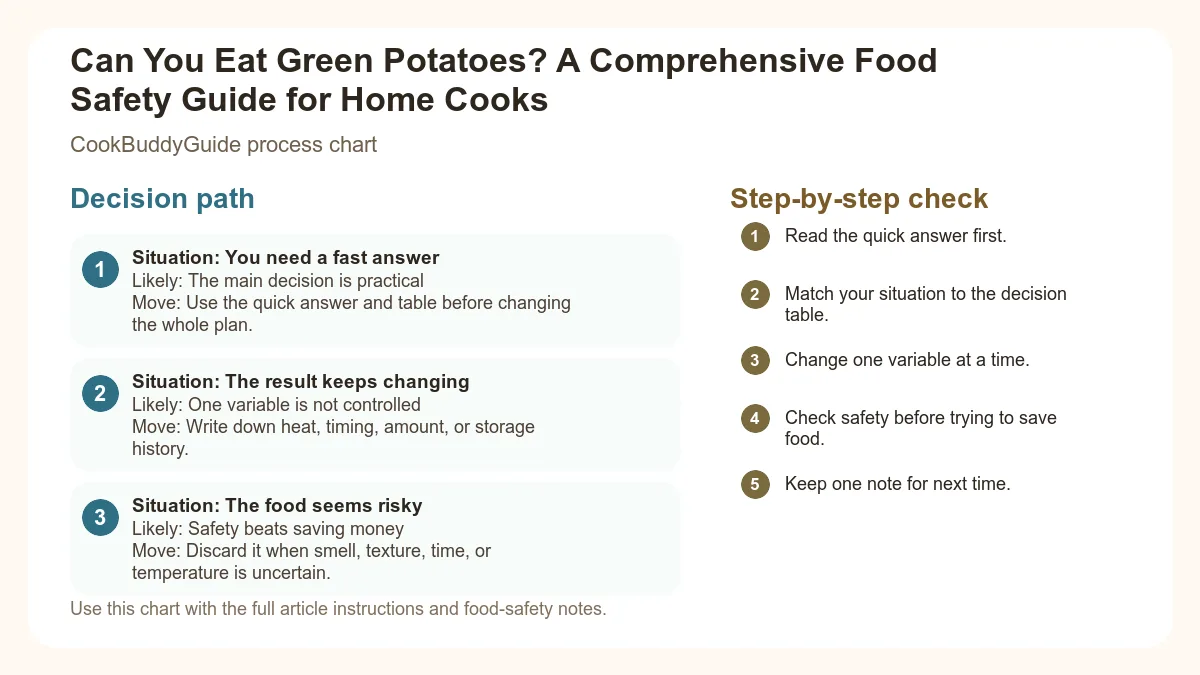
| You need a fast answer | The main decision is practical | Use the quick answer and table before changing the whole plan. |
| The result keeps changing | One variable is not controlled | Write down heat, timing, amount, or storage history. |
| The food seems risky | Safety beats saving money | Discard it when smell, texture, time, or temperature is uncertain. |
Step-by-step fix
- Read the quick answer first.
- Match your situation to the decision table.
- Change one variable at a time.
- Check safety before trying to save food.
- Keep one note for next time.
Common mistakes
- Skipping the quick answer and changing too much at once.
- Treating quality problems and safety problems the same way.
- Not writing down the detail that caused the repeat problem.
Related topic hubs
It’s 6:15 PM on a Tuesday. You’ve had a long day, and the only thing standing between you and a relaxing evening is getting dinner on the table. You reach into the pantry for a few Russets to whip up some easy sheet pan dinner ideas, but as you pull them out, you notice a distinct, sickly green hue creeping across the skin. Your mind flashes back to a vague warning you heard years ago: "Green potatoes are poisonous." But you’re hungry, the potatoes feel firm, and you really don't want to make another trip to the store.
Do not eat a heavily green, bitter, soft, or extensively sprouted potato. A very small green area can sometimes be cut away generously if the rest of the potato is firm and tastes normal, but greening can accompany increased glycoalkaloids. When the color is widespread or the potato tastes bitter, discard it.
This guide explains light-induced greening, glycoalkaloid risk, when trimming may be reasonable, and when the safer choice is to discard the potato.
Table of Contents
- Why Do Potatoes Turn Green? Chlorophyll vs. Solanine
- Are Green Potatoes Safe? Understanding the Risks
- The Science of Solanine: How Much is Too Much?
- Can You Save a Green Potato? The Peeling Rule
- Does Cooking Destroy Solanine? Myths vs. Reality
- Proper Storage: How to Prevent Greening
- What About Sprouted Potatoes?
- Shopping Tips: How to Spot "Bad" Potatoes
- Frequently Asked Questions
Why Do Potatoes Turn Green? Chlorophyll vs. Solanine
To understand if are green potatoes safe, we first have to understand what that green color actually is. When a tuber (the part of the potato we eat) is exposed to light—whether it’s natural sunlight in the field or the harsh fluorescent bulbs of a grocery store—it begins a process called photosynthesis.
The Role of Chlorophyll
The green color you see is actually chlorophyll. On its own, chlorophyll is completely harmless; it’s the same pigment that makes spinach and kale green. However, in the Nightshade family (Solanaceae), which includes potatoes, tomatoes, and eggplants, the production of chlorophyll is a biological "red flag." When a potato senses light, it assumes it is near the surface of the ground and needs to protect itself from being eaten by pests or animals.
The Hidden Danger: Solanine and Glycoalkaloids
Light exposure increases chlorophyll and can also increase the potato's natural glycoalkaloids, mainly solanine and chaconine. Chlorophyll itself is not toxic, but Poison Control advises discarding green or sprouted potatoes because greening can accompany elevated glycoalkaloids.
Are Green Potatoes Safe to Eat? Understanding the Risks
What is Solanine Poisoning?
Solanine is a cholinesterase inhibitor. In plain English, it interferes with a chemical in your body that is responsible for breaking down certain neurotransmitters. When this process is disrupted, your nervous system and digestive tract go into revolt. According to health experts, the symptoms of solanine poisoning can range from mild to severe depending on the dose and the individual's body weight.
Symptoms of Toxicity
- Gastrointestinal distress: This is the most common reaction. It includes nausea, diarrhea, stomach cramps, and vomiting. These symptoms usually appear within 8 to 12 hours after ingestion.
- Neurological symptoms: In higher doses, solanine can cause headaches, dizziness, confusion, and even fever. In extreme, rare cases, it can lead to paralysis or death, though this is virtually unheard of with modern commercial potatoes.
- Bitter flavor: Your taste buds are your first line of defense. Solanine has a distinct, sharp, bitter flavor. If you take a bite of a potato and it tastes "off" or leaves a burning sensation in the back of your throat, spit it out immediately.
Pro Safety Tip: The Sensitivity Scale
Use a conservative standard when cooking for children or anyone medically vulnerable: discard a green potato rather than trying to salvage it. The cost of replacing one potato is small compared with the avoidable risk from an uncertain glycoalkaloid level.
The Science of Solanine: How Much is Too Much?
You might be wondering, "Why don't all potatoes kill us? Don't they all have some solanine?" You’re absolutely right. All potatoes contain trace amounts of glycoalkaloids. In fact, these compounds contribute to the characteristic "earthy" flavor of a good potato. However, the concentration is what matters.
The standard safety threshold recognized by food scientists and regulators is 20 milligrams of solanine per 100 grams of potato (roughly 200mg/kg). Most commercial potatoes you buy at the store have levels well below 8mg/100g. However, once light-induced greening occurs, those levels can spike to 5 or 10 times the safe limit in the skin and the area immediately beneath it.
Where the Toxins Hide
Solanine is not distributed evenly throughout the potato. It is most concentrated in:
- The skin (the periderm).
- The "eyes" or potato sprouts.
- The area roughly 1/8th to 1/4th of an inch below the skin.
Because the flesh of the potato (the parenchyma) usually has much lower levels, there is often a way to save a mildly affected tuber—but you have to be precise.
Can You Save a Green Potato? The Peeling Rule
The "Half-Inch" Rule
If you see a small patch of green on an otherwise healthy, firm potato, follow these steps:
- Deep Peeling: Don't just take off the surface skin. Use a high-quality Y-peeler and remove the skin plus at least 1/8th of an inch of the flesh underneath.
- The Visual Check: Once peeled, look at the flesh. Is it creamy white or yellow? If so, it is likely safe. If the green tint persists in the flesh, keep peeling.
- The Discard Threshold: If you have to peel away more than 1/2 inch of the potato to get to "clean" flesh, or if the greening has reached the core of the tuber, toss it. The peeling depth required to make it safe would leave you with almost no potato anyway, and the risk of residual toxins is too high.
Research from culinary experts on peeling and cutting green potatoes suggests that while peeling can remove up to 90% of the solanine, it cannot remove the toxins if they have leached deep into the center. When in doubt, throw it out.
Does Cooking Destroy Solanine? Myths vs. Reality
The Boiling Point Fallacy
Solanine has a melting point of approximately 518°F (270°C). Most home cooking methods—boiling (212°F), baking (350-425°F), or even deep-frying (375°F)—never reach the temperatures necessary to break down the glycoalkaloid molecule.
- Boiling: Solanine is not water-soluble. Boiling a green potato won't leach the toxins into the water; it just leaves you with a hot, toxic potato.
- Frying: There is some evidence that deep-frying at very high temperatures can slightly reduce glycoalkaloid levels, but it is inconsistent and not a reliable safety method.
- Baking: Baking has virtually no effect on solanine levels.
The Verdict: You cannot "cook away" the danger. If the potato is green and bitter before it goes into the pot, it will be green, bitter, and toxic when it comes out.
Proper Storage: How to Prevent Greening
The Ideal Environment: Dark, Cool, and Dry
To prevent light-induced greening, you must mimic the potato's natural environment: underground. Storing potatoes in the dark is the single most important factor in preventing solanine buildup.
The CookBuddy Storage Protocol
- Temperature: Aim for 45-50°F (7-10°C). A cool pantry or a basement is perfect.
- Light: Total darkness. If your pantry has a window, store potatoes in a thick paper bag or a wooden crate with a lid.
- Airflow: Use burlap or mesh bags. Never store potatoes in sealed plastic bags, as the moisture buildup will lead to rot and mold.
- The Fridge Rule: Never store potatoes in the refrigerator. Cold temperatures cause "cold-induced sweetening," where the starch converts to sugar. This makes the potato turn brown and bitter when cooked (due to the Maillard reaction) and can actually increase the production of acrylamide, a suspected carcinogen.
What About Sprouted Potatoes?
We’ve all seen it: that bag of potatoes you forgot about starts growing "tentacles." These potato sprouts (or eyes) are high-intensity zones for solanine. The plant is trying to grow, and it concentrates its defenses in the new growth to protect it from predators.
Are Sprouted Potatoes Safe?
If the potato is still firm and the sprouts are small, it is generally safe to eat if you remove the sprouts. Use the tip of a vegetable peeler or a melon baller to gouge out the "eye" entirely, going about 1/4 inch deep to ensure all the concentrated toxic alkaloids are removed.
However, if the potato is shriveled, soft, or wrinkled, it means the starches have been converted to sugars to feed the sprouts, and the solanine levels throughout the tuber have likely increased. For more on this, the Michigan State University extension provides an excellent breakdown of solanine poisoning and prevention regarding sprouts. When a potato is soft and sprouted, its nutritional value is gone, and its toxicity is up—toss it into the compost bin.
Shopping Tips: How to Spot "Bad" Potatoes
Safety starts at the grocery store because bright display lights can encourage greening. Use these checks when choosing potatoes:
- Check the Bag: Look for potatoes sold in opaque paper bags or dark mesh. Avoid the ones in clear plastic sitting directly under the fluorescent lights.
- The "Rub" Test: If you see a suspicious dusty coating on a potato, rub it gently. Sometimes it's just dirt, but if a green skin tone is revealed underneath, put it back.
- Inspect the Bulk Bin: If you’re buying individual potatoes, dig a little deeper. The ones on the very top of the pile have had the most light exposure. The ones underneath are usually fresher and "cleaner."
- Practice FIFO: Use the "First-In, First-Out" method. Don't dump new potatoes on top of old ones in your pantry. Finish the old batch before starting the new one to prevent forgotten, sprouting tubers at the bottom of the bin.
Frequently Asked Questions
A: Absolutely not. Dogs, cats, and even farm animals like pigs and chickens are susceptible to solanine poisoning. In fact, because they are often smaller than humans, a smaller dose can be fatal to them.
A: Any potato variety can turn green after light exposure. Greening may simply be easier to see through pale, smooth skin than through the darker skin of a russet, so inspect the flesh when peeling.
A: Symptoms can include vomiting, abdominal pain, diarrhea, headache, confusion, or dizziness. In the United States, contact Poison Control online or at 1-800-222-1222 for case-specific guidance; seek emergency care for severe symptoms.
Conclusion: Safety First in the Kitchen
At CookBuddyGuide.com, we believe that cooking should be a joy, not a source of anxiety. Understanding can you eat green potatoes is a fundamental part of kitchen literacy. To recap our safety checklist:
- Small green spots: Peel deeply (at least 1/8th inch) until no green remains.
- Widespread greening: Discard the potato entirely.
- Bitter taste: Stop eating immediately and discard the dish.
- Sprouts: Remove them deeply if the potato is firm; toss if the potato is soft.
- Storage: Keep them in a cool dark place, never the fridge.
Appearance, firmness, and bitterness are practical warning signs, but they cannot measure a potato's glycoalkaloid concentration. Discard potatoes with extensive greening, bitterness, softness, or heavy sprouting, and store the next bag in a cool, dark place.