Quick Answer
Cool leftovers promptly, divide them into shallow meal-size portions, seal them airtight, and label the food and freeze date. Freeze refrigerated leftovers before their safe fridge window closes, then thaw perishable dishes in the refrigerator rather than on the counter.
Practical note
For How to Freeze Leftover Food, the home-kitchen check is not only the number of days. We look at the start date, fridge temperature, container seal, serving time, and spoilage signs. If one of those facts is missing, the safer move is to use the shorter window.
Decision table
| Situation | Likely cause or meaning | Best move |
|---|---|---|
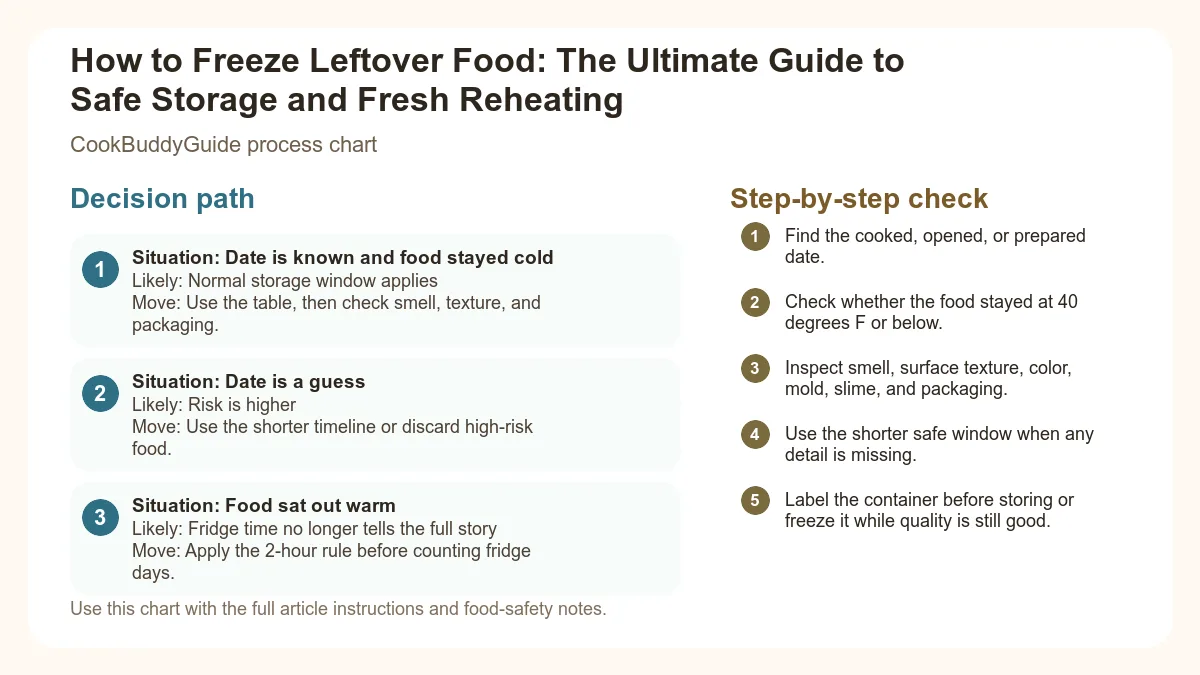
| Date is known and food stayed cold | Normal storage window applies | Use the table, then check smell, texture, and packaging. |
| Date is a guess | Risk is higher | Use the shorter timeline or discard high-risk food. |
| Food sat out warm | Fridge time no longer tells the full story | Apply the 2-hour rule before counting fridge days. |
Step-by-step fix
- Find the cooked, opened, or prepared date.
- Check whether the food stayed at 40 degrees F or below.
- Inspect smell, surface texture, color, mold, slime, and packaging.
- Use the shorter safe window when any detail is missing.
- Label the container before storing or freeze it while quality is still good.
Common mistakes
- Counting fridge days from the day you noticed the container instead of the day it was made.
- Ignoring time spent on the counter, in a lunch bag, or on a serving table.
- Trusting smell alone when the date or temperature history is unknown.
- Putting warm food into a deep container that cools slowly.
Related topic hubs
Table of Contents
- The Golden Rules of Food Safety and Freezing
- Essential Gear: Choosing the Right Containers
- The 'No-Freeze' List: Foods That Don't Survive
- Food-by-Food Freezing Guide
- Labeling and Organization: The FIFO Method
- Freezer Life Chart: How Long is Too Long?
- Thawing and Reheating for Maximum Flavor
- Common Freezing Mistakes and How to Fix Them
The Golden Rules of Food Safety and Freezing
Before we talk about containers or meal prep tips, we have to talk about food safety. The freezer doesn't actually kill bacteria; it simply puts them into a state of suspended animation. If you put "borderline" food into the freezer, you’re just preserving a future stomach ache. According to the USDA guidelines for leftover safety, you must refrigerate or freeze leftovers within two hours of cooking.
The Two-Hour Rule: Cooling Down Safely
Preventing the Danger Zone with Ice Baths
Essential Gear: Choosing the Right Containers
If you want to master how to freeze leftover food, you need to invest in the right gear. Air is the enemy of frozen food. When air reaches the surface of your food, it dehydrates it, leading to that grayish, leathery texture we call freezer burn.
Glass vs. Plastic: Which is Better?
The Magic of Vacuum Sealing
If you’re serious about food waste reduction, a vacuum sealer is a helpful shortcut. The vacuum sealer benefits are undeniable: by removing 99% of the air, you can extend the freezer life of meats and cooked meals by months, if not years. A vacuum-sealed pulled pork can hold quality far better than loosely wrapped leftovers.
Pro Tip: The "Flat-Freeze" Method for Soups
The 'No-Freeze' List: Foods That Don't Survive the Cold
- High-Water Content Vegetables: Lettuce, cucumbers, and radishes will turn into translucent slime.
- Emulsified Sauces: Mayonnaise, sour cream, and some cream-based sauces will break and separate. Your creamy pasta sauce will turn into a grainy, oily mess.
- Fried Foods: The moisture in the freezer ruins the crispy batter. While you can reheat them in an air fryer to save them, they will never be as good as day one.
- Fully Cooked Pasta: If you freeze pasta that is already soft, it will be mushy when reheated. If you know you're making a batch for the freezer, cook the pasta "extra al dente."
Food-by-Food Freezing Guide: Best Practices
Cooked Proteins: Steaks, Chops, and Poultry
Grains and Starches: Rice and Bread
How to Flash Freeze Individual Portions
Flash freezing is a technique used for meatballs, pancakes, or individual cookie dough balls. Place the items on a parchment-lined baking sheet so they aren't touching. Put the whole sheet in the freezer for 1-2 hours until the items are hard. Then, transfer them to an airtight container. This prevents them from sticking together in one giant clump, allowing you to take out exactly what you need.
Labeling and Organization: The FIFO Method
The Essential Labeling Checklist
Every container should have three things written on it:
- Name of the Dish: (e.g., "Turkey Chili")
- Date of Freezing: (e.g., "Oct 12, 2023")
- Reheating Instructions: (e.g., "Thaw in fridge, microwave 3 mins")
Freezer Life Chart: How Long is Too Long?
While food kept at a constant 0°F is technically safe to eat indefinitely, the quality will eventually degrade. Use this cold food storage chart as a reference for peak quality.
| Food Item | Recommended Freezer Life | Signs of Decline |
|---|---|---|
| Soups and Stews | 2–3 Months | Ice crystals, separation |
| Cooked Poultry/Meat | 2–4 Months | Dryness, graying color |
| Cooked Rice/Grains | 1 Month | Hard, "chalky" texture |
| Casseroles | 2–3 Months | Soggy topping, freezer odor |
| Bread and Pastries | 3 Months | Dryness, loss of flavor |
Thawing and Reheating for Maximum Flavor
You’ve done the work to freeze it safely; don't ruin it in the last mile! There are three safe thawing methods recommended by experts. If you're looking for inspiration on what to cook specifically for the freezer, check out our guide on easy crockpot freezer meals.
The Refrigerator Thaw (The Gold Standard)
This is the safest and best way to preserve texture. By letting food thaw slowly in the fridge overnight, you minimize the "purge" of moisture. It takes planning, but the results are worth it.
The Cold-Water Bath (The Quick Fix)
If you forgot to take out dinner, place your airtight container or Ziploc bag in a bowl of cold tap water. Change the water every 30 minutes. A small bag of soup will usually thaw in about an hour this way. Never use hot water, as this can start "cooking" the outside of the food while the inside is still frozen, creating a food safety risk.
Reheating Instructions for Success
Common Freezing Mistakes and How to Fix Them
- Overcrowding the Freezer: A full freezer is actually more energy-efficient than an empty one, but if you pack it so tightly that air can't circulate, your food won't freeze fast enough. This leads to larger ice crystals and worse texture.
- Ignoring Freezer Burn: If you see those white, dried-out patches, don't throw the whole meal away! You can often just trim off the affected area. The food is still safe to eat; it just might have a slightly "off" flavor in that spot.
- The Power Outage Panic: If the power goes out, keep the freezer door closed! A full freezer will keep its temperature for about 48 hours. If the food still contains ice crystals or is below 40°F when the power comes back, it is generally safe to refreeze.
Frequently Asked Questions
Yes, as long as it was thawed in the refrigerator and hasn't been sitting out for more than two hours. However, the texture may suffer due to the repeated formation of ice crystals.
It is safe as long as the plastic is labeled "freezer-safe." However, standard plastic containers are rarely truly airtight, so use them for short-term storage (under a month) to avoid freezer burn.
This usually happens because the food wasn't sealed in an airtight container. Odors from other foods (like onions or fish) can migrate through thin plastic. Double-bagging or using vacuum sealer benefits can prevent this.
Conclusion: Your Freezer is Your Best Friend
Mastering how to freeze leftover food is one of the most valuable skills you can develop as a home cook. It saves you money, reduces your environmental impact, and ensures that a healthy, home-cooked meal is always just a few minutes away. Remember the basics: cool it fast, seal it tight, label it clearly, and thaw it safely. For more ways to save time in the kitchen, don't miss our favorite breakfast meal prep ideas to start your mornings right.
For further reading on the technical side of preservation, consider checking out this guide on safely freezing your leftovers. Happy freezing, and here's to a kitchen with zero waste and infinite possibilities!