Quick Answer
Yes, you can freeze avocado, but purée gives the best texture. It also explains how to prep, portion, thaw, prevent browning, and choose the right uses later.
Related topic hubs
Quick Answer
Yes, you can freeze avocado. For the best color and texture, peel and purée ripe avocado, then mix in 1 tablespoon of lemon juice for every 2 avocados. Freeze it in small portions with as little trapped air as possible. Thawed avocado is soft, so use it in guacamole bases, smoothies, dressings, sauces, or baking rather than salads and neat slices.
Practical note
This is an editorial preservation guide, not a report of CookBuddyGuide freezer testing. The method below follows the National Center for Home Food Preservation. That source recommends purée because whole and sliced avocado do not freeze satisfactorily. Culinary sources describe whole or sliced freezing as possible, but they also warn that thawed avocado becomes mushy and darker.
Which avocado freezing method should you choose?
| Form | What to expect after thawing | Best uses | Recommendation |
|---|---|---|---|
| Whole, skin on | Soft flesh, possible greying, awkward peeling | Blended recipes only | Possible, but lowest quality |
| Halves or slices | Soft and less tidy than fresh slices | Smoothies, sauces, blended dips | Convenient for direct-from-frozen use |
| Mashed | Soft texture is already expected | Toast spread, guacamole base, baking | Good choice |
| Puréed | Most even texture and acid distribution | Dressings, dips, sauces, smoothies | Best overall method |
What happens to avocado when it freezes?
Frozen avocado stays usable, but it does not keep a fresh avocado's firm bite. University of Minnesota Extension explains that water expands into ice crystals during freezing and ruptures plant cell walls. The result is softer produce after thawing. That change matters on toast or in a salad, but it is much less noticeable after blending.
Color can change too. The National Center for Home Food Preservation recommends mixing either 1/4 teaspoon of ascorbic acid into each quart of avocado purée or 1 tablespoon of lemon juice into every 2 avocados. The acid helps protect color. Good packaging matters as well because exposed surfaces can dry out and brown.
Set the right expectation: freezing saves ripe avocado for recipes where creaminess matters. It does not preserve the clean slices or fresh texture needed for a composed salad.
Can you freeze avocado whole, sliced, mashed, or puréed?
All four forms can go into a freezer, but they do not produce equal results. The National Center for Home Food Preservation says avocado is best frozen as purée and is not satisfactorily frozen whole or sliced. Food Network Kitchen treats whole freezing as a convenience option while warning that the flesh turns mushier and slightly grey-brown.
Whole avocado
Whole freezing requires almost no preparation, but it gives you little control over browning or portion size. The skin is not an airtight package. If you freeze an avocado whole, expect to use the thawed flesh in a blender, not as a garnish.
Halves, slices, or chunks
Pieces are easier to portion and can go directly into smoothies. Brush or toss every cut surface with lemon juice, freeze the pieces on a lined tray until firm, then transfer them to a freezer bag. This method limits clumping, but thawed pieces will still be soft.
Mashed avocado
Mashing is practical when the final dish can tolerate a little uneven texture. Mix in the measured lemon juice, portion the mash, and press out air before sealing. It works for a simple guacamole base or a spread where appearance is not the main concern.
Avocado purée
Purée is the most reliable choice because the texture is uniform and the acid disperses evenly. It also packs into small containers without large air pockets. Use a fork for a coarse purée or a food processor for a smooth one.
How do you freeze avocado purée?
- Choose ripe, sound fruit. Use avocado that yields gently to pressure. Do not freeze fruit with rotten areas or an off smell.
- Wash before cutting. The FDA recommends rinsing produce under running water even when you will remove the peel. Do not use soap or produce wash.
- Peel and pit it. Remove bruised or discolored flesh that you would not otherwise eat.
- Purée the flesh. Mash it thoroughly or use a food processor. Keep the batch small so you can work quickly.
- Add acid for color. Mix in 1 tablespoon of lemon juice for every 2 avocados, following the National Center for Home Food Preservation formula.
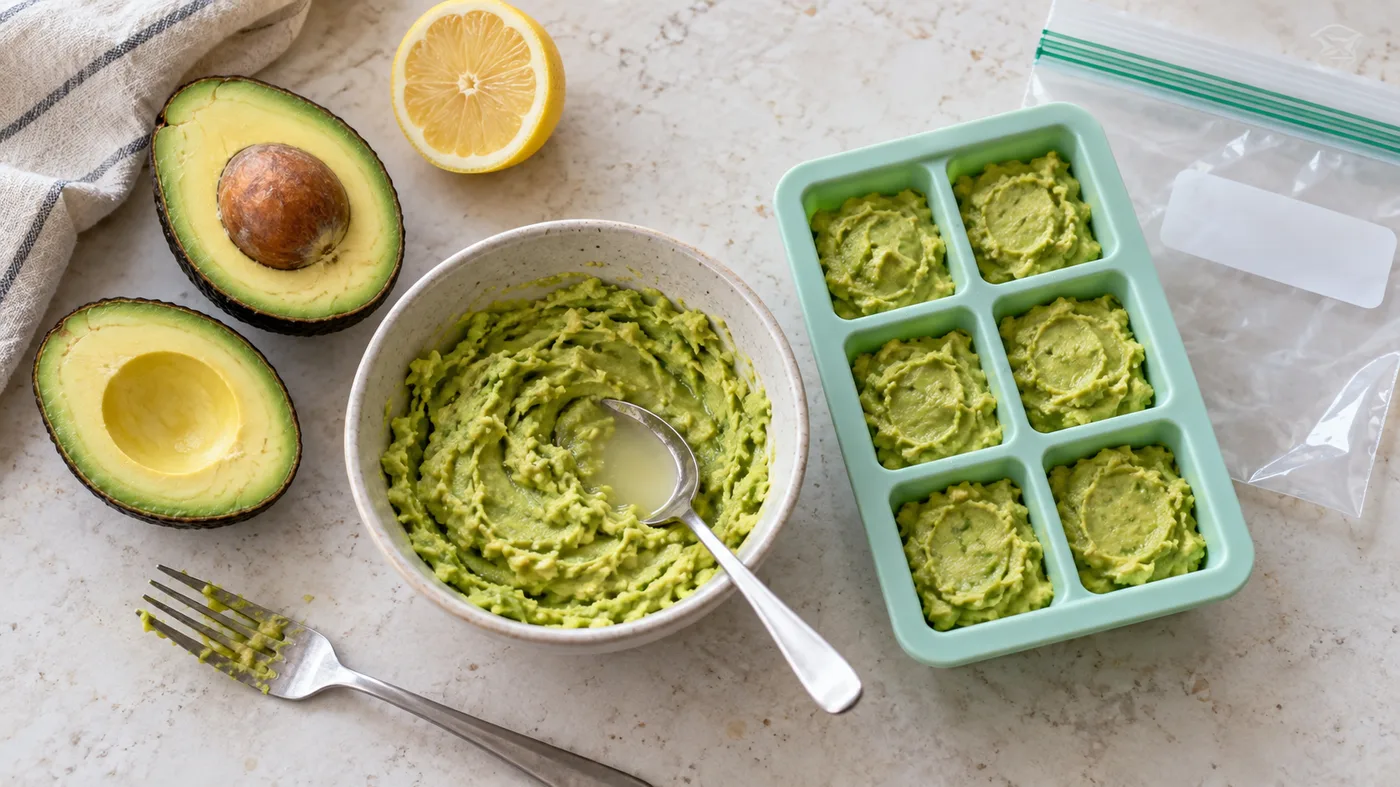
- Pack small portions. Spoon the purée into freezer containers or freezer-safe silicone portions. Leave the container headspace specified by its maker, wipe the rim, and seal.
- Label and freeze promptly. Mark the contents and date. Set the freezer to 0°F (-18°C) or colder.
If you use a silicone tray, cover it while the portions freeze. Once solid, move the portions to a moisture- and vapor-resistant freezer container. Ice cube trays vary widely, so record the amount each cavity holds instead of assuming that one cube equals a fixed serving.
How long does frozen avocado keep?
Plan to use frozen avocado purée within about one month for the best avocado-specific quality. That is Food Network Kitchen's recommendation for mashed avocado. The University of Minnesota Extension gives a broader 8-to-12-month quality range for frozen fruit in general, but avocado's delicate color and creamy texture make the shorter target more useful here.
Keep the freezer at 0°F (-18°C) or below. Freezing pauses bacterial growth but does not kill every microorganism, so clean preparation still matters. If a package loses moisture, the avocado may develop dry or brown freezer-burned areas. Read the separate guide to freezer-burned food before deciding whether a quality defect makes the food unusable.
How should you thaw frozen avocado?
Thaw avocado in a covered container in the refrigerator when you want to use it as a spread or dip. Stir the purée after thawing and pour off only clearly separated water if the recipe would become too loose. Use the thawed portion promptly rather than repeatedly warming and chilling it.
For a thick smoothie bowl or one of these high-protein smoothies, add a frozen portion directly to the blender. Direct-from-frozen use avoids an unnecessary thaw and makes the softer texture irrelevant. A frozen portion can also go straight into a sauce or cooked soup that will be heated through.
What can you make with frozen avocado?
Frozen avocado works best when another preparation step blends or cooks it. It is a poor substitute for fresh slices, but a good source of body in dips, smoothies, dressings, sauces, and some baked recipes. Start with less liquid than usual because thawed fruit may release moisture.
| Use | Thaw first? | Adjustment |
|---|---|---|
| Smoothie or smoothie bowl | No | Blend from frozen and reduce ice |
| Guacamole base | Yes | Stir, then add fresh onion, tomato, and herbs |
| Creamy dressing | Usually | Add liquid gradually |
| Pasta sauce or soup | No | Blend in while heating |
| Toast spread | Yes | Expect a softer, less fresh-tasting spread |
| Salad slices | Yes | Not recommended because the shape and bite suffer |
If the surface is brown, check whether it is normal oxidation or actual spoilage. The guide to brown avocado explains the difference. Discard avocado with visible mold, a rotten smell, or other clear spoilage rather than trying to hide it in a blended dish.
Can you freeze guacamole?
Freeze a plain avocado-and-citrus base instead of fully mixed guacamole. Food Network notes that onions, tomatoes, and herbs can become loose and watery after thawing. Add those ingredients fresh after the avocado base has thawed, then adjust salt and lime to taste.
Commercial guacamole may contain stabilizers or packaging designed for that product. Follow its label instead of assuming that the same home method applies. If the package says not to freeze, keep it refrigerated and use it by the labeled date.
Five mistakes that make frozen avocado worse
- Expecting fresh slices after thawing. Ice crystals damage cell structure, so plan a blended or mashed use before freezing.
- Freezing underripe or spoiled fruit. Freezing preserves the fruit's current condition. It does not finish ripening or reverse spoilage.
- Skipping the measured acid. A casual squeeze makes results inconsistent. Use 1 tablespoon of lemon juice for every 2 avocados.
- Leaving large air pockets. Pack purée into small containers and smooth the surface before sealing.
- Freezing fully loaded guacamole. Fresh tomato, onion, and herbs usually give better texture when added after thawing.
Frequently asked questions
What is the best way to freeze avocado?
Puree ripe avocado, mix in 1 tablespoon of lemon juice for every 2 avocados, pack it in small freezer containers with headspace, and seal. The National Center for Home Food Preservation says puree gives better quality than freezing avocados whole or sliced.
Can you freeze a whole avocado with the skin on?
You can, but it is a convenience method with a lower-quality result. The National Center for Home Food Preservation says whole and sliced avocados do not freeze satisfactorily. Expect darker, softer flesh after thawing, and use it in blended dishes rather than as neat slices.
How do you thaw frozen avocado?
Thaw avocado in a covered container in the refrigerator, then stir the puree. If water has separated, drain only what would make the recipe too loose. For smoothies, sauces, and cooked soups, you can often add a frozen portion directly without thawing.
Can you freeze guacamole?
Plain avocado puree freezes more predictably than finished guacamole. Tomatoes, onions, and herbs can release water and lose texture after thawing, so freeze the avocado and citrus base, then add fresh mix-ins before serving.