Quick Answer
Yes, you can freeze bananas, but the texture may change after thawing. Freeze it while fresh in an airtight, labeled container, and thaw perishable foods in the refrigerator before using them in the ways described below.
Practical note
For Can You Freeze Bananas? Guide to Freezing for Smoothies, Baking, and More, the home-kitchen check is not only the number of days. We look at the start date, fridge temperature, container seal, serving time, and spoilage signs. If one of those facts is missing, the safer move is to use the shorter window.
Decision table
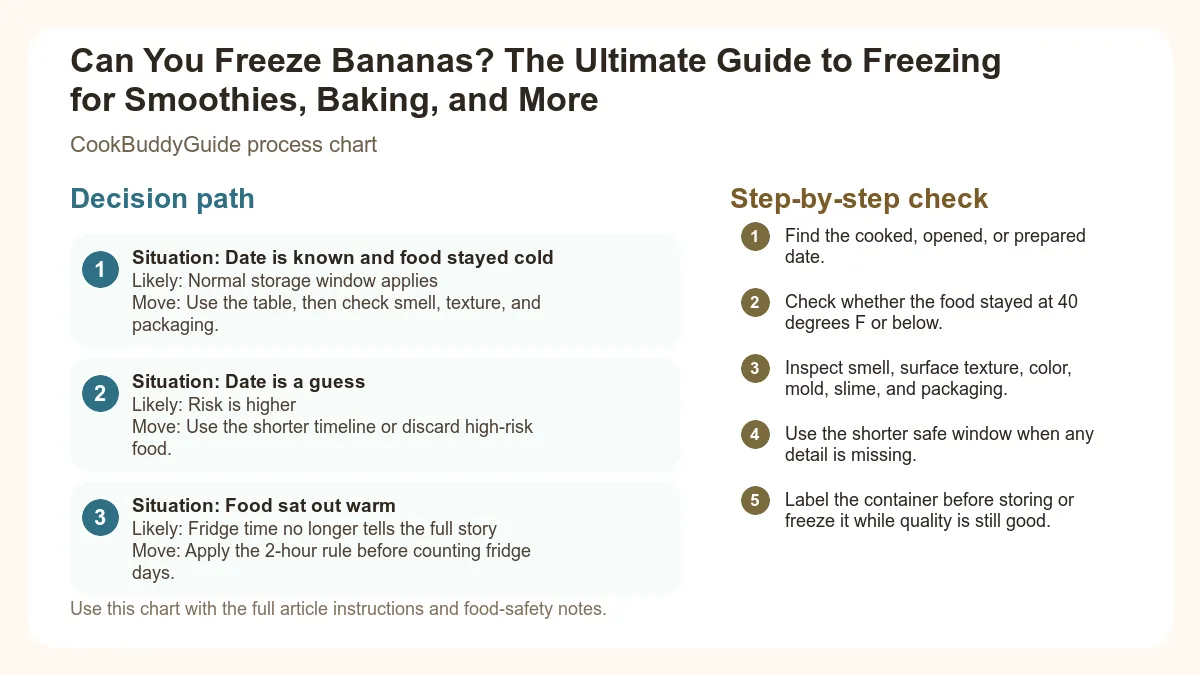
| Situation | Likely cause or meaning | Best move |
|---|---|---|
| Date is known and food stayed cold | Normal storage window applies | Use the table, then check smell, texture, and packaging. |
| Date is a guess | Risk is higher | Use the shorter timeline or discard high-risk food. |
| Food sat out warm | Fridge time no longer tells the full story | Apply the 2-hour rule before counting fridge days. |
Step-by-step fix
- Find the cooked, opened, or prepared date.
- Check whether the food stayed at 40 degrees F or below.
- Inspect smell, surface texture, color, mold, slime, and packaging.
- Use the shorter safe window when any detail is missing.
- Label the container before storing or freeze it while quality is still good.
Common mistakes
- Counting fridge days from the day you noticed the container instead of the day it was made.
- Ignoring time spent on the counter, in a lunch bag, or on a serving table.
- Trusting smell alone when the date or temperature history is unknown.
- Putting warm food into a deep container that cools slowly.
Related topic hubs
Table of Contents
- The Science of Freezing Bananas
- When is the Best Time to Freeze?
- Method 1: Freezing Whole Bananas
- Method 2: The Sliced Flash-Freeze Technique
- Method 3: Freezing Mashed Bananas
- Preventing Browning and Freezer Burn
- How Long Do They Last?
- Thawing Tips: Don't Toss the Liquid!
- Best Uses for Frozen Bananas
- Common Mistakes to Avoid
The Science of Freezing Bananas: What Happens to the Fruit?
To understand why frozen bananas are so prized by bakers and smoothie enthusiasts, we have to look at what’s happening on a molecular level. Bananas are unique because of their high starch and sugar content. As a banana ripens, it produces Ethylene gas, a natural plant hormone that triggers the conversion of complex starches into simple sugars. This is why overripe bananas are significantly sweeter than their yellow counterparts.
When you place a banana in the freezer, the water inside the fruit's cells expands as it turns into ice crystals. These sharp crystals act like tiny needles, puncturing the cell walls. This process is known as cell degradation. While this might sound like a bad thing, it’s actually the secret to that "creamy" texture we love. Once thawed or blended, the broken cell walls release their contents more easily, creating a smooth, custard-like consistency. This is why a frozen banana blended alone creates "nice cream," whereas a fresh banana blended alone just becomes a chunky puree.
However, freezing doesn't stop Oxidation entirely. Even in the cold, Enzymatic browning can occur if the fruit is exposed to oxygen. This is why choosing the right airtight container or freezer-safe bags is crucial to maintaining that bright, appetizing color. Furthermore, bananas are a powerhouse of Potassium, and freezing preserves this vital mineral perfectly, making them an ideal addition to your breakfast meal prep ideas.
When is the Best Time to Freeze Bananas?
- Green to Bright Yellow: Do not freeze yet. The starches haven't converted to sugar, meaning the flavor will be bland and the texture will be chalky.
- Yellow with Small Brown Specks: This is the "sweet spot" for smoothie ingredients. The banana is sweet but still has enough structure to provide a slight tang.
- Heavily Spotted to Solid Brown: These are gold for baking recipes. The sugar concentration is at its peak, and the aroma is intense.
- Black and Shriveled: If the peel is black but the fruit inside isn't moldy or fermented (smelling like alcohol), it’s still safe to freeze, though it will be very soft.
Method 1: How to Freeze Bananas Whole (In the Peel vs. Peeled)
Freezing in the Peel: The Lazy Method
You can technically throw a whole banana, peel and all, directly into the freezer. This is a great way to prevent food waste when you are in a massive rush. However, there is a major caveat: peeling a frozen banana is incredibly difficult. The banana peel becomes thin, brittle, and sticks to the fruit like glue. If you use this method, you must let the banana thaw completely before you can even think about removing the skin. This is a decent method for freezing bananas in the peel if you only plan to use them for baking later.
Freezing Peeled Whole Bananas: The Pro Method
This is my preferred way to freeze whole fruit. It takes 30 seconds of work now to save 5 minutes of frustration later. By peeling the fruit first, you ensure that the banana is ready to use the moment it hits the counter.
Step-by-Step: Freezing Whole Peeled Bananas
- Peel: Remove the skins from your ripe bananas.
- Protect: Line a small tray with parchment paper to prevent sticking.
- Pre-freeze: Place the whole bananas on the tray, making sure they aren't touching. Freeze for 2 hours.
- Store: Transfer the hard bananas into a freezer-safe bag. Squeeze out as much air as possible before sealing.
Method 2: How to Freeze Sliced Bananas (The Flash Freeze Technique)
If you are a smoothie lover, this is the only method you need. Slicing bananas before freezing allows you to grab exactly what you need without having to break apart a giant frozen block. This is where the Flash freezing technique comes into play, a method highly recommended for freezing bananas for smoothies.
The Flash-Freeze Slicing Method
- Slice: Cut peeled bananas into 1/2-inch thick coins.
- Arrange: Lay the slices in a single layer on a baking sheet lined with parchment paper or a silicone mat. Ensure the slices do not touch, or they will fuse together.
- Flash Freeze: Place the sheet in the freezer for about 1 to 2 hours, or until the slices are rock solid.
- Bag: Peel the frozen slices off the paper and toss them into a freezer-safe bag. Because they were frozen individually, they won't stick together!
Kitchen Hack: If you don't have room for a baking sheet in your freezer, you can "stack" layers of slices separated by sheets of parchment paper inside a plastic container. Just make sure the layers are distinct!
Method 3: How to Freeze Mashed Bananas
For the avid baker, mashing bananas before freezing is a helpful shortcut. Most baking recipes call for a specific volume of mashed banana (like "1 cup" or "3 medium bananas, mashed"). By mashing and measuring before you freeze, you turn your freezer into a "grab-and-go" pantry for banana bread.
The Freezer-Bag Flattening Trick
- Mash: In a bowl, mash your overripe bananas until relatively smooth.
- Measure: Use a measuring cup to portion out exactly 1 cup (or the amount your favorite recipe requires).
- Fill: Spoon the mash into a quart-sized freezer-safe bag.
- Flatten: Squeeze out all the air and seal the bag. Use your hands to flatten the mash so it fills the bag in a thin, even layer.
- Label: Use a permanent marker to write the date and the exact quantity (e.g., "1 Cup / 2 Bananas") on the bag.
How to Prevent Browning and Freezer Burn
Even in the freezer, the enemy is oxygen. Oxidation is what turns your beautiful fruit into a gray, unappealing mess. While a little browning doesn't hurt the flavor in a smoothie, it can be off-putting.
The Lemon Juice Secret
If you are particularly concerned about Enzymatic browning, toss your slices or mash with a teaspoon of lemon juice before freezing. The ascorbic acid in the lemon juice acts as an antioxidant, slowing down the browning process. Don't worry—you won't taste the lemon in your final smoothie or bread.
Choosing the Right Storage
Not all bags are created equal. To prevent freezer burn (those icy, dehydrated patches), you need a thick barrier.
- Vacuum Sealing: This is the gold standard. Removing all air prevents ice crystals from forming on the surface of the fruit.
- Double Wrapping: If you don't have a vacuum sealer, place your wrapped bananas or freezer bags inside a second, larger freezer bag or an airtight container. This "double hull" approach is a classic kitchen hack for long-term storage.
- Stasher Bags: These silicone bags are fantastic because they are thick and create a very tight seal, though they can be an investment.
How Long Do Frozen Bananas Last?
According to the USDA's guidelines on freezing and food safety, food kept at a constant 0°F (-18°C) is safe to eat indefinitely. However, "safe to eat" and "good to eat" are two different things.
- 1 Month: Perfect quality. No difference from fresh.
- 3 Months: The "Sweet Spot." This is the best way to freeze bananas for optimal flavor and texture.
- 6 Months: You may start to see some minor freezer burn or ice crystal buildup, but they are still excellent for baking.
- 12 Months+: The bananas are likely very dark and may have developed a "freezer taste." At this point, Usually, toss them.
Signs of spoilage: If you see large, snowy ice crystals inside the bag or if the banana smells like the "inside of a freezer," it's time to let it go. If the fruit is sticky or slimy after thawing (more than usual), discard it.
Thawing Frozen Bananas: Tips and Tricks
How you thaw your bananas depends entirely on what you’re making. If you’re making a smoothie or "nice cream," do not thaw them. Use them straight from the freezer for that signature thick, frosty texture.
However, for baking recipes like muffins or bread, you must thaw them first. Here is how to do it properly:
The Refrigerator Thaw
Place the bag in the fridge overnight. This is the gentlest method and preserves the most flavor. Place the bag in a bowl just in case it leaks!
The Microwave Shortcut
If you're in a hurry (we've all been there at 8:00 PM on a school night), place the peeled frozen banana in a microwave-safe bowl. Use the defrost setting in 30-second increments. Be careful—bananas have a high sugar content and can get very hot very quickly.
Don't Toss the Liquid!
Best Uses for Frozen Bananas
1. A Practical Smoothie Base
Frozen bananas act as both the sweetener and the thickener. They replace the need for ice, which can water down the flavor. For a standard 16oz smoothie, consider 1/2 to 1 full frozen banana. Pro-Tip: Blend the frozen banana with a little almond milk first to create a "slush" before adding your greens or protein powder. This ensures a perfectly smooth texture.
2. One-Ingredient "Nice Cream"
This is the miracle of frozen fruit. Take 2 cups of frozen banana slices and put them in a high-powered food processor. Process for 2-3 minutes. At first, it will look like crumbs. Then it will look like oatmeal. Suddenly, it will turn into a smooth, creamy, soft-serve consistency. It is dairy-free, fat-free, and incredibly delicious.
3. Baking: Bread, Muffins, and Pancakes
Common Mistakes to Avoid
- The "Banana Brick": This happens when you throw a bunch of fresh slices into a bag and put them in the freezer without flash-freezing first. You end up with a solid mass of fruit that requires a hammer and chisel to break apart. Always flash-freeze!
- Freezing Green Bananas: I’ll say it again—green bananas are for frying or eating fresh if you like the crunch, but they are terrible for the freezer. They won't ripen once frozen, so you'll be stuck with a flavorless, starchy mess.
- Forgetting to Label: A bag of frozen mashed banana looks remarkably like a bag of frozen chicken stock or apple sauce. Always label with the date and the quantity.
- Not Peeling Before Freezing: Unless you have the patience of a saint to wait for a full thaw, always peel your bananas before they hit the ice.
Frequently Asked Questions
A: Yes, but the peel will turn black and become very difficult to remove while frozen. You must thaw the banana completely before peeling.
A: No. Freezing is an excellent way to lock in vitamins and minerals like Potassium and Vitamin B6. In some cases, frozen fruit can be more nutrient-dense than "fresh" fruit that has been sitting on a grocery shelf for a week.
A: This is due to Oxidation and Enzymatic browning. It usually happens if there was too much air in the freezer bag. They are still safe to eat, though they might look a bit unappealing.
A: On average, one medium-to-large banana yields about 1 cup of 1/2-inch slices. This is a helpful measurement for prepping bananas for specific uses.
Conclusion: Master Your Freezer, Save Your Bananas
Learning how to freeze bananas is one of those simple kitchen hacks that truly changes the way you cook. It eliminates food waste, saves money, and ensures you always have the base for a healthy snack or a decadent dessert ready to go. Whether you prefer the convenience of the Flash freezing method for your morning smoothies or the pre-measured ease of mashed bananas for your weekend baking recipes, you now have the professional tools to do it right.
The next time you see those brown spots appearing on your counter, don't feel guilty. Instead, see it as an opportunity. Grab your freezer-safe bags and parchment paper, and start building your stash of "frozen gold." Your future self—and your blender—will thank you!
Have a favorite way to use frozen bananas that I didn't mention? Or a freezing trick you've discovered in your own kitchen? Leave a comment below and let the CookBuddyGuide community know!