Quick Answer
The right substitute for cornstarch depends on what that ingredient contributes: flavor, salt, acidity, fat, moisture, or structure. Use the comparison below to choose the closest match and adjust the amount for your recipe.
Practical note
For cornstarch recipes substitutes, we judge swaps by job first: flavor, salt, acid, fat, moisture, or structure. That keeps a substitution from fixing one problem while creating another.
Decision table
| Situation | Likely cause or meaning | Best move |
|---|---|---|
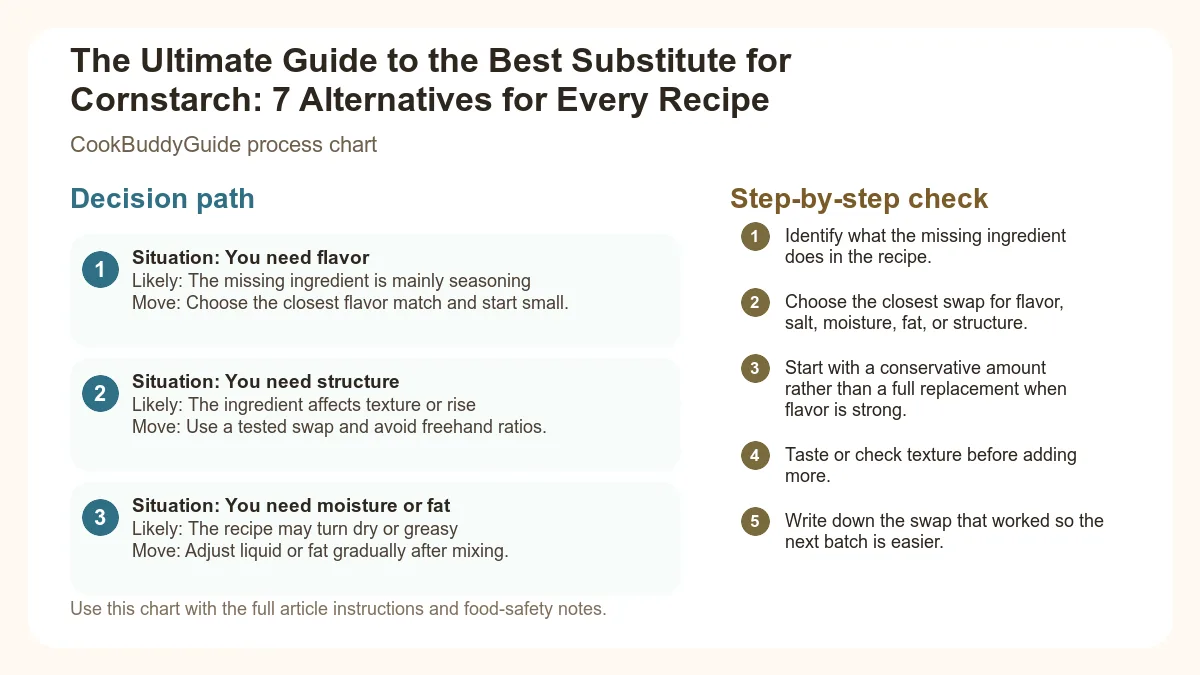
| You need flavor | The missing ingredient is mainly seasoning | Choose the closest flavor match and start small. |
| You need structure | The ingredient affects texture or rise | Use a practical swap and avoid freehand ratios. |
| You need moisture or fat | The recipe may turn dry or greasy | Adjust liquid or fat gradually after mixing. |
Step-by-step fix
- Identify what the missing ingredient does in the recipe.
- Choose the closest swap for flavor, salt, moisture, fat, or structure.
- Start with a conservative amount rather than a full replacement when flavor is strong.
- Taste or check texture before adding more.
- Write down the swap that worked so the next batch is easier.
Common mistakes
- Replacing a strong ingredient 1:1 before tasting.
- Choosing a flavor match when the recipe actually needs structure.
- Forgetting that salty swaps can change the whole dish.
- Adding extra liquid before the batter, dough, or sauce has time to hydrate.
Related topic hubs
It’s 6:15 PM. Your Mongolian Beef is sizzling in the wok, the aromas of ginger and garlic are filling the kitchen, and you reach into the pantry for that familiar yellow container of cornstarch to thicken the sauce. Your fingers meet empty space. We’ve all been there—the "pantry panic" that happens right when a recipe hits its critical stage. Whether you’ve run out, you're managing a corn allergy, or you're following a strict keto lifestyle, finding a reliable substitute for cornstarch is a skill every home cook needs in their repertoire.
Table of Contents
- Why You Need a Reliable Cornstarch Replacement
- 1. Arrowroot Powder: The Best for Glossy Sauces
- 2. Potato Starch: The High-Heat Heavyweight
- 3. Tapioca Starch: The Freezer-Friendly Choice
- 4. All-Purpose Flour: The Reliable Pantry Staple
- 5. Rice Flour: The Secret to Extra-Crispy Frying
- 6. Ground Flaxseed: The Keto and Vegan Binder
- 7. Xanthan Gum: The Low-Carb Powerhouse
- Cornstarch Substitute Comparison Chart
- Practical Tips: How to Avoid Lumps and Common Mistakes
Why You Need a Reliable Cornstarch Replacement
Common Reasons for Substituting Cornstarch
While cornstarch is a staple in most American pantries (often referred to as corn flour in the UK and Australia), there are several valid reasons to look for an alternative. Dietary restrictions are the most common driver. For those with corn allergies or sensitivities, cornstarch is an obvious "no." Additionally, the rise of the ketogenic diet has many cooks looking for low-carb options, as cornstarch is essentially a pure carbohydrate. Lastly, some cooks prefer non-GMO alternatives, as a significant portion of the corn crop in the U.S. is genetically modified.
The Role of Cornstarch in Cooking and Baking
To find the right substitute for cornstarch, we have to understand what it actually does. Cornstarch is a thickening agent that creates viscosity. When you mix it with a cold liquid (creating a slurry) and then heat it, the starch granules absorb water and swell. This process, known as gelatinization, typically begins around 144°F (62°C) and is complete near the boiling point.
1. Arrowroot Powder: The Best for Glossy Sauces
If you are looking for a gluten-free alternative that mimics the appearance of cornstarch almost perfectly, arrowroot powder is your best friend. Derived from the roots of several tropical plants, arrowroot is a pure starch that produces a beautiful glossy finish.
The Arrowroot to Cornstarch Ratio
When to Use Arrowroot (and When to Avoid It)
Arrowroot is particularly effective when thickening sauces that contain acidic ingredients like lemon juice or vinegar. Unlike cornstarch, which can lose its thickening power in highly acidic environments, arrowroot stands strong. It is also the superior choice for fruit jellies and dessert toppings where you want a clear, jewel-like transparency.
Mastering the Arrowroot Slurry
Use this method to finish stir-fries or fruit compotes for a professional shine.
- Measure 1 tablespoon of arrowroot powder into a small bowl.
- Add 2 tablespoons of cold liquid (water, broth, or juice).
- Whisk vigorously until no lumps remain.
- Pour the slurry into your simmering liquid while whisking constantly.
- Remove from heat as soon as the sauce thickens and becomes translucent (usually within 30-60 seconds).
2. Potato Starch: The High-Heat Heavyweight
How to Substitute Potato Starch
The ratio is a straightforward 1:1 replacement. However, keep in mind that potato starch is quite heavy and can settle at the bottom of your container, so always give it a good stir before measuring.
Best Use Cases: Gravies and Stews
3. Tapioca Starch (Cassava): The Freezer-Friendly Choice
Tapioca starch, also known as tapioca flour, is extracted from the cassava root. It is a powerhouse in the world of gluten-free baking and is particularly beloved by pie enthusiasts.
The Tapioca Ratio for Pie Fillings
Because tapioca starch is not quite as potent as cornstarch, you need to use more of it. The ratio is 2:1. For every 1 tablespoon of cornstarch required, use 2 tablespoons of tapioca starch.
Why Bakers Love Tapioca Starch
If you are making a fruit pie filling that you intend to freeze, tapioca is the only way to go. Cornstarch-thickened fillings tend to become spongy and weep liquid when thawed. Tapioca, however, remains stable and maintains its viscosity through the freezing and thawing process. It also provides a stunning, glossy finish that makes the fruit colors pop.
4. All-Purpose Flour: The Reliable Pantry Staple
When you have absolutely nothing else, wheat flour is the most common cornstarch replacement. However, it behaves very differently on a molecular level. Flour contains gluten and fiber, whereas cornstarch is pure starch.
Converting Flour to Cornstarch
Because flour is less "starchy" than cornstarch, you need significantly more of it to achieve the same thickness. According to thickening agents for cooking, you generally need a 2:1 or 3:1 ratio. Consider starting with 2 tablespoons of flour for every 1 tablespoon of cornstarch and adjusting as needed.
The Importance of Making a Roux
You cannot simply drop raw flour into a hot soup; you’ll end up with "dumplings" of dry flour. To use flour effectively, you should either create a roux (cooking the flour with equal parts fat, like butter or oil) or a very well-blended slurry.
5. Rice Flour: The Secret to Extra-Crispy Frying
Rice flour is made from finely milled rice and is a staple in Asian cuisine. While it can be used for thickening, its true superpower is in the deep fryer.
Using Rice Flour for Coatings
Thickening with Rice Flour
When used as a thickener, rice flour is colorless and virtually flavorless. It’s a great substitute for cornstarch in clear soups. However, it can have a slightly "gritty" texture if not whisked thoroughly. Always use a slurry method with cold water before adding it to your pot.
6. Ground Flaxseed: The Keto and Vegan Binder
For those on a specialized diet, ground flaxseed offers a unique way to add body to recipes. While it won't give you a silky-smooth gravy, it is an excellent thickening agent for rustic dishes.
How to Prepare a Flax Slurry
To replace 2 tablespoons of cornstarch, mix 1 tablespoon of ground flaxseed with 4 tablespoons of water. Let it sit for about 5 minutes until it forms a thick, mucilaginous gel. This is often called a "flax egg" in vegan baking.
Nutritional Benefits of Flax as a Thickener
7. Xanthan Gum: The Low-Carb Powerhouse
If you are looking for a keto-friendly thickener, xanthan gum is the undisputed king. It is a vegetable gum produced through fermentation, and its thickening power is immense.
Measuring Xanthan Gum Carefully
Xanthan Gum for Keto Cooking
One of the unique properties of xanthan gum is that it does not require heat to activate. This makes it a perfect substitute for cornstarch in cold applications like salad dressings or smoothies. As noted by xanthan gum as a thickener, it is also an excellent stabilizer for home-made ice creams, preventing the formation of ice crystals.
Keto-Friendly Pan Gravy
A rich, savory gravy without the carb count of cornstarch or flour.
- 2 cups beef or chicken drippings/broth
- 1/2 teaspoon xanthan gum
- 2 tablespoons butter
- Salt and pepper to taste
- Bring your broth to a simmer in a saucepan.
- Slowly sprinkle the xanthan gum over the surface of the liquid while whisking vigorously. Do not dump it all in one spot, or it will clump!
- Continue to whisk for 2-3 minutes as the gravy thickens.
- Whisk in the butter at the end for a glossy finish and extra richness.
Cornstarch Substitute Comparison Chart
| Substitute | Ratio | Best For | Heat Stability | Finish |
|---|---|---|---|---|
| Arrowroot | 1:1 | Acidic sauces, jellies | Low (Add at end) | Glossy/Clear |
| Potato Starch | 1:1 | Stews, Roasts | High | Matte/Opaque |
| Tapioca Starch | 2:1 | Fruit pies, Frozen foods | Medium | Bright/Glossy |
| AP Flour | 2:1 | Cream soups, Roux | Very High | Opaque/Matte |
| Rice Flour | 2:1 | Frying, Tempura | High | Crispy/Clear |
| Ground Flax | 1 tbsp + 4 tbsp water | Baking, Veggie burgers | High | Textured/Brown |
| Xanthan Gum | 1/4 tsp : 1 tbsp | Keto sauces, Dressings | Very High | Clear/Smooth |
Practical Tips: How to Avoid Lumps and Common Mistakes
The Slurry Method Explained
Temperature Matters: When to Add Your Thickener
As we discussed with arrowroot and tapioca, not all starches are built for the long haul. If you are making a slow-cooked meal, wait until the final 15-30 minutes of cooking to add your thickener. This prevents the starch bonds from breaking down and ensures your sauce has the peak viscosity when it hits the table.
The "Back of the Spoon" Test
How do you know if your sauce is thick enough? Use the classic kitchen technique: dip a metal spoon into the sauce. If the sauce coats the back of the spoon and you can draw a clear line through it with your finger that doesn't fill back in immediately, you've reached "nappe" consistency. This is the gold standard for sauces and gravies.
Frequently Asked Questions
No. Baking powder contains leavening agents (like baking soda and acid) that will cause your sauce to foam and impart a bitter, metallic taste. It is not a thickening agent.
In the US, corn flour is finely ground whole corn (yellow), while cornstarch is the white, refined starch. In the UK, "cornflour" is actually what Americans call cornstarch. Always check the origin of your recipe!
This is likely due to "over-cooking" the starch or the presence of enzymes in certain foods (like egg yolks or honey) that can break down starch chains over time. Re-thickening with a fresh slurry usually fixes this.
Conclusion: Choosing Your Best Cornstarch Replacement
Finding the right substitute for cornstarch doesn't have to be a guessing game. If you want that high-gloss shine for a stir-fry, reach for the arrowroot. If you're frying up a batch of crispy wings, rice flour is your secret weapon. And for those busy nights when you're using the slow cooker or Instant Pot, potato starch or a traditional flour roux will provide the stability you need.
Cooking is as much a science as it is an art. By understanding how these different starches behave—from the amylopectin content to the gelatinization temperature—you can pivot mid-recipe with confidence. So, the next time you find that empty yellow box in your pantry, don't panic. You have all the tools and knowledge you need to create a perfectly thickened, delicious meal.
Happy cooking, and may your sauces always be smooth and your crusts always be crispy!