Quick Answer
The right substitute for buttermilk depends on what that ingredient contributes: flavor, salt, acidity, fat, moisture, or structure. Use the comparison below to choose the closest match and adjust the amount for your recipe.
Practical note
For buttermilk recipes substitutes, we judge swaps by job first: flavor, salt, acid, fat, moisture, or structure. That keeps a substitution from fixing one problem while creating another.
Decision table
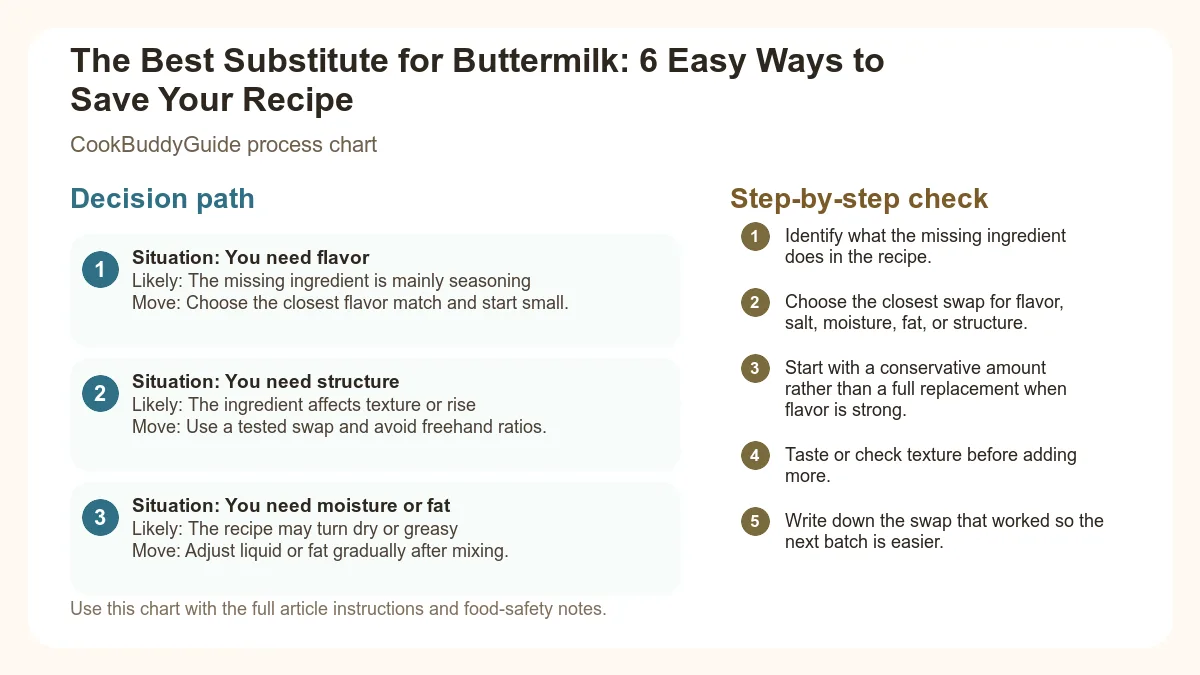
| Situation | Likely cause or meaning | Best move |
|---|---|---|
| You need flavor | The missing ingredient is mainly seasoning | Choose the closest flavor match and start small. |
| You need structure | The ingredient affects texture or rise | Use a practical swap and avoid freehand ratios. |
| You need moisture or fat | The recipe may turn dry or greasy | Adjust liquid or fat gradually after mixing. |
Step-by-step fix
- Identify what the missing ingredient does in the recipe.
- Choose the closest swap for flavor, salt, moisture, fat, or structure.
- Start with a conservative amount rather than a full replacement when flavor is strong.
- Taste or check texture before adding more.
- Write down the swap that worked so the next batch is easier.
Common mistakes
- Replacing a strong ingredient 1:1 before tasting.
- Choosing a flavor match when the recipe actually needs structure.
- Forgetting that salty swaps can change the whole dish.
- Adding extra liquid before the batter, dough, or sauce has time to hydrate.
Related topic hubs
Table of Contents
- Why Buttermilk is the Secret Ingredient You Can't Just Skip
- 1. The Classic Acidified Milk (Vinegar Method)
- 2. The Citrus Twist: Milk and Lemon Juice
- 3. The Thick & Creamy Swap: Greek Yogurt and Water
- 4. The Pro Choice: Using Kefir as a 1:1 Replacement
- 5. The Richness Booster: Sour Cream and Milk
- 6. Plant-Based & Vegan Buttermilk Substitutes
- Which Substitute Should You Choose? (Cheat Sheet)
- Common Mistakes When Replacing Buttermilk
Why Buttermilk is the Secret Ingredient You Can't Just Skip
The Science of Acidity and Leavening
Buttermilk is a fermented dairy product. During fermentation, bacteria convert lactose into lactic acid. This acidity is the engine behind chemical leavening. When the acid in buttermilk hits the baking soda in your batter, it triggers an immediate reaction, releasing carbon dioxide bubbles. These bubbles are what make your cakes rise and your waffles light. Without that acid, the baking soda has nothing to react with, leaving your baked goods dense and soapy-tasting.
How Buttermilk Affects Texture and Crumb
Beyond the rise, buttermilk plays a crucial role in texture. The acid helps break down long strands of gluten, which is why a buttermilk-based cake has such a tender crumb. Furthermore, the acid interacts with the casein (protein) in the milk, causing it to thicken and provide a richer mouthfeel. According to the USDA, the buttermilk nutrition and tenderizing properties are unique because they provide this acidity without the high fat content of heavy cream.
As noted in the science of buttermilk substitutes, a DIY buttermilk replacement needs to mimic both the pH level (acidity) and the viscosity (thickness) of the real thing to be truly effective.
1. The Classic Acidified Milk (Vinegar Method)
The Vinegar Buttermilk Method
The Ratio: 1 cup of milk (minus 1 tablespoon) + 1 tablespoon of white vinegar.
Instructions: Measure out your tablespoon of vinegar and pour it into a liquid measuring cup. Fill the rest of the cup with milk until it reaches the 1-cup line. Stir gently and let it sit at room temperature for at least 5 to 10 minutes.
The Exact Ratio: Milk + White Vinegar
Best Uses: Quick Breads and Muffins
2. The Citrus Twist: Milk and Lemon Juice
The Lemon Juice Buttermilk Method
The Ratio: 1 cup of milk (minus 1 tablespoon) + 1 tablespoon of fresh lemon juice.
Instructions: Mix the fresh lemon juice into the milk. Let it stand until small curdles form on the surface and the liquid thickens slightly.
Why Fresh is Better Than Bottled
Troubleshooting: What to do if it doesn't look curdled enough
Sometimes, modern ultra-pasteurized milk resists curdling. If you don't see distinct clumps, don't worry. As long as the acid is in the milk, the chemical leavening will still occur once it hits the baking powder or soda in your dry ingredients. The tangy flavor will still be there, even if the visual "clabber" is subtle.
3. The Thick & Creamy Swap: Greek Yogurt and Water
If you are looking for a substitute for buttermilk that matches the thickness of the real thing, look no further than your yogurt stash. This is actually a practical method for pancakes because it creates a heavy, rich batter that doesn't spread too thin on the griddle.
The Ratio: Thinning Out Heavy Yogurt
The Yogurt Buttermilk Method
The Ratio: 3/4 cup plain yogurt + 1/4 cup milk or water.
Instructions: Whisk the yogurt and liquid together in a bowl until completely smooth. Ensure there are no large lumps before adding to your recipe.
Best Uses: Pancakes and Thick Batters
The beauty of yogurt is that it contains actual live cultures, much like real buttermilk. This provides a depth of flavor that vinegar and milk simply can't match. It provides the closest protein and fat match to real buttermilk, ensuring your pancakes have that iconic tender crumb. Consider using full-fat yogurt if you can; the extra lipids help in creating a moist, decadent texture in cakes.
4. The Pro Choice: Using Kefir as a 1:1 Replacement
If I could only have one buttermilk replacement in my fridge, it would be kefir. Kefir is a fermented milk drink that is almost identical to buttermilk in terms of acidity, texture, and tangy flavor. In fact, in many home kitchens, kefir is used interchangeably with buttermilk without any modifications.
Why Kefir is the Ultimate Buttermilk Twin
- 1:1 Ratio: Use exactly the same amount of kefir as the recipe calls for in buttermilk.
- No Wait Time: Unlike the acidified milk methods, kefir is ready to use immediately.
- Probiotic Benefit: While some probiotics die off during baking, the enzymes present in kefir still help in tenderizing the casein in the dough.
Adjusting Salt and Sugar
5. The Richness Booster: Sour Cream and Milk
The Sour Cream Buttermilk Method
The Ratio: 3/4 cup sour cream + 1/4 cup milk or water.
Instructions: Whisk the sour cream and liquid together until smooth. If the sour cream is very cold, let the mixture sit for a few minutes to reach room temperature for better incorporation.
Best Uses: Biscuits and Scones
Whisking Techniques
6. Plant-Based & Vegan Buttermilk Substitutes
For my vegan friends or those with dairy sensitivities, creating a plant-based buttermilk alternative is entirely possible. However, not all non-dairy milk is created equal when it comes to curdling.
Soy Milk vs. Almond Milk: Which Curdles Best?
- The Vegan Ratio: 1 cup unsweetened soy milk + 1 tablespoon white vinegar or lemon juice.
- Coconut Milk: For tropical-flavored cakes, full-fat canned coconut milk mixed with lime juice works beautifully, though it will add a distinct coconut flavor.
- Avoid: Rice milk or oat milk for this specific purpose, as they tend to stay very thin even after adding acid.
Which Substitute Should You Choose? (Cheat Sheet)
Choosing the right buttermilk replacement depends entirely on what you are making. Use this table to decide which method will give you the best texture and tender crumb.
| Method | Best For... | Why it Works |
|---|---|---|
| Milk + Vinegar | Muffins, Quick Breads | Neutral flavor, consistent rise. |
| Milk + Lemon | Pancakes, Fruit Cakes | Bright flavor, excellent leavening. |
| Yogurt + Water | Waffles, Thick Batters | High protein, matches buttermilk body. |
| Kefir (1:1) | Everything (The Pro Choice) | True fermentation, perfect acidity. |
| Sour Cream + Milk | Biscuits, Scones | High fat content for maximum flakiness. |
| Soy Milk + Acid | Vegan Baking | Best plant-based curdling. |
Best for Fried Chicken Marinades
Common Mistakes When Replacing Buttermilk
Using Cold vs. Room Temperature Ingredients
This is a big one. If you add cold buttermilk replacement to a batter with melted butter, the butter will immediately clump up. For the best texture, let your substitute sit on the counter for 20-30 minutes before using. Room temperature liquids incorporate much more smoothly into fats, creating a more uniform emulsion.
The "Wait Time" Error
Over-mixing the Batter
Because DIY buttermilk substitutes are often slightly different in pH than the store-bought version, they can sometimes react more quickly or more slowly. Once you combine your wet and dry ingredients, mix only until just combined. Over-mixing develops gluten, which fights against the tenderizing work the acid is trying to do. This is especially true for pancakes and biscuits.
Frequently Asked Questions
Yes! Buttermilk powder is a fantastic pantry staple. You simply mix the dry powder with your flour and add water to the wet ingredients. It’s the most shelf-stable way to ensure you always have a substitute for buttermilk on hand.
Absolutely. Whole milk is always preferred. The fat in the milk helps tenderize the gluten and provides a richer flavor. If you only have 1% or skim, consider adding a teaspoon of heavy cream to the mix to boost the fat content.
Yes, you can use 1 ¾ teaspoons of cream of tartar per cup of milk. However, whisk the cream of tartar into the dry ingredients first, then add the milk to the wet ingredients. If you add it directly to the milk, it tends to clump.
Final Thoughts from the CookBuddy Kitchen
Next time you find yourself with an empty carton, don't panic. Reach for the vinegar, grab a lemon, or thin out that yogurt. Your biscuits will still be flaky, your cakes will still be moist, and your Sunday morning will be saved. Happy cooking!