Quick Answer
The right substitute for baking powder depends on what that ingredient contributes: flavor, salt, acidity, fat, moisture, or structure. Use the comparison below to choose the closest match and adjust the amount for your recipe.
Practical note
For Baking Powder Substitutes, the most useful home checks are temperature, measuring, resting time, and visible texture. Those details tell you more than guessing, especially before adding extra flour, liquid, heat, or leavening.
Decision table
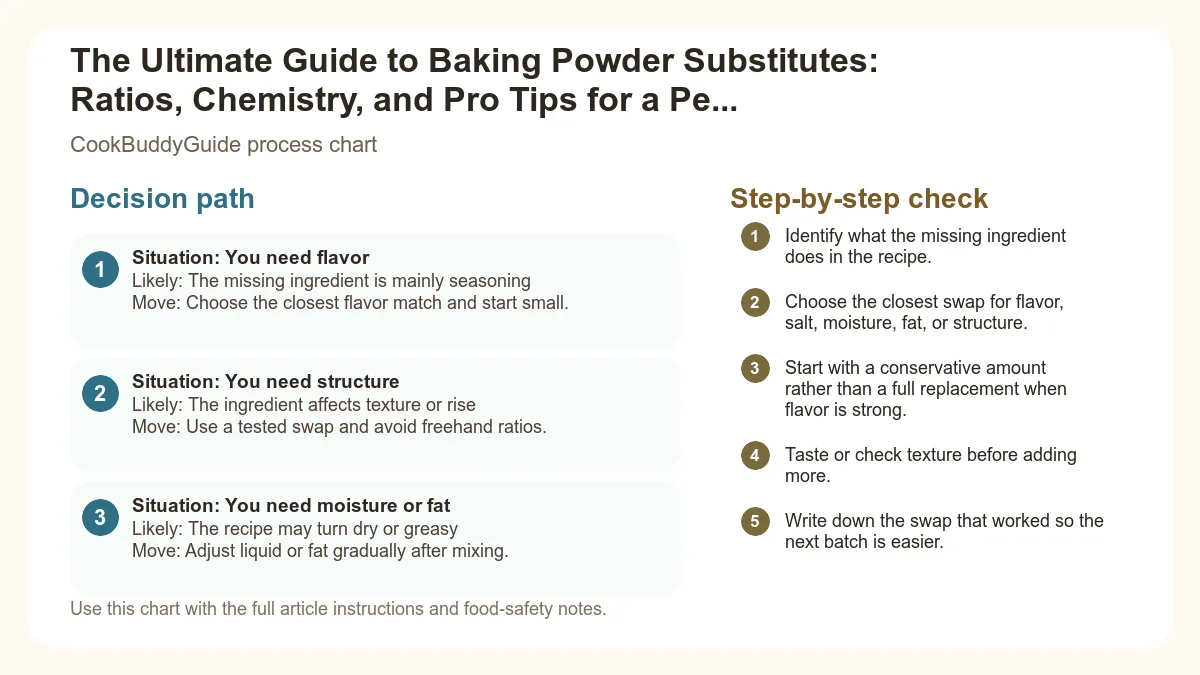
| Situation | Likely cause or meaning | Best move |
|---|---|---|
| You need flavor | The missing ingredient is mainly seasoning | Choose the closest flavor match and start small. |
| You need structure | The ingredient affects texture or rise | Use a practical swap and avoid freehand ratios. |
| You need moisture or fat | The recipe may turn dry or greasy | Adjust liquid or fat gradually after mixing. |
Step-by-step fix
- Identify what the missing ingredient does in the recipe.
- Choose the closest swap for flavor, salt, moisture, fat, or structure.
- Start with a conservative amount rather than a full replacement when flavor is strong.
- Taste or check texture before adding more.
- Write down the swap that worked so the next batch is easier.
Common mistakes
- Replacing a strong ingredient 1:1 before tasting.
- Choosing a flavor match when the recipe actually needs structure.
- Forgetting that salty swaps can change the whole dish.
- Adding extra liquid before the batter, dough, or sauce has time to hydrate.
Related topic hubs
Table of Contents
- Why You Need a Reliable Substitute for Baking Powder
- The Science of the Rise: Understanding Leavening Agents
- The Gold Standard: Baking Soda and Cream of Tartar
- Pantry-Friendly Liquid Acid Substitutes
- Using Dairy as a Leavening Catalyst
- The Shortcut: Converting to Self-Rising Flour
- Mechanical Leavening: The Power of Whipped Egg Whites
- Common Mistakes and Troubleshooting
- Quick Reference: Conversion Chart
Why You Need a Reliable Substitute for Baking Powder
The 'Oh No' Moment: Running Out Mid-Recipe
Why You Can't Just Leave It Out
If you omit the leavening entirely, your fluffy cakes will turn into dense, leaden bricks. The role of baking powder is to release Carbon dioxide (CO2) gas into the batter. These gas bubbles expand in the heat of the oven, stretching the gluten or protein structure of your cake or bread. Without this expansion, the heat simply sets the batter in its original, compressed state. Furthermore, baking powder influences the Maillard reaction—the chemical reaction between amino acids and reducing sugars that gives your crust that beautiful golden-brown color. Without the proper pH level provided by a balanced leavener, your bakes will look pale and unappetizing.
The Science of the Rise: Understanding Leavening Agents
What is Baking Powder, Exactly?
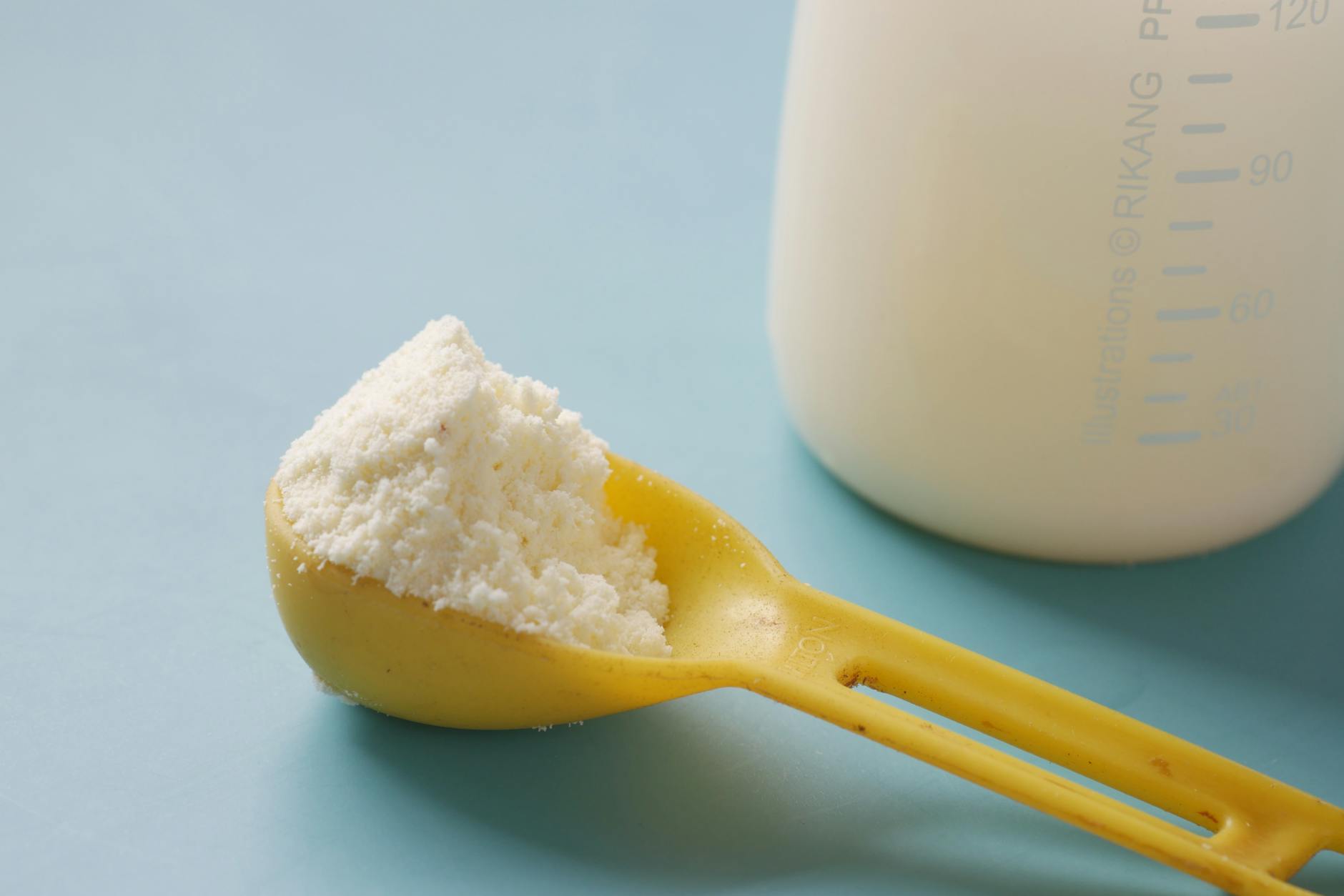
To find a perfect baking powder replacement, you have to understand its components. Pure baking powder is actually a mixture of three things: Sodium bicarbonate (baking soda), a dry acid (usually cream of tartar or sodium aluminum sulfate), and a buffer (typically cornstarch). The cornstarch serves two purposes: it keeps the acid and base from reacting prematurely by absorbing moisture, and it ensures the powder stays free-flowing and clump-free.
The Acid-Base Reaction Explained
The magic happens when moisture hits the powder. The acid and the base dissolve and react with each other to produce CO2. As Serious Eats explains in their deep dive into chemical leaveners, baking soda is a base that requires an acid to "activate" it. Baking powder is essentially "self-activating" because it carries its own acid. When you create a substitute, you are manually recreating this balanced ecosystem.
Single-Acting vs. Double-Acting: What You Need to Know
The Gold Standard: Baking Soda and Cream of Tartar
If you have tartaric acid (commonly known as cream of tartar) in your spice rack, you are in luck. This is the most stable and flavor-neutral substitute for baking powder. It mimics the commercial product almost perfectly because cream of tartar is the very acid used in many high-end baking powders.
The Pro's Homemade Baking Powder
Yield: 1 teaspoon of baking powder replacement
- 1/4 teaspoon Sodium bicarbonate (Baking Soda)
- 1/2 teaspoon Cream of Tartar
- 1/4 teaspoon Cornstarch (Optional, for stability)
Instructions: Sift the ingredients together through a fine-mesh strainer to ensure there are no lumps of soda. If you are using this immediately, you can skip the cornstarch. If you are making a larger batch to store, the cornstarch is mandatory to prevent the mixture from reacting with humidity in the air. This ratio provides the perfect pH level for neutralization, ensuring no metallic aftertaste.
Pantry-Friendly Liquid Acid Substitutes
What if you don't have cream of tartar? You likely have white vinegar or lemon juice. These are excellent acidic catalysts, but because they are liquids, they require a bit of "baker's math" to ensure your dough consistency remains correct.
Baking Soda and White Vinegar
The Ratio: 1/4 tsp baking soda + 1/2 tsp white vinegar = 1 tsp baking powder.
Baking Soda and Lemon Juice
The Ratio: 1/4 tsp baking soda + 1/2 tsp lemon juice = 1 tsp baking powder.
Pro Tip: When using liquid acids, always add the baking soda to your dry ingredients and the vinegar/lemon juice to your wet ingredients. Do not mix them together in a separate cup first, or you'll watch your leavening power literally vanish into the air in a cloud of bubbles! As noted by Healthline's science-backed guide, the reaction is immediate, so speed is your best friend here.
Using Dairy as a Leavening Catalyst
Dairy products like buttermilk, yogurt, and sour cream are naturally acidic. When they meet baking soda, they create a vigorous reaction that results in some of the most tender crumbs you’ll ever experience. This is due to the fats and proteins in the dairy which interfere with gluten development.
The Buttermilk Method
If your recipe calls for 1 cup of regular milk and 2 teaspoons of baking powder, you can swap the milk for 1 cup of buttermilk and add 1/2 teaspoon of baking soda.
The Ratio: 1/2 cup buttermilk + 1/4 tsp baking soda = 1 tsp baking powder.
Plain Yogurt or Sour Cream
The Shortcut: Converting to Self-Rising Flour
Sometimes the best substitute for baking powder is already inside your flour. Self-rising flour is a staple in Southern kitchens, specifically designed for biscuits and pancakes. It is a pre-mixed blend of all-purpose flour, baking powder, and salt.
If a recipe calls for 1 cup of all-purpose flour and 1.5 teaspoons of baking powder, you can simply use 1 cup of self-rising flour and omit the extra leavener. However, you must also be careful with the salt. Most self-rising flours contain about 1/4 to 1/2 teaspoon of salt per cup. According to King Arthur Baking's conversion guide, you should generally reduce the added salt in your recipe by half when making this switch.
Mechanical Leavening: The Power of Whipped Egg Whites
Before the invention of modern chemical leaveners in the mid-1800s, bakers relied on "mechanical leavening"—the process of physically trapping air in a matrix of protein. If you are completely out of baking soda *and* baking powder, this is your only hope.
This method involves separating the eggs already called for in your recipe. You beat the whites to "stiff peaks" (where the foam stands straight up when you lift the whisk) and then gently fold them into the finished batter at the very end. This is the secret to fluffy cakes like Chiffon or Angel Food.
The Risk: The danger here is over-mixing. If you are too aggressive with your spatula, you will pop the tiny CO2 bubbles you worked so hard to create. Use a "cut and fold" motion: cut through the center of the whites with a spatula, scrape along the bottom of the bowl, and fold the batter over the top. Rotate the bowl and repeat until no white streaks remain.
Common Mistakes and Troubleshooting
This usually happens when there isn't enough acid to neutralize the Sodium bicarbonate. Baking soda is highly alkaline. If it doesn't react completely with an acid, the leftover soda creates a "soapy" or "metallic" flavor. Always ensure your ratios are exact—never "eyeball" the baking soda.
This is often a sign of "over-leavening." If you use too much substitute for baking powder, the gas bubbles grow too large and the gluten structure can't support them. They pop, and the cake sinks. Stick to the 1/4 tsp soda per 1 tsp powder rule.
Use the "Hot Water Test." Take 1/2 teaspoon of the powder (or your homemade mix) and drop it into a small bowl of hot tap water. If it bubbles and fizzes vigorously immediately, it’s active. If it just sits there or fizzes weakly, throw it out and start fresh. As the Kansas State University extension article on leavening points out, moisture is the enemy of shelf life.
Quick Reference: Baking Powder Substitute Conversion Chart
Keep this chart handy on your fridge for those recipe rescue moments. All ratios are designed to replace 1 teaspoon of baking powder.
| Substitute Method | Ratio/Ingredients | Best For... |
|---|---|---|
| Cream of Tartar | 1/4 tsp Baking Soda + 1/2 tsp Cream of Tartar | Everything (Cakes, Cookies, Biscuits) |
| Buttermilk | 1/4 tsp Baking Soda + 1/2 cup Buttermilk* | Pancakes, Muffins, Quick Breads |
| Lemon Juice | 1/4 tsp Baking Soda + 1/2 tsp Lemon Juice | Fruit-based cakes, Pancakes |
| White Vinegar | 1/4 tsp Baking Soda + 1/2 tsp Vinegar | Chocolate cakes, Cookies |
| Plain Yogurt | 1/4 tsp Baking Soda + 1/2 cup Yogurt* | Dense cakes, Scones |
| Self-Rising Flour | Replace All-Purpose Flour 1:1 | Biscuits, Cobblers |
| Whipped Egg Whites | Beat existing recipe eggs to stiff peaks | Waffles, Chiffon Cakes |
*Note: When using buttermilk or yogurt, remember to reduce the other liquids in your recipe by 1/2 cup to maintain the correct hydration level.