Quick Answer
Yes, you can freeze yogurt, but the texture may change after thawing. Freeze it while fresh in an airtight, labeled container, and thaw perishable foods in the refrigerator before using them in the ways described below.
Practical note
For Can You Freeze Yogurt? Guide to Freezing, Thawing, and Using It, the home-kitchen check is not only the number of days. We look at the start date, fridge temperature, container seal, serving time, and spoilage signs. If one of those facts is missing, the safer move is to use the shorter window.
Decision table
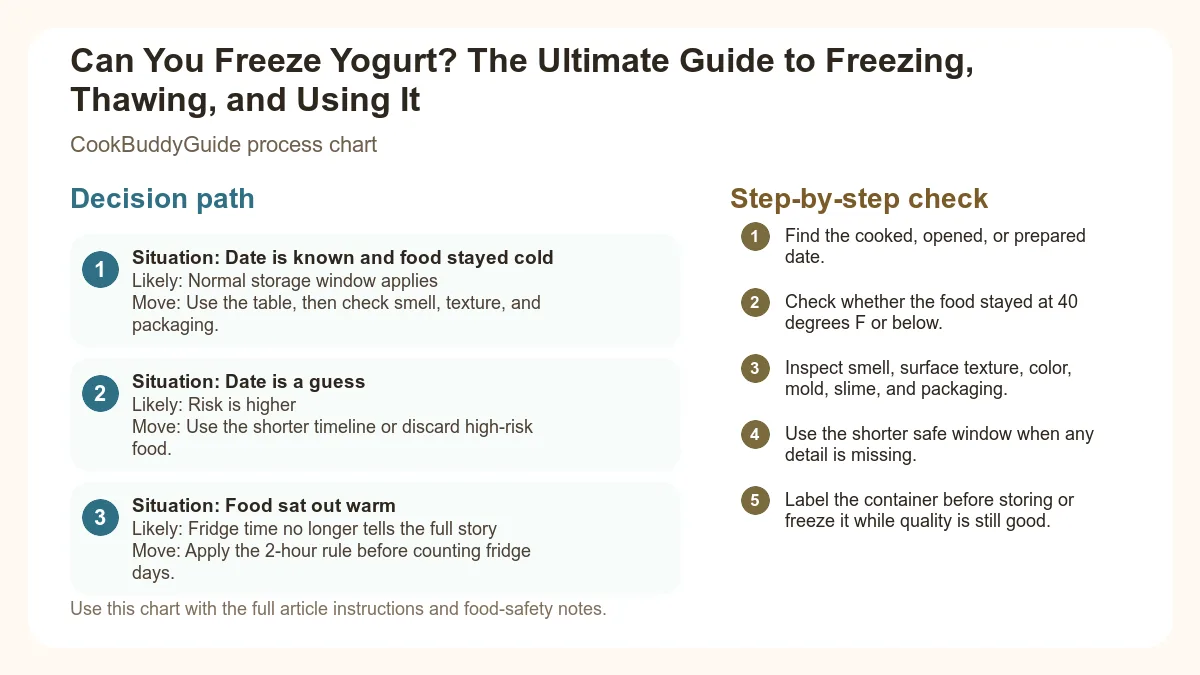
| Situation | Likely cause or meaning | Best move |
|---|---|---|
| Date is known and food stayed cold | Normal storage window applies | Use the table, then check smell, texture, and packaging. |
| Date is a guess | Risk is higher | Use the shorter timeline or discard high-risk food. |
| Food sat out warm | Fridge time no longer tells the full story | Apply the 2-hour rule before counting fridge days. |
Step-by-step fix
- Find the cooked, opened, or prepared date.
- Check whether the food stayed at 40 degrees F or below.
- Inspect smell, surface texture, color, mold, slime, and packaging.
- Use the shorter safe window when any detail is missing.
- Label the container before storing or freeze it while quality is still good.
Common mistakes
- Counting fridge days from the day you noticed the container instead of the day it was made.
- Ignoring time spent on the counter, in a lunch bag, or on a serving table.
- Trusting smell alone when the date or temperature history is unknown.
- Putting warm food into a deep container that cools slowly.
Related topic hubs
You’ve been there: standing in front of the open refrigerator at 7:00 AM, staring at a nearly full 32-ounce tub of expensive Greek yogurt that expires tomorrow. You bought it with the best of intentions for a week of healthy breakfasts, but life happened, and now you’re facing the prospect of throwing money down the drain. As a home cook who despises food waste, the question naturally arises: can you freeze yogurt to save it for later?
- The Short Answer: Yes, But There’s a Catch
- The Science of Freezing Yogurt: Texture and Probiotics
- Greek Yogurt vs. Regular Yogurt: Which Freezes Better?
- 3 Best Methods for Freezing Yogurt
- How Long Does Frozen Yogurt Last?
- How to Properly Thaw Yogurt
- Best Uses for Previously Frozen Yogurt
- Common Mistakes to Avoid
- Frequently Asked Questions
The Short Answer: Yes, But There’s a Catch
Yes, You Can Freeze It!
The immediate answer to the question can you freeze yogurt is a resounding yes. Whether it is plain yogurt, vanilla yogurt, or a fruit-on-the-bottom variety, the freezer will safely preserve the dairy for several weeks. However, the "catch" is all about the texture changes. If you are expecting to thaw a container of yogurt and eat it with a spoon just like a fresh cup of Chobani or Fage, you are going to be disappointed.
Freezing causes the moisture in the yogurt to crystallize, which breaks down the smooth protein structure. When it thaws, the liquid (whey) separates from the solids, leaving you with a consistency that is often described as "gritty" or "grainy." While it is perfectly safe to eat, the mouthfeel is no longer ideal for raw consumption in a parfait or bowl.
Why Freezing Yogurt is a Helpful Shortcut for Busy Cooks
Even with the texture changes, this freezing yogurt guide will show you why keeping a stash of frozen yogurt is a brilliant move. It is an incredible way to portion out ingredients for breakfast meal prep ideas. Instead of rushing to finish a tub, you can portion it into ice cube trays and have ready-to-go thickeners for your morning smoothies. It’s also a lifesaver for baking and marinades, where the texture of the yogurt is completely transformed by heat or other ingredients anyway.
The Science of Freezing Yogurt: What Happens to the Texture?
Why Yogurt Becomes Grainy or Gritty
To understand why the texture changes, we have to look at the process of dairy fermentation. Yogurt is essentially milk that has been thickened by lactic acid-producing bacteria. These bacteria create a delicate web of proteins that trap water. When you freeze yogurt, that water turns into ice crystals. These crystals act like tiny needles, puncturing the protein web.
According to research on the texture of thawed yogurt, this structural collapse is what leads to the separation of whey (the liquid) and the milk solids. Once the protein network is broken, it can never fully return to its original, perfectly smooth state, regardless of how much you stir it.
The Role of Whey and Water Content
The amount of water in your yogurt dictates how much it will separate. Regular yogurt has a much higher water content than Greek yogurt. Consequently, regular yogurt will often look much more "broken" upon thawing. This is why emulsification becomes important during the thawing process—you are essentially trying to force that water back into the solids.
Does Freezing Kill Probiotics?
Studies on probiotics in frozen yogurt suggest that these beneficial cultures can survive sub-zero temperatures quite well. While they won't be as active as they are in fresh yogurt, you are still getting the gut-health benefits when you consume previously frozen yogurt in smoothies or cold preparations.
Greek Yogurt vs. Regular Yogurt: Which Freezes Better?
Freezing Greek Yogurt: High Protein, Low Moisture
Freezing Regular Yogurt: Higher Water Content Challenges
Regular yogurt, especially the "low fat" versions that use thickeners like pectin or gelatin, tends to struggle in the freezer. When it thaws, it can look almost like curdled milk. If you are freezing regular yogurt, consider using it only for baking with yogurt or in smoothie recipes where the texture is blended away.
Full-Fat vs. Non-Fat: The Fat Content Factor
- 0% Fat: Resulted in a very icy, hard block that was difficult to whisk back together. The graininess was very pronounced.
- 5% Fat: The fat molecules act as a buffer, preventing the ice crystals from growing too large. The thawed result was significantly creamier and easier to re-incorporate.
Kitchen Tip: If you know you’re going to freeze your yogurt, always opt for the full-fat version. The lipids help maintain a much better emulsification after thawing.
3 Best Methods for Freezing Yogurt
Method 1: The Ice Cube Tray (Best for Smoothies)
Instructions: Yogurt Smoothie Cubes
- Clean and dry a silicone ice cube tray (silicone makes it easier to pop the cubes out).
- Stir your plain yogurt or vanilla yogurt thoroughly to ensure it is homogenous.
- Spoon exactly 2 tablespoons (1 ounce) of yogurt into each well.
- Tap the tray on the counter to remove air bubbles.
- Freeze for 4 hours or until solid.
- Pop the cubes out and transfer them to a heavy-duty freezer bag.
Method 2: The Baking Sheet (Yogurt 'Drops' for Snacking)
If you have kids (or just love a cold snack), yogurt drops are fantastic. This "flash-freeze" method prevents the yogurt from clumping together in the bag.
- Line a baking sheet with parchment paper.
- Place small dollops (about 1 teaspoon each) of yogurt onto the paper.
- Freeze the entire sheet for 2 hours.
- Once hard, peel them off and store them in an airtight container. These are great for tossing into a bowl of hot oatmeal—they melt instantly and add creaminess!
Method 3: Airtight Containers (Best for Baking and Large Batches)
If you plan on baking with yogurt (like making a lemon yogurt cake), freezing in larger quantities is fine. However, you must use a proper airtight container. The original thin plastic tubs that yogurt comes in are not designed for long-term freezer storage; they are oxygen-permeable, which leads to freezer burn very quickly.
Pro-tip: When filling a container, always leave at least 1/2 inch of "headspace" at the top. Yogurt contains water, and water expands when it freezes. If you fill it to the brim, the lid will pop off or the container might crack.
How Long Does Frozen Yogurt Last?
The Ideal Freezer Window
While the freezer technically keeps food safe indefinitely, the quality of dairy degrades over time. For the best flavor and the least amount of freezer burn, consider using frozen yogurt within 1 to 2 months.
According to the recommended storage times for dairy, yogurt quality starts to decline significantly after the 60-day mark. The lactic acid can start to taste overly sharp, and the texture becomes increasingly difficult to salvage.
Signs of Freezer Burn and Spoilage
How do you know if your frozen yogurt has gone bad? Look for these signs:
- Ice Crystals: A thick layer of "snow" on the surface of the yogurt indicates that moisture has left the dairy and crystallized on top. This usually means the yogurt will be very dry and grainy.
- Discoloration: If the yogurt looks yellow or darkened, it has likely oxidized.
- The Smell Test: Once thawed, if it smells sour in a "rancid" way rather than a "tangy" way, toss it.
How to Properly Thaw Yogurt
The Refrigerator Method (Slow and Steady)
Never, under any circumstances, thaw yogurt on the kitchen counter. Room temperature encourages bacterial growth and makes the separation even worse. The only safe way to thaw yogurt is in the refrigerator. Depending on the size of the container, this can take anywhere from 6 to 24 hours.
The Secret to Fixing Grainy Thawed Yogurt
Once your yogurt is thawed, it will look unappealing. It will be watery and lumpy. Don't panic! This is where the emulsification technique comes in.
- Pour the thawed yogurt (including all the liquid whey) into a bowl.
- Use a balloon whisk or an immersion blender.
- Whisk vigorously for 30-60 seconds.
This won't make it 100% as smooth as fresh yogurt, but it will reintegrate the fats and liquids enough to make it perfectly usable for most recipes.
When You Don't Need to Thaw at All
Best Uses for Previously Frozen Yogurt
Since the texture has changed, you want to use the yogurt in ways that highlight its acidity and moisture rather than its creaminess. There are plenty of best ways to use thawed yogurt that will make you forget it was ever frozen.
Smoothies and Shakes
Baking: Cakes, Muffins, and Quick Breads
Yogurt is a miracle ingredient in baking. The lactic acid reacts with baking soda to create a beautiful lift and a tender crumb. Because the yogurt will be mixed into a batter and baked, the grainy texture is completely irrelevant. Use thawed Greek yogurt in my blueberry muffins and it produces a result that is indistinguishable from fresh.
Savory Marinades for Meat
Yogurt-Marinated Chicken Prep
Use this for chicken thighs or breasts before grilling.
- 1 cup thawed Greek yogurt (whisked)
- 2 cloves minced garlic
- 1 tbsp lemon juice
- 1 tsp dried oregano
- 1/2 tsp salt and black pepper
Mix all ingredients and coat 1.5 lbs of chicken. The enzymes in the yogurt will make the meat incredibly tender!
Common Mistakes to Avoid When Freezing Yogurt
1. Freezing in the Original Plastic Tub
the original packaging is your enemy in the freezer. It leads to freezer burn and off-flavors from other foods in your freezer (nobody wants "onions and garlic" flavored yogurt). Always transfer to a freezer-safe airtight container or a heavy-duty Ziploc bag with the air squeezed out.
2. Forgetting to Stir Before Freezing
If you have a large tub of yogurt, the whey often settles at the top. If you freeze it without stirring, you’ll have a block of ice on top and a dense mass on the bottom. Always give it a good stir to ensure food preservation is uniform throughout the batch.
3. Expecting a 'Fresh' Texture for Parfaits
Manage your expectations! If you thaw yogurt and try to layer it with granola and fresh berries for a fancy brunch parfait, you will be disappointed. The texture just isn't there. Save the frozen stuff for the "hidden" applications like baking and blending.
Frequently Asked Questions
Yes! These are actually designed to be frozen and eaten like a popsicle. Because they are eaten while still frozen, you don't notice the texture separation that happens during thawing.
Yes, but be aware that the fruit will also change texture. It will become much softer and may release more juice into the yogurt upon thawing, making it even more watery.
The lactic acid levels remain stable, so the "tanginess" will be the same. This is why it remains an excellent tenderizer for marinades.
Conclusion: Stop Wasting Your Yogurt!
So, can you freeze yogurt? Absolutely. While the texture changes make it less than ideal for eating straight from the container, it remains a versatile, healthy, and cost-effective ingredient for a variety of culinary applications. By using ice cube trays to portion your yogurt and following the "whisk and emulsify" method for thawing, you can extend the life of your dairy and save money.
Next time you see a "Buy One, Get One Free" deal on your favorite Greek yogurt, don't hesitate. Bring it home, portion it out, and tuck it away in the freezer. Your future smoothies and muffins will thank you! For more ways to save time and money in the kitchen, check out our guides on breakfast meal prep and freezer-friendly dinners. Happy cooking!