Quick Answer
Yes, you can freeze milk, but the texture may change after thawing. Freeze it while fresh in an airtight, labeled container, and thaw perishable foods in the refrigerator before using them in the ways described below.
Practical note
For Can You Freeze Milk? The Complete Guide to Freezing, Thawing, and Cooking with Frozen Milk, the home-kitchen check is not only the number of days. We look at the start date, fridge temperature, container seal, serving time, and spoilage signs. If one of those facts is missing, the safer move is to use the shorter window.
Decision table
| Situation | Likely cause or meaning | Best move |
|---|---|---|
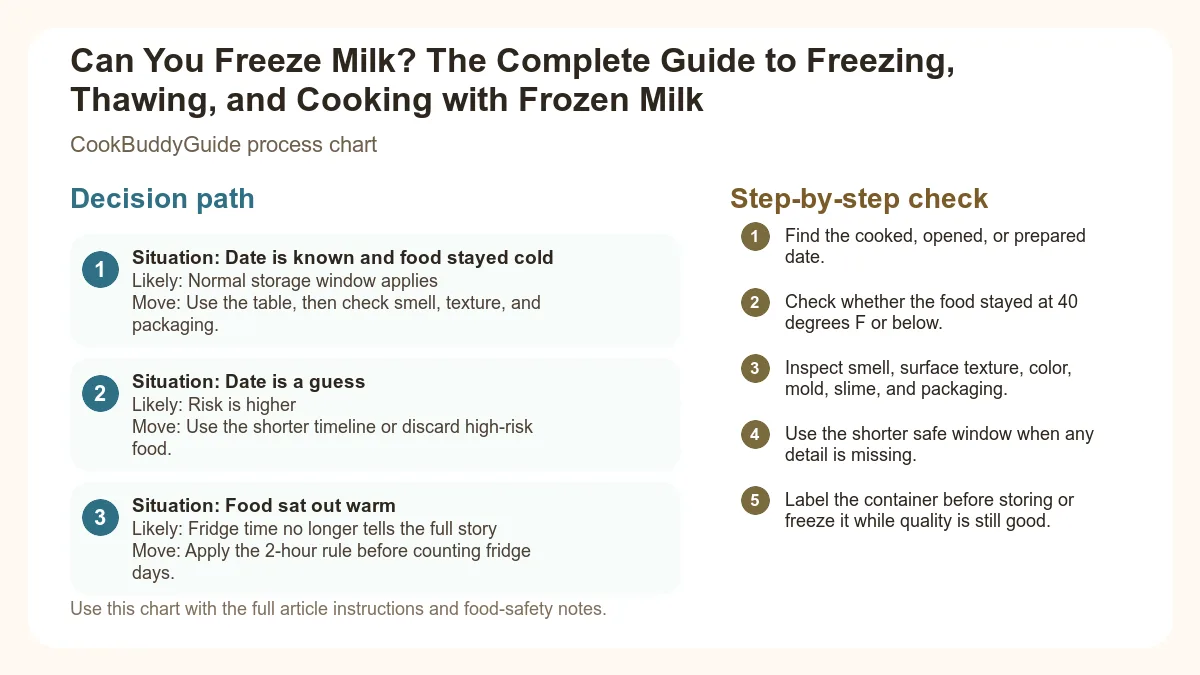
| Date is known and food stayed cold | Normal storage window applies | Use the table, then check smell, texture, and packaging. |
| Date is a guess | Risk is higher | Use the shorter timeline or discard high-risk food. |
| Food sat out warm | Fridge time no longer tells the full story | Apply the 2-hour rule before counting fridge days. |
Step-by-step fix
- Find the cooked, opened, or prepared date.
- Check whether the food stayed at 40 degrees F or below.
- Inspect smell, surface texture, color, mold, slime, and packaging.
- Use the shorter safe window when any detail is missing.
- Label the container before storing or freeze it while quality is still good.
Common mistakes
- Counting fridge days from the day you noticed the container instead of the day it was made.
- Ignoring time spent on the counter, in a lunch bag, or on a serving table.
- Trusting smell alone when the date or temperature history is unknown.
- Putting warm food into a deep container that cools slowly.
Related topic hubs
It’s 11:00 PM on a Sunday, you’re prepping for a busy week of breakfast meal prep, and you realize that the two gallons of milk you bought on sale are set to expire in forty-eight hours. We’ve all been there. Whether it’s a bulk-buy bargain or a sudden vacation that leaves your fridge full of perishables, the question inevitably arises: can you freeze milk?
Table of Contents
- Why Freezing Milk is a Helpful Shortcut
- The Science of Freezing Milk
- Which Types of Milk Freeze Best?
- Step-by-Step Instructions for Freezing
- The Best Containers for Frozen Dairy
- How Long Does Frozen Milk Last?
- How to Thaw Frozen Milk Safely
- Fixing Texture Issues
- Best Uses for Previously Frozen Milk
- Common Mistakes to Avoid
Introduction: Why Freezing Milk is a Helpful Shortcut for Busy Kitchens
The Economics of Bulk Buying
In today's economy, savvy home cooks know that buying in bulk is one of the most effective ways to slash the grocery bill. However, dairy products are often the limiting factor. When my local dairy has a "Buy One, Get One" sale on organic whole milk, I no longer hesitate. By understanding how to freeze milk properly, you can take advantage of these sales without the fear of the product spoiling before you can use it.
Reducing Food Waste at Home
Food waste is a significant issue in modern households. According to my research into sustainable kitchen practices, dairy is one of the most frequently discarded items due to its short shelf life. Learning the art of freezing milk allows you to hit the "pause button" on the expiration date. If you see that you won't finish a half-gallon before you leave for a long weekend, freezing it is an ethical and financial win.
The Science of Freezing Milk: What Happens to the Molecules?
Fat Separation and Homogenization
To understand why milk looks different after it thaws, we have to look at Homogenization. Milk is an emulsion of water, proteins, and fats. During the freezing process, the water molecules expand and form ice crystals. These crystals push the fat globules aside. When the milk thaws, these fats don't always naturally jump back into their perfectly emulsified state. This results in the separation of fats, which can give the milk a yellow, curdled, or grainy appearance. This is entirely normal and does not mean the milk is spoiled.
Why Texture Changes Occur
The Role of Water Content in Dairy
Which Types of Milk Freeze Best? A Comprehensive Comparison
Whole Milk vs. Skim and 2%
Plant-Based Milks: Almond, Oat, and Soy
Specialty Milks: Goat, Buttermilk, and Heavy Cream
- Heavy Cream: You can freeze it, but it will not whip well into stiff peaks after thawing. Use it for sauces and soups instead.
- Goat Milk: Similar to whole cow's milk, it separates significantly but is safe.
Warning: Never freeze canned evaporated or condensed milk inside the metal can. The expansion will break the seal and lead to food safety issues and a massive mess.
How to Freeze Milk: Step-by-Step Instructions
The CookBuddyGuide Method for Perfect Frozen Milk
- Step 1: Checking the Expiration Date. Only freeze milk that is fresh. Freezing doesn't "kill" bacteria; it only pauses it. If the milk is one day away from souring, it will be one day away from souring the moment it thaws.
- Step 2: Choosing the Right Container. If using the original plastic jugs, pour out at least 1.5 to 2 cups of milk to allow for expansion. If using smaller containers, ensure they are labeled "freezer-safe."
- Step 3: Leaving Room for Expansion (The 1.5-Inch Rule). This is the most important step. Always leave at least 1.5 inches of "headspace" at the top of your container. As noted in this guide on how to freeze milk, failing to do this is the #1 cause of freezer messes.
- Step 4: Labeling and Dating. Use a permanent marker to write the date of freezing and the original expiration date on the container. This helps you track the 3-month quality window.
The Best Containers for Freezing Milk
Plastic Jugs and Cartons
The original plastic jug is convenient, but it’s bulky. If you have a chest freezer, this is fine. Just remember to pour some out first! Cardboard cartons (like those used for half-gallons) are less ideal because they can sometimes absorb "freezer smells" over time. If you use them, wrap them in a layer of plastic wrap for extra protection against freezer burn.
Glass Mason Jars (Safety Tips)
Silicone Molds and Ice Cube Trays
For the ultimate convenience, use ice cube trays. Once frozen, pop the milk cubes into a heavy-duty freezer bag. Each cube is usually about 1 ounce (2 tablespoons). This is perfect for dropping into a cup of hot coffee or adding to a smoothie without needing to thaw a whole quart. Use this method for heavy cream constantly.
Freezer-Safe Bags
If you are short on space, heavy-duty freezer bags are a great option. Lay them flat on a baking sheet to freeze, then stack them like books. This "flat-freezing" method also allows the milk to thaw much faster than a solid block in a jug.
How Long Does Frozen Milk Last?
Optimal Quality vs. Food Safety
According to USDA Guidelines for safe food handling, milk kept at a constant 0°F (-18°C) is technically safe to consume indefinitely. However, "safe to eat" and "good to eat" are two different things. Over time, the proteins begin to break down and the fats can take on an "off" flavor.
The 3-Month Rule
Signs of Spoilage
When you thaw the milk, give it the "sniff test." If it smells sour or has a distinct "freezer" odor that persists after shaking, toss it. If the milk has turned a deep yellow or has a slimy texture that doesn't resolve with blending, it has likely undergone temperature fluctuations in the freezer and is no longer at peak quality.
How to Thaw Frozen Milk Safely
The Refrigerator Method (Best for Quality)
This is the only method Consider for maintaining the best texture. Move the frozen milk from the freezer to the fridge. A full gallon will take 24 to 48 hours to thaw completely. A quart usually takes about 24 hours. As per best practices for thawing milk, keeping the dairy at a consistent, cold temperature prevents harmful bacterial growth.
The Cold Water Bath (The Quick Fix)
If you’re in a hurry, you can submerge the sealed container in a sink full of cold water. Change the water every 30 minutes to ensure it stays cold. This can cut the thawing time down to 3-5 hours for a half-gallon. Never use hot water, as this will "cook" the outer layer of milk and ruin the proteins.
Why You Should Never Thaw Milk on the Counter
It is tempting to leave a jug out on the counter to speed things up, but this is a major food safety risk. The outer layer of milk will reach the "Danger Zone" (above 40°F) while the center is still a block of ice. This allows bacteria to multiply rapidly. Always thaw in the fridge!
Fixing Texture Issues: How to Make Thawed Milk Drinkable
The Power of the Blender
Whisking and Shaking Techniques
When to Accept the Graininess
Best Uses for Previously Frozen Milk
While you can drink thawed milk, most people prefer to use it as an ingredient. Here are the best ways to use your frozen stash, as suggested by experts on using previously frozen milk:
- Baking: This is the #1 use. Whether it's muffins, cakes, or yeast breads, the texture of the milk is completely irrelevant once it hits the oven. The proteins and sugars perform exactly the same as fresh milk.
- Cooking: Use thawed milk for creamy soups, chowders, and casseroles. It’s perfect for a classic Bechamel sauce or a big pot of Mac and Cheese.
- Smoothies: Since you’re blending everything anyway, frozen milk (or milk cubes) is a perfect base. It adds creaminess and helps keep the smoothie cold.
- Oatmeal: Cooking your morning oats in thawed milk adds a richness that water just can't match.
Common Mistakes to Avoid When Freezing Milk
Freezing in Full Containers
expansion room is vital. If you freeze a brand-new, unopened gallon of milk, the plastic will almost certainly crack, or the cap will pop off, exposing the milk to the air and causing instant freezer burn.
Thawing in the Microwave
The microwave creates "hot spots." It will literally begin to cook the proteins in the milk, leading to a foul smell and a grainy, curdled texture that no amount of blending can fix. If you forgot to thaw milk for breakfast, it's better to run to the store than to use the microwave.
Refreezing Thawed Milk
Once milk has been thawed, do not refreeze it. Each time you freeze and thaw, the cellular structure of the proteins and fats breaks down further. Not only will the texture be appalling, but the risk of bacterial contamination increases every time the milk changes temperature.
Frequently Asked Questions
A: Some people with very sensitive palates notice a slight sweetness or a change in "mouthfeel." However, when used in coffee, cereal, or cooking, most people cannot tell the difference.
A: Yes, as long as you remove about 10% of the liquid first to allow for expansion. For long-term storage (over a month), consider transferring it to a more airtight container.
A: No. Freezing preserves the current state of the milk. If it's already starting to spoil, it will be spoiled when it thaws. Always freeze at the peak of freshness.
Conclusion: Master the Freezer, Master Your Kitchen
Learning that you can freeze milk is a total helpful shortcut for any busy home cook. It’s a simple skill that saves money, reduces waste, and ensures you’re never caught without dairy for your morning coffee or a last-minute batch of pancakes. Remember the golden rules: leave expansion room, thaw slowly in the fridge, and give it a good shake before using.