Quick Answer
The right substitute for milk in recipes depends on what that ingredient contributes: flavor, salt, acidity, fat, moisture, or structure. Use the comparison below to choose the closest match and adjust the amount for your recipe.
Practical note
For substitutes for milk in recipes substitutes, we judge swaps by job first: flavor, salt, acid, fat, moisture, or structure. That keeps a substitution from fixing one problem while creating another.
Decision table
| Situation | Likely cause or meaning | Best move |
|---|---|---|
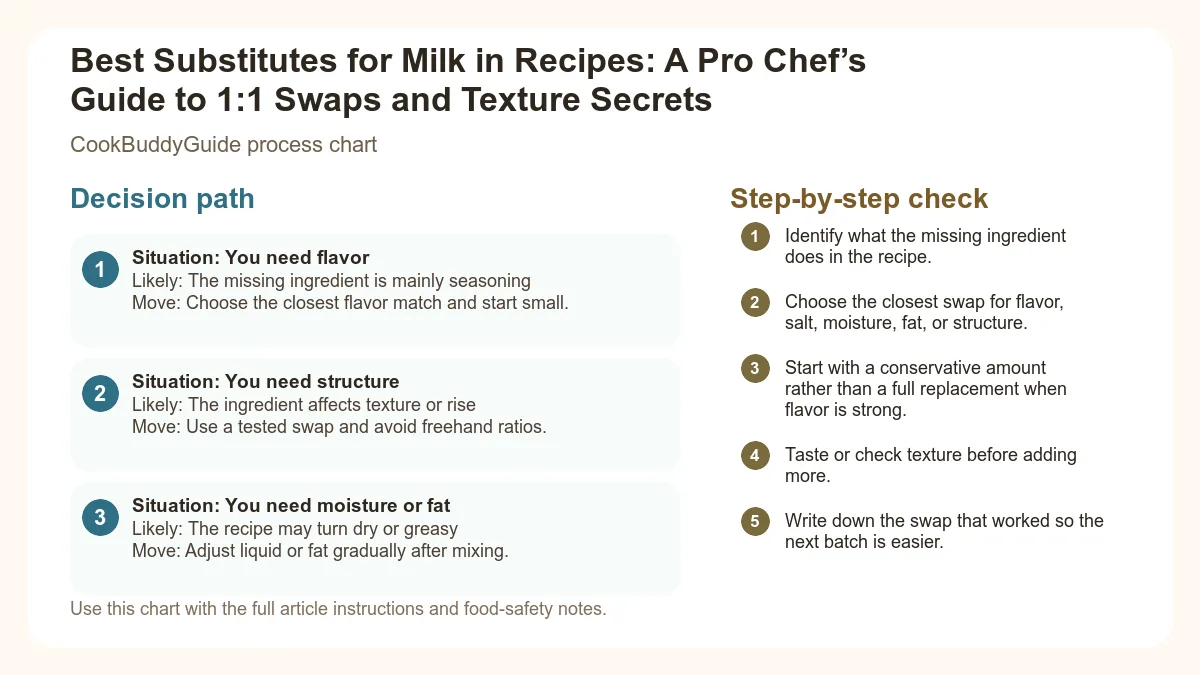
| You need flavor | The missing ingredient is mainly seasoning | Choose the closest flavor match and start small. |
| You need structure | The ingredient affects texture or rise | Use a practical swap and avoid freehand ratios. |
| You need moisture or fat | The recipe may turn dry or greasy | Adjust liquid or fat gradually after mixing. |
Step-by-step fix
- Identify what the missing ingredient does in the recipe.
- Choose the closest swap for flavor, salt, moisture, fat, or structure.
- Start with a conservative amount rather than a full replacement when flavor is strong.
- Taste or check texture before adding more.
- Write down the swap that worked so the next batch is easier.
Common mistakes
- Replacing a strong ingredient 1:1 before tasting.
- Choosing a flavor match when the recipe actually needs structure.
- Forgetting that salty swaps can change the whole dish.
- Adding extra liquid before the batter, dough, or sauce has time to hydrate.
Related topic hubs
You’re halfway through whisking your pancake batter or prepping a batch of Sunday morning muffins when you reach for the carton, only to find three lonely tablespoons of milk left. We’ve all been there. Whether you’re staring at an empty fridge, navigating a new lactose-free lifestyle, or cooking for a vegan friend, finding the right substitute for milk in recipes is about more than just replacing liquid volume. It’s about understanding the delicate balance of fat, protein, and sugar that makes dairy milk such a powerhouse in the kitchen.
Table of Contents
- The Science of Milk in Cooking and Baking
- The Master Milk Substitution Ratio Chart
- Oat Milk: The Best All-Rounder for Baking
- Almond Milk: The Light and Nutty Alternative
- Soy Milk: The High-Protein Powerhouse
- Coconut Milk: For Richness and Savory Depth
- Cashew Milk: The Secret to Dairy-Free Cream Sauces
- The Emergency Pantry Swap: Water and Butter
- Savory vs. Sweet: Choosing the Right Profile
- Troubleshooting: Why Your Substitute Might Fail
The Science of Milk in Cooking and Baking
To choose the right plant-based milk, we first have to understand what cow’s milk actually does. Milk isn't just "wetness." It is a complex emulsion of water, milk solids, proteins (casein and whey), and fats. In baking, these components perform three critical roles:
- The Maillard Reaction: This is the chemical reaction between amino acids and reducing sugars that gives bread its golden-brown crust and cookies their toasted flavor. Without the protein and lactose found in dairy, your baked goods may look pale and unappealing.
- Emulsification: The proteins in milk act as emulsifiers, helping to bond water and fats together. This creates a smooth, uniform crumb in cakes.
- Tenderizing: The fat content in whole milk weakens gluten strands, leading to a softer, more tender texture.
When you use a non-dairy milk, you are essentially trying to replicate these chemical reactions. According to the nutrient differences in milk alternatives outlined by the FDA, the protein and fat levels vary wildly. For example, almond milk has almost no protein, while soy milk is nearly identical to dairy in its protein structure. This is why baking chemistry matters—choosing the wrong swap can lead to structural collapse or a lack of browning.
The Master Milk Substitution Ratio Chart
| Substitute | Ratio | Best For... | Pro Tip |
|---|---|---|---|
| Oat Milk | 1:1 | Muffins, Lattes, Pancakes | Use "Barista" versions for more fat. |
| Soy Milk | 1:1 | Yeasted Breads, Cakes | Best for browning (Maillard reaction). |
| Almond Milk | 1:1 | Light Cakes, Smoothies | Add 1 tsp cornstarch for body. |
| Canned Coconut Milk | 1/2 cup + 1/2 cup water | Curries, Rich Desserts | Excellent substitute for heavy cream. |
| Water + Butter | 1 cup water + 1.5 tsp butter | Pie Crusts, Biscuits | Replicates fat content perfectly. |
Oat Milk: The Best All-Rounder for Baking
If I could only keep one vegan milk for cooking in my fridge, it would be oat milk. Why? Because of its unique starch profile. Unlike nut milks, which are mostly water and a few ground nuts, oat milk contains natural grain starches that provide a creamy texture without dairy.
Pro Tip: The Oat Milk "Fat" Hack
Oat milk is also a fantastic addition to your breakfast meal prep ideas, as it holds up well in overnight oats and chia puddings without separating or turning "chalky" after a few days in the fridge.
Almond Milk: The Light and Nutty Alternative
Unsweetened almond milk is perhaps the most common substitute for milk in recipes found in home kitchens today. However, it’s also the one most likely to cause "baking fails" if you aren't careful. Almond milk is very high in water and very low in protein and fat. If you use it in a recipe that relies on milk for structure (like a sponge cake), the result can be fragile or crumbly.
The "Sugar Trap"
Soy Milk: The High-Protein Powerhouse
When it comes to soy milk protein, this is the gold standard for milk replacement cooking. Soy milk is the only plant-based milk that naturally contains a similar amount of protein to cow’s milk (about 7-8 grams per cup). This protein is essential for the Maillard reaction.
If you are making yeasted breads, like cinnamon rolls or brioche, soy milk is your best friend. The proteins help the dough rise and provide the strength needed to hold onto those air bubbles. As noted in this resource on superior plant-based milk for baking, soy milk is the top choice for any recipe where browning and structure are the priorities.
DIY Dairy-Free Buttermilk
You can make a dairy-free buttermilk that actually curdles (which is what you want for leavening) using soy milk. Because of its high protein content, it reacts to acid just like dairy milk does.
- 1 cup unsweetened soy milk
- 1 tablespoon lemon juice or apple cider vinegar
Stir and let sit for 10 minutes. You’ll see the milk thicken and slightly curdle. This is the secret to the best dairy-free biscuits you’ve ever had.
Coconut Milk: For Richness and Savory Depth
When a recipe calls for whole milk but you want something even richer, full-fat coconut milk (the canned variety) is an incredible evaporated milk replacement or substitute for heavy cream. However, there is a massive difference between the coconut milk in a carton (found in the dairy aisle) and the coconut milk in a can (found in the international aisle).
- Carton Coconut Milk: Highly diluted with water. Good for cereal or smoothies, but too thin for most cooking.
- Canned Coconut Milk: Extremely high in fat (up to 20%). This is what you use for creamy one-pot pasta recipes or thick sauces.
In savory cooking, coconut milk adds a distinct tropical flavor. To mask this in non-tropical dishes, consider adding a splash of acidity (lime juice or vinegar) and extra salt. This helps balance the natural sweetness of the coconut. If you’re making a one-pot pasta, use half canned coconut milk and half vegetable broth for a decadently creamy sauce that isn't overwhelmingly coconut-heavy.
Cashew Milk: The Secret to Dairy-Free Cream Sauces
Cashew milk is the "chef's secret" for savory sauces. Why? Because cashews are naturally high in fats that undergo emulsification very easily. Unlike almond milk, which can separate or look "watery" when boiled, cashew milk stays creamy and smooth under high heat.
Quick 5-Minute Cashew Cream
If you have a high-speed blender, you don't even need to buy cashew milk. You can make a heavy cream substitute on demand.
- Add 1/2 cup raw cashews and 1 cup water to a blender.
- Blend on high for 60-90 seconds until completely smooth.
- Use this 1:1 as a substitute for heavy cream in soups, pastas, or gratins.
The Emergency Pantry Swap: Water and Butter
The Ratio: 1 cup water + 1.5 teaspoons melted butter = 1 cup whole milk.
In many cases, water is actually superior to milk. For example, in pie crusts, the proteins in milk can lead to a tougher crust. Using water and butter ensures maximum flakiness. Similarly, in some bread recipes, using water instead of milk results in a crispier, more "artisan" style crust because there are no milk sugars to soften the exterior during the Maillard reaction.
Savory vs. Sweet: Choosing the Right Profile
Choosing a substitute for milk in recipes requires a bit of flavor matching. You wouldn't put chocolate chips in your mashed potatoes, so why use a nutty milk in a delicate herb sauce?
For Savory Recipes (Mashed Potatoes, Soups, Gravy):
- Best: Unsweetened Soy, Cashew, or Water + Butter.
- Avoid: Almond (too nutty/thin) and Coconut (too sweet/tropical) unless specifically called for.
For Sweet Recipes (Cakes, Cookies, Custards):
- Best: Oat, Almond, or Coconut.
- Pro Tip: Almond milk pairs beautifully with chocolate and cherry flavors. Oat milk is the perfect partner for cinnamon, nutmeg, and brown sugar.
Troubleshooting: Why Your Substitute Might Fail
This usually happens due to "acid shock" or "heat shock." Plant milks are less stable than dairy. To prevent this, never pour cold plant milk into boiling liquid. Warm the milk slightly first, or remove the sauce from the heat before whisking the milk in. If it does curdle, a quick whiz with an immersion blender can often save the texture.
Oat milk contains starches that thicken when heated. If you boil it too long or whisk it too vigorously while hot, those starches can become slimy. For sauces, add oat milk at the very end and heat just until warmed through.
If you used almond milk, there isn't enough protein or sugar to trigger the Maillard reaction. Try brushing the tops of your unbaked goods with a little maple syrup or diluted agave nectar to encourage browning.
Conclusion: Finding Your House Favorite
Don't be afraid to mix and match! Sometimes a blend of half almond and half coconut milk provides the perfect balance of lightness and fat. The beauty of home cooking is that you can tailor these swaps to your own palate. Next time you're out of milk, don't panic—just reach for the oats, the nuts, or even just the butter and water. Your recipe is in good hands.
Happy cooking! For more kitchen tips and easy weeknight wins, check out our latest guides on CookBuddyGuide.com.