Quick Answer
The right substitute for dijon mustard depends on what that ingredient contributes: flavor, salt, acidity, fat, moisture, or structure. Use the comparison below to choose the closest match and adjust the amount for your recipe.
Practical note
For dijon mustard recipes substitutes, we judge swaps by job first: flavor, salt, acid, fat, moisture, or structure. That keeps a substitution from fixing one problem while creating another.
Decision table
| Situation | Likely cause or meaning | Best move |
|---|---|---|
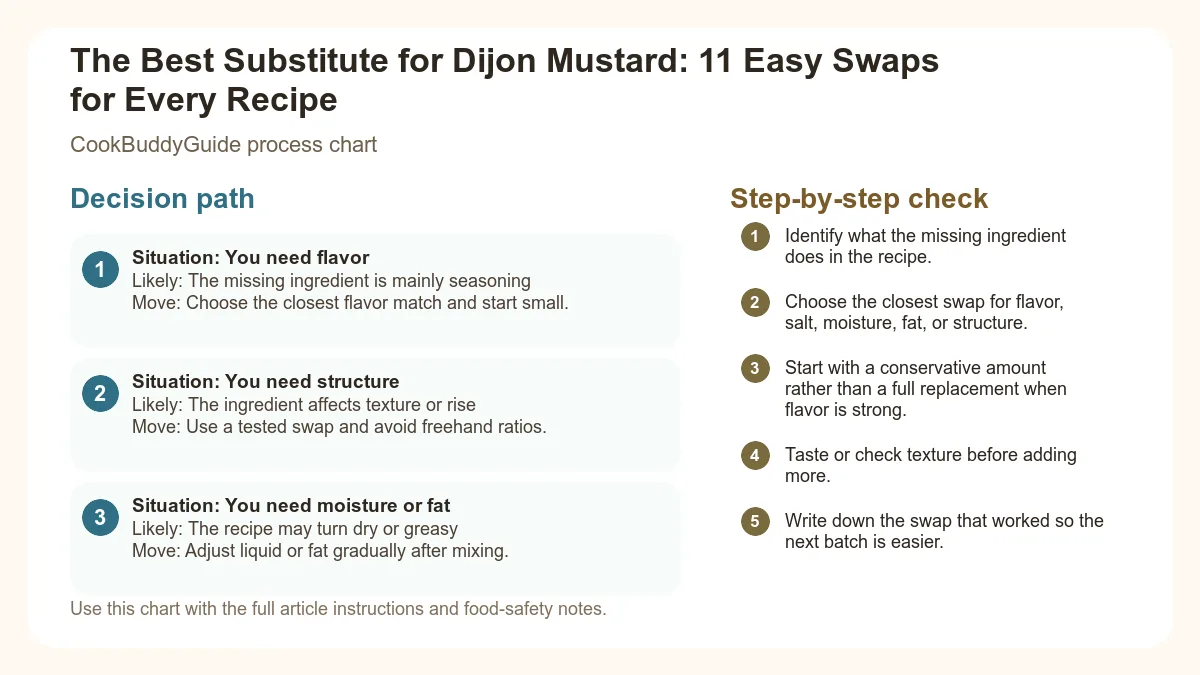
| You need flavor | The missing ingredient is mainly seasoning | Choose the closest flavor match and start small. |
| You need structure | The ingredient affects texture or rise | Use a practical swap and avoid freehand ratios. |
| You need moisture or fat | The recipe may turn dry or greasy | Adjust liquid or fat gradually after mixing. |
Step-by-step fix
- Identify what the missing ingredient does in the recipe.
- Choose the closest swap for flavor, salt, moisture, fat, or structure.
- Start with a conservative amount rather than a full replacement when flavor is strong.
- Taste or check texture before adding more.
- Write down the swap that worked so the next batch is easier.
Common mistakes
- Replacing a strong ingredient 1:1 before tasting.
- Choosing a flavor match when the recipe actually needs structure.
- Forgetting that salty swaps can change the whole dish.
- Adding extra liquid before the batter, dough, or sauce has time to hydrate.
Related topic hubs
- Understanding the Dijon Profile: Why It’s a Kitchen Essential
- The #1 Best Substitute: Spicy Brown Mustard
- The Yellow Mustard "Acid Hack"
- The Dry Mustard Powder Method (DIY Professional)
- High-Heat Substitutes: Horseradish and Wasabi
- Whole Grain Mustard: Texture vs. Smoothness
- The Best Substitutes for Vinaigrettes and Dressings
- Marinades and Glazes: Replacements That Hold Up to Heat
- The Science of Emulsification: Why Dijon is Hard to Replace
- Common Mistakes When Swapping Mustard
- Frequently Asked Questions
Understanding the Dijon Profile: Why It’s a Kitchen Essential
Before we dive into the condiment swap options, we have to understand what we are trying to replicate. Dijon mustard originated in the town of Dijon, France. Historically, it was made with the juice of unripe grapes, known as verjuice, rather than vinegar. This gave it a smoother, more complex acidity than the harsh "bite" of standard white vinegar used in American yellow mustard.The Role of Verjuice and White Wine
In modern commercial production, most Dijon replaces verjuice with white wine vinegar or actual white wine. This is a crucial detail. When you're looking for a culinary alternative, you aren't just looking for heat; you're looking for that sophisticated, wine-based acidity. To understand the nuances of these ingredients, it's helpful to look at what makes Dijon mustard unique, as the specific fermentation process dictates its final flavor.The Science of the "Dijon Kick"
The pungent heat of Dijon comes from the mustard seed itself—specifically the Brassica nigra (black mustard) or Brassica juncea (brown mustard) seeds. These seeds contain compounds called glucosinolates. When the seeds are crushed and mixed with a cold liquid, an enzyme called myrosinase breaks down the glucosinolates into sinigrin, which creates that famous sinus-clearing heat.The #1 Best Substitute for Dijon Mustard: Spicy Brown Mustard
Why Texture and Heat Match Perfectly
Spicy brown mustard is made from the same Brassica juncea seeds used in Dijon. Because the seeds are processed less finely, it retains a slightly coarser texture, but the flavor profile is remarkably similar. It possesses the same deep, earthy heat and lacks the heavy turmeric flavor found in yellow mustard.The Best Ratio for Swapping
Substitution Guide: Spicy Brown for Dijon
Ratio: 1:1 (1 tablespoon Spicy Brown = 1 tablespoon Dijon)
Best for: Sandwiches, heavy meat marinades, and thick sauces like Remoulade.
Pro Tip: If your recipe requires a perfectly smooth texture (like a refined French sauce), you can pass the spicy brown mustard through a fine-mesh sieve to remove the larger seed casings.
Turning Yellow Mustard into a Worthy Dijon Mustard Replacement
Yellow mustard is a kitchen staple, but it is often too mild and too vinegary to stand in for Dijon directly. Yellow mustard uses white mustard seeds (Sinapis alba), which are significantly less potent than the brown or black seeds used in Dijon. However, with a few tweaks, you can bridge the gap.The "Acid Hack" for Yellow Mustard
To make yellow mustard behave like Dijon, you need to address two things: the acidity and the heat. Yellow mustard is very high in distilled vinegar. To mimic the "winey" depth of Dijon, consider adding a splash of white wine vinegar or even a dry white wine. To fix the heat, a pinch of cayenne pepper or a tiny bit of prepared horseradish does wonders.When to Avoid Yellow Mustard Swaps
The Dry Mustard Powder Method: A DIY Professional Approach
If you have mustard flour (dry mustard powder), you can mix a small batch of Dijon mustard substitute when a recipe needs that specific pungent heat.Creating a Mustard Paste from Scratch
Dry mustard is dormant. The heat only develops when the powder is hydrated. By controlling the liquid you add, you can actually create a "Dijon" that is better than some store-bought brands.The 10-Minute DIY Dijon Recipe
- 1 teaspoon dry mustard powder
- 1 teaspoon cold water
- 1/2 teaspoon white wine vinegar (or lemon juice)
- A tiny pinch of salt and sugar
Instructions: Whisk the ingredients together into a smooth paste. Crucial Step: Let the mixture sit for exactly 10 minutes. This allows the sinigrin to fully develop. If you use it immediately, it will taste bitter and flat.
High-Heat Substitutes: Using Horseradish or Wasabi
Sometimes, you don't need the mustard flavor as much as you need the "burn." If your recipe uses Dijon to provide a back-of-the-throat kick, horseradish or wasabi are excellent culinary alternative choices.The Horseradish Ratio for Creamy Sauces
Wasabi: The Secret Ingredient for Asian-Fusion Dressings
Wasabi (even the paste form, which is often just dyed horseradish) is much stronger than Dijon. If a recipe calls for 1 tablespoon of Dijon, start with only 1/4 teaspoon of wasabi. It works beautifully in ginger-soy vinaigrettes where a traditional mustard might feel out of place. For more on heat levels, check this guide to different mustard types.Whole Grain Mustard: When Texture Matters More Than Smoothness
Whole grain mustard is essentially Dijon before it has been ground smooth. It contains the same acidity balance and heat, but the seeds are left intact.Best Uses in Roasts and Sandwiches
The Emulsification Trade-off
The Best Substitutes for Dijon Mustard in Vinaigrettes and Dressings
In a salad dressing, Dijon serves two purposes: flavor and emulsification. If you are out of mustard entirely, you have to find another way to keep the oil and vinegar from separating.Maintaining the Emulsion Without Mustard
Egg Yolks and Lecithin
For a more traditional French approach, a raw egg yolk (if you are comfortable with it) is the ultimate emulsifier. It contains lecithin, which binds the fats and liquids perfectly. If you want to stay vegan, a small amount of tahini or even a teaspoon of honey can help stabilize the mixture. For more ideas on quick dressings, see my quick chicken breast recipes which often feature these condiment swap techniques.Marinades and Glazes: Which Replacements Hold Up to Heat?
When you cook mustard, its flavor changes. The high heat of a grill or oven mellows the pungent heat and brings out the sweetness.The Honey Mustard Swap for Chicken and Pork
If you have a pre-mixed honey mustard in the fridge, it can work as a substitute for dijon mustard in glazes. However, you must adjust the other sweeteners in your recipe. If the recipe calls for Dijon and honey separately, and you use honey mustard, skip the extra honey entirely!Using Worcestershire Sauce for Depth
In beef marinades, Dijon is often used to provide umami and acidity. A great dijon mustard replacement in this context is a combination of Worcestershire sauce and a splash of lemon juice. It provides that savory complexity that mimics the fermented depth of a good Dijon. For more pantry-friendly swaps, refer to this list of common Dijon mustard alternatives.The Science of Emulsification: Why Dijon is Hard to Replace
To be a truly expert home cook, you have to understand why ingredients behave the way they do. Dijon is a powerhouse because of mucilage. This is a thick, gluey substance produced by the mustard seed coat when it's ground and hydrated.Mucilage and Mustard Seeds
When you whisk Dijon into oil and vinegar, the mucilage acts as a bridge, holding the tiny droplets of oil in suspension within the vinegar. This is why a Dijon vinaigrette stays creamy for hours, while a simple oil-and-vinegar mix separates in minutes.How to Fix a Broken Dressing
If your substitute for dijon mustard (like yellow mustard or dry powder) isn't holding the emulsion, don't panic.- Transfer the separated dressing to a jar.
- Add 1/2 teaspoon of honey or a tiny dab of mayo.
- Shake vigorously for 30 seconds.
Common Mistakes When Swapping Mustard in Recipes
1. Overpowering with Vinegar
Many substitutes, especially yellow mustard and certain stone-ground mustard brands, have a much higher vinegar-to-seed ratio than Dijon. If you use them 1:1, your dish might end up unpleasantly sour. Always taste your substitute first; if it makes your eyes water from the vinegar fumes, reduce the other acids (like lemon juice or vinegar) in your recipe.2. Ignoring the Salt Content
Dijon is surprisingly salty. Some culinary alternative options, like dry mustard powder, have zero salt. If you use the powder method, you must add a pinch of salt to match the flavor profile of the original recipe. Conversely, if you use a "deli-style" mustard, it might be saltier than Dijon, so hold back on the seasoning until the end.3. Forgetting the "Bloom" Time
Frequently Asked Questions
Yes, but only in marinades or glazes. It is too sweet for vinaigrettes or savory sauces like Hollandaise. If you use it, reduce the other sugars in your recipe by at least 50%.
No. Ground mustard is the dry, powdered form of the seed. To make it a substitute for dijon mustard, you must mix it with liquid (water and vinegar) and let it sit for 10 minutes to develop its flavor.
A mix of yellow mustard, a pinch of cayenne, and a teaspoon of tahini works wonders. The tahini provides the creamy consistency and emulsification that Dijon usually offers.