Quick Answer
This guide explains how to make food last longer in fridge. It also covers pro food storage tips to reduce waste, save money, and keep ingredients fresh.
Practical note
For How to Make Food Last Longer in Fridge, the home-kitchen check is not only the number of days. We look at the start date, fridge temperature, container seal, serving time, and spoilage signs. If one of those facts is missing, the safer move is to use the shorter window.
Decision table
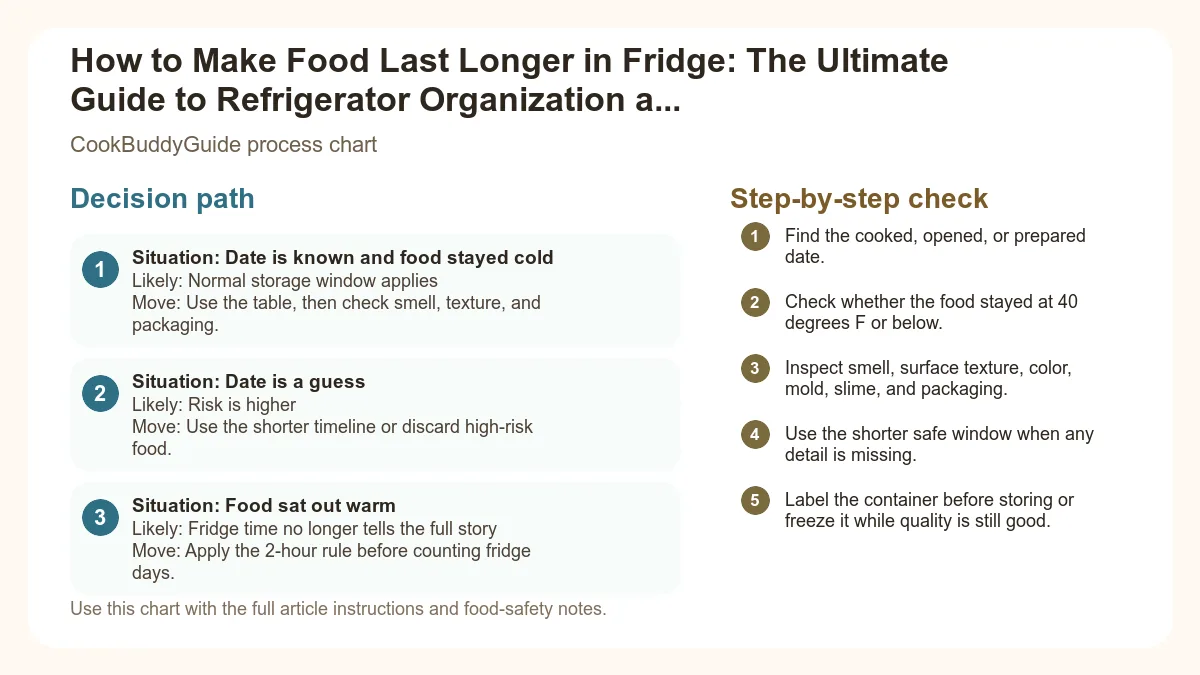
| Situation | Likely cause or meaning | Best move |
|---|---|---|
| Date is known and food stayed cold | Normal storage window applies | Use the table, then check smell, texture, and packaging. |
| Date is a guess | Risk is higher | Use the shorter timeline or discard high-risk food. |
| Food sat out warm | Fridge time no longer tells the full story | Apply the 2-hour rule before counting fridge days. |
Step-by-step fix
- Find the cooked, opened, or prepared date.
- Check whether the food stayed at 40 degrees F or below.
- Inspect smell, surface texture, color, mold, slime, and packaging.
- Use the shorter safe window when any detail is missing.
- Label the container before storing or freeze it while quality is still good.
Common mistakes
- Counting fridge days from the day you noticed the container instead of the day it was made.
- Ignoring time spent on the counter, in a lunch bag, or on a serving table.
- Trusting smell alone when the date or temperature history is unknown.
- Putting warm food into a deep container that cools slowly.
Related topic hubs
Table of Contents
- The Science of Freshness: Why Food Spoils
- Mastering Your Fridge Zones: Where Everything Belongs
- Produce Storage: Keeping Fruits and Vegetables Crisp
- Meat, Poultry, and Seafood: Safety and Longevity
- Dairy and Eggs: Maintaining Quality
- Leftovers and Prepared Meals: The 4-Day Rule
- The "Never Together" List: Incompatible Foods
- The Weekly Fridge Audit Routine
- Frequently Asked Questions
The Science of Freshness: Why Food Spoils in the Refrigerator
Temperature Fluctuations and Bacteria Growth
The Role of Humidity in Produce Longevity
Ethylene Gas: The Silent Ripener
Many fruits, like apples and bananas, emit ethylene gas as they ripen. This gas acts as a ripening hormone. If you store ethylene-sensitive foods (like broccoli or leafy greens) next to high-producers, the greens will yellow and decay prematurely. Understanding this chemical interaction is the "secret sauce" of food waste reduction.
Mastering Your Fridge Zones: Where Everything Actually Belongs
Your refrigerator is not a uniform box of cold air. Because of how air circulates, there are distinct temperature zones that dictate where specific items should live for maximum longevity. Proper how to organize your fridge strategies can prevent your meal prep storage from becoming a safety hazard.
The Upper Shelves: Deli, Drinks, and Ready-to-Eat
The upper shelves have the most consistent temperature. This is the place for "ready-to-eat" foods that don't require cooking to be safe. I store my deli meats, hummus, leftovers, and drinks here. Since heat rises, this area is slightly warmer than the bottom, but it is perfect for items that don't have a high risk of spoilage.
The Lower Shelves: The Coldest Zone for Meat and Dairy
As you move down, the temperature drops. The very bottom shelf is usually the coldest part of the fridge. This is the only place I store raw meat, poultry, and fish. Not only is it the coldest, but placing raw proteins here prevents cross-contamination. If a package of chicken leaks, it won't drip onto your fresh strawberries below.
The Refrigerator Door: Why It’s Not for Milk
Crisper Drawers: High vs. Low Humidity Settings
- High Humidity (Closed Vent): Best for things that wilt, like leafy greens, carrots, and broccoli. The closed vent traps moisture inside.
- Low Humidity (Open Vent): Best for things that rot, like apples, pears, and stone fruits. The open vent allows ethylene gas to escape.
Produce Storage: Keeping Fruits and Vegetables Crisp
Cucumbers need a more specific balance because very cold storage can damage their texture. Use our whole, cut, and sliced cucumber storage guide for the best fridge location, wrapping method, and spoilage checks.
The "Berry Spa Day" Method
Berries are notorious for molding within 48 hours. This vinegar wash kills mold spores and keeps them fresh for over a week.
- Prepare a bowl with 3 cups of cold water and 1 cup of white vinegar.
- Submerge berries (strawberries, blueberries, raspberries) for 2 minutes.
- Rinse thoroughly with cold water to remove the vinegar scent.
- Crucial Step: Dry the berries completely. I line a salad spinner with paper towels and spin them gently, then let them air dry on a clean towel for 30 minutes.
- Store in a glass container lined with a dry paper towel, leaving the lid slightly ajar for airflow.
Leafy Greens: The Paper Towel Trick
Extending the Life of Herbs: The Bouquet Method
Soft herbs like cilantro and parsley should be treated like fresh flowers. Trim the bottoms of the stems and place them in a glass jar with an inch of water. Cover the tops loosely with a plastic bag and secure it with a rubber band. This keeps them hydrated without suffocating them. Hard herbs like rosemary and thyme, however, prefer to be wrapped in a damp paper towel and tucked into a sealed bag.
Meat, Poultry, and Seafood: Safety and Longevity
When dealing with raw proteins, the stakes are higher. We aren't just worried about flavor; we are worried about FDA guidelines and foodborne illness. Consider using a refrigerator and freezer storage chart to track exactly how long meat is safe.
The Bottom Shelf Rule and Secondary Trays
Original Packaging vs. Vacuum Sealing
If you plan to cook the meat within 48 hours, the original grocery store packaging is fine. However, if you are doing meal prep storage for later in the week, consider vacuum sealing. Removing the oxygen prevents oxidation (which turns beef gray) and significantly slows bacterial growth. If you don't have a vacuum sealer, wrap the meat tightly in plastic wrap, then a layer of foil to create a pseudo-airtight barrier.
The FIFO Method
Dairy and Eggs: Maintaining Creaminess and Quality
Dairy is highly sensitive to light and temperature swings. To keep your morning latte tasting fresh, placement is everything.
Why Eggs Should Stay in Their Original Carton
It is tempting to use those cute built-in egg trays many fridges come with. Don't. Eggshells are porous and easily absorb odors from the fridge (like that half-cut onion). The original carton is designed to protect the eggs from physical damage and odor absorption. Keep them on a middle shelf, not the door.
Keeping Cheese Fresh: Ditch the Plastic Wrap
The "Sweet Spot" for Milk and Yogurt
Leftovers and Prepared Meals: The 4-Day Rule
The 2-Hour Window
Bacteria can double in number every 20 minutes at room temperature. You must get your leftovers into the fridge within 2 hours of cooking (or 1 hour if it’s a hot summer day). To speed up cooling, Use shallow glass containers. Large, deep pots trap heat in the center, keeping the food in the "Danger Zone" for too long even after it's in the fridge.
The "Eat Me First" Bin Strategy
- The Goal: Reduce food waste by highlighting items that need to be eaten within 24 hours.
- What goes inside: The last serving of lasagna, the half-used avocado, or the yogurt that expires tomorrow.
- The Result: When someone is looking for a snack or a quick lunch, they check the bin first, ensuring nothing gets lost at the back of the shelf.
Labeling and Dating
The "Never Together" List: Incompatible Foods
Sometimes, the reason your food is spoiling has nothing to do with temperature and everything to do with "bad neighbors." Here are the pairings Avoid at all costs:
- Apples and Leafy Greens: Apples are high ethylene producers; they will turn your kale yellow and bitter in 48 hours.
- Onions and Potatoes: Even though many people store these in a pantry, if you keep them in the fridge, the onions will cause the potatoes to sprout.
- Tomatoes and... Anything: Honestly, keep tomatoes out of the fridge entirely. The cold temperature breaks down their cellular structure, making them mealy and flavorless.
The Weekly Fridge Audit: A 10-Minute Routine to Reduce Waste
The most effective way to ensure you are following all these food storage tips is to perform a weekly "Sunday Reset." This 10-minute habit has saved me hundreds of dollars over the years.
The Sunday Reset Steps:
- Clear the Decks: Take everything out of the fridge. This sounds daunting, but it only takes 2 minutes.
- Wipe and Sanitize: Use a mixture of water and vinegar to wipe down the shelves. This prevents bacterial growth from spills you might not have noticed.
- Check the Seals: Inspect your fridge gasket (the rubber seal around the door). If it’s cracked or loose, cold air is escaping, and your cold chain is broken. A quick way to test is the "dollar bill trick": close the door on a dollar bill; if it pulls out easily, your seal is weak.
- Inventory Management: Look at what you have left before you go grocery shopping. This prevents you from buying a third jar of mayonnaise when you already have two hidden in the back.
- The "First In, First Out" Check: Move the older items to the front and the "Eat Me First" bin.
Frequently Asked Questions
A: For most vegetables, glass containers with an airtight seal are superior because they don't leach chemicals and they maintain a more consistent temperature. However, for greens, a breathable silicone bag with a paper towel is often better to manage moisture.
A: Trust your senses over the label. If the meat is slimy to the touch, has a sour or ammonia-like smell, or has turned a distinct grayish-green hue, toss it. When in doubt, throw it out.
A: Not exactly. "Use By" is usually the manufacturer's recommendation for peak quality. "Expiration" or "Safety" dates are more critical. However, for perishable goods like infant formula, these dates are strictly regulated by FDA guidelines.
Conclusion: Your Path to a Waste-Free Kitchen
Learning how to make food last longer in fridge is a journey of small, intentional habits. It starts with a thermometer and ends with a weekly audit. When you treat your refrigerator like a precision tool rather than a storage closet, you'll find that your vegetables stay crisp, your meats stay safe, and your grocery bill shrinks.
Start today: move your milk off the door, put a paper towel in your spinach container, and set a 10-minute timer for your first Sunday Reset. Your future self (and your wallet) will thank you. For more ways to streamline your kitchen, check out our guides on meal prep storage and time-saving recipes here at CookBuddyGuide.com. Happy cooking!