Quick Answer
This guide explains the science behind the slump and discover how to fix sinking cake with practical baking troubleshooting guide.
Practical note
For your cake sinking, the most useful home checks are temperature, measuring, resting time, and visible texture. Those details tell you more than guessing, especially before adding extra flour, liquid, heat, or leavening.
Decision table
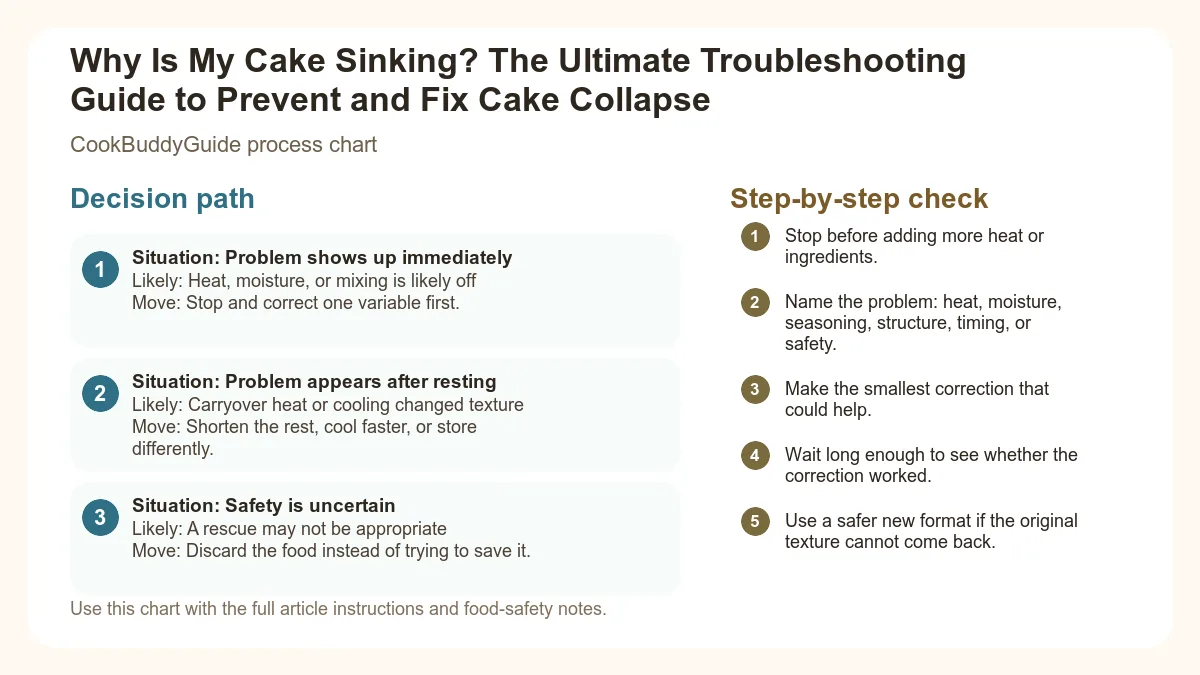
| Situation | Likely cause or meaning | Best move |
|---|---|---|
| Problem shows up immediately | Heat, moisture, or mixing is likely off | Stop and correct one variable first. |
| Problem appears after resting | Carryover heat or cooling changed texture | Shorten the rest, cool faster, or store differently. |
| Safety is uncertain | A rescue may not be appropriate | Discard the food instead of trying to save it. |
Step-by-step fix
- Stop before adding more heat or ingredients.
- Name the problem: heat, moisture, seasoning, structure, timing, or safety.
- Make the smallest correction that could help.
- Wait long enough to see whether the correction worked.
- Use a safer new format if the original texture cannot come back.
Common mistakes
- Adding several fixes at once and losing track of what helped.
- Using high heat to rush a texture problem.
- Trying to rescue food when safety is uncertain.
- Repeating the recipe without writing down the likely cause.
Related topic hubs
The Heartbreak of the Sunken Cake: Why It Happens to Everyone
You’ve spent the last hour meticulously measuring flour, creaming butter until it’s the color of pale primroses, and folding in eggs one by one. The kitchen smells like a vanilla-scented dream. But as you peek through the oven glass, your heart drops. That glorious, domed center is starting to dip. By the time you pull the tin out and set it on the cooling rack, the middle has completely cratered. You’re left staring at a sugary canyon, asking yourself the age-old baker’s question: why is my cake sinking?
A cake is essentially a temporary foam that becomes a permanent solid. To achieve this, you need three pillars: the expansion of carbon dioxide bubbles (leavening), the coagulation of proteins (structure), and the gelatinization of starches (body). When one of these pillars fails, the structural integrity of the cake collapses. This guide will walk you through the science of "the slump" and provide you with practical strategies for prevention and recovery.
Table of Contents
- Reason 1: Opening the Oven Door Too Early
- Reason 2: Too Much Leavening Agent
- Reason 3: Underbaking and the 'False Finish'
- Reason 4: Overmixing the Batter
- Reason 5: Incorrect Oven Temperature
- Reason 6: Too Much Liquid or Fat
- How to Fix Sinking Cake: Creative Rescue Missions
- A Practical Prevention Checklist
Reason 1: Opening the Oven Door Too Early
The Science of Thermal Shock
Early in the baking process, the carbon dioxide bubbles created by your leavening agents are fragile. They are held up by the pressure of the hot air inside them. If a rush of cool air enters the oven, those bubbles contract before the surrounding walls of flour and egg have had a chance to set (coagulate). Once those bubbles pop or shrink, they cannot be re-inflated. The result? A sunken cake center that no amount of extra baking can fix.
The 'Peek-a-Boo' Mistake
According to research on common reasons for sinking cakes, the most critical window is the first 75% of the baking time. If the recipe says 30 minutes, do not even think about touching that handle until at least 22 minutes have passed.
Pro-Tip: The "Light-Only" Rule
Reason 2: Too Much Leavening Agent (Baking Powder/Soda)
The 'Rise and Fall' Chemical Reaction
It’s a common misconception that more leavening equals a fluffier cake. In reality, baking is a game of precise ratios. When discussing baking powder vs baking soda, we are looking at chemicals designed to produce gas. If you add too much, you create too much gas, too quickly.
The carbon dioxide bubbles grow so large and so fast that they merge into giant "mega-bubbles." These bubbles become too heavy for the weak, developing crumb structure to support. Eventually, they burst—much like a balloon that’s been over-inflated—and the cake collapses in on itself. This is a primary reason why is my cake sinking even if you followed the temperature instructions perfectly.
Measuring Mistakes: Volume vs. Weight
- Baking Powder: Contains both an acid and a base; reacts with heat and moisture.
- Baking Soda: Requires an acid (like buttermilk or cocoa) to react.
- The Golden Ratio: Generally, use 1 to 1.25 teaspoons of baking powder for every cup of flour.
Reason 3: Underbaking and the 'False Finish'
Why the Center is the Last to Set
Heat travels from the outside in. The edges of your cake are supported by the metal of the pan, which conducts heat rapidly. The center, however, relies on the slow migration of heat through the batter. If you pull the cake out when the edges are firm but the center is still "wobbly," the structural integrity isn't there. As the cake cools, the steam inside the center condenses back into water, and without a solid protein structure to hold it up, the middle drops.
Testing for Doneness Beyond the Toothpick
The traditional toothpick test is iconic, but it can be misleading. A toothpick might come out clean even if the internal temperature hasn't reached the point of coagulation of proteins. This is what science of cake structure failure often points to as the "False Finish."
The Three-Step Doneness Check
- The Visual: The cake should be pulling away slightly from the sides of the pan.
- The Touch: Gently press the center with your finger. It should spring back immediately. If your fingerprint stays, it needs 5 more minutes.
- The Temp: Use an instant-read thermometer. Most butter cakes (sponges) are perfectly "set" at an internal temperature of 205°F to 210°F (96°C to 99°C).
Reason 4: Overmixing the Batter
Gluten Development vs. Air Incorporation
When you mix flour with liquid, you start developing gluten. In bread, we want lots of gluten for that chewy bite. In cake, we want very little. Overbeating batter creates a web of gluten that is too strong and elastic. While the cake is in the oven, this elastic web traps air and expands beautifully. However, once the heat is removed, that "rubbery" structure contracts forcefully, squeezing the air out and causing a cake collapse.
The 'Folding' Technique
According to the essential cake baking science tips, overmixing also destroys the delicate air bubbles you worked so hard to create during the creaming stage, leading to a dense, heavy cake that can't support its own weight.
Reason 5: Incorrect Oven Temperature
The Danger of the 'Hot Oven' Illusion
Conversely, if the oven is too cool, the leavening agents will spend their energy before the proteins can set, leading to a flat, dense cake that never quite makes it to the finish line.
The Necessity of an External Oven Thermometer
Reason 6: Too Much Liquid or Fat
The Ratio of Wet to Dry Ingredients
A cake needs a balance between "tougheners" (flour and egg whites) and "tenderizers" (sugar, fat, and egg yolks). If you have too much liquid—perhaps you used extra-large eggs when the recipe called for large, or you didn't drain your crushed pineapple—the batter becomes too heavy. The steam produced by the excess moisture creates large pockets that the gluten development can't sustain.
High Altitude Adjustments
If you live 3,000 feet or more above sea level, why is my cake sinking becomes a question of atmospheric pressure. Air pressure is lower at high altitudes, meaning cakes rise faster and moisture evaporates more quickly. You’ll often need to slightly increase your flour or liquid and decrease your leavening to prevent a collapse. Precision is key here; even a slight deviation can ruin the structural integrity.
The "Room Temp" Mandate
How to Fix Sinking Cake: Creative Rescue Missions
So, the damage is done. You have a cake with a crater. Before you throw it in the bin, remember that a sunken cake usually tastes just as good as a perfect one. Here is how to fix sinking cake with a bit of professional flair.
The 'Fill the Crater' Strategy
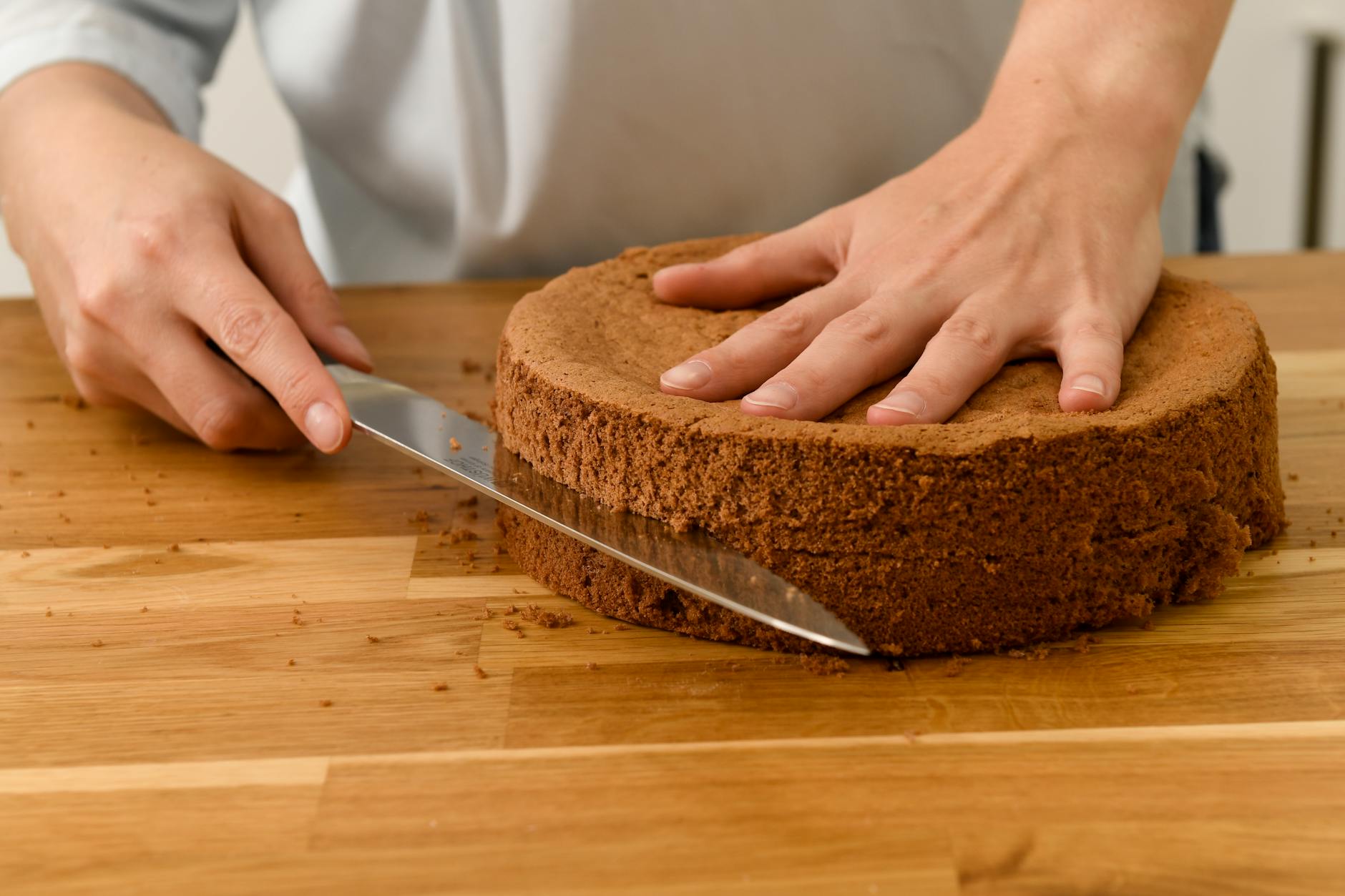
The easiest way to hide a sinkhole is to turn it into a feature. If you're looking for how to fix sinking cake, the "fill and chill" method is a classic. Use a serrated knife to level off the very top of the cake if the edges are too high. Then, fill the center with:
- Fresh Berries and Whipped Cream: Creates a beautiful, rustic look.
- Chocolate Ganache: A thick ganache will set firm and hide any structural flaws.
- Pastry Cream: Turn your mistake into a "Boston Cream" style surprise.
Transforming a Disaster into a Delicacy
A Practical Prevention Checklist for Your Next Bake
The "No-Sink" Checklist
- Check Expiration: Baking powder loses its "oomph" after 6 months. Test it by dropping a teaspoon into hot water; if it doesn't fizz vigorously, toss it.
- Calibrate: Use your oven thermometer to ensure you are baking at the true temperature.
- Measure by Weight: Use a kitchen scale for flour (120g per cup) and sugar.
- Prep the Pan: Use the exact pan size called for. A batter spread too thin in a large pan will over-expand and collapse.
- Room Temp: Ensure butter, eggs, and liquids are all at room temperature to maintain a stable emulsion.
- Cool Properly: Leave the cake in the pan for exactly 10 minutes before moving it to a cooling rack. Moving it too soon can cause the warm structure to tear.
Final Thoughts on Baking Success
Baking is a science, but it's also a practice. Even with careful planning, I still have the occasional sunken cake center. The key is not to panic but to analyze. Was the butter too cold? Did I get distracted and overbeat the eggs? Once you identify the "why," you can master the "how."
If you're looking to upgrade your baking environment to match your growing skills, you might want to check out our guide on 2026 Kitchen Design Trends, which features the latest in precision steam ovens and built-in cooling stations. Until then, keep your oven door closed, your ingredients at room temperature, and your confidence high. Happy baking!
Frequently Asked Questions
A: Generally, no. Once the cake has cooled and the air bubbles have collapsed, reheating it won't bring the rise back. It will only dry out the edges. It's better to repurpose it or fill the center.
A: This is almost always due to underbaking. The structure was held up by hot steam, but once it hit the cool air, the steam turned to water and the unset proteins couldn't hold the weight.
A: Yes! Cake flour has less protein than all-purpose flour, leading to a more delicate crumb structure. If you swap them without adjusting the recipe, you may experience structural failure.