Quick Answer
Rice can be reheated safely when it was cooled quickly, refrigerated promptly, and kept cold before reheating. Heat it until steaming throughout, and discard rice that sat at room temperature for more than two hours or has an uncertain storage history.
Practical note
For Is It Safe to Reheat Rice? Guide to Preventing Food Poisoning and Perfect Leftovers, this guide centers on Emetic (Vomiting) Toxin, Diarrheal Toxin, Spread it out. Those are the checkpoints we would use first in a normal home kitchen before making a bigger change.
Decision table
| Situation | Likely cause or meaning | Best move |
|---|---|---|
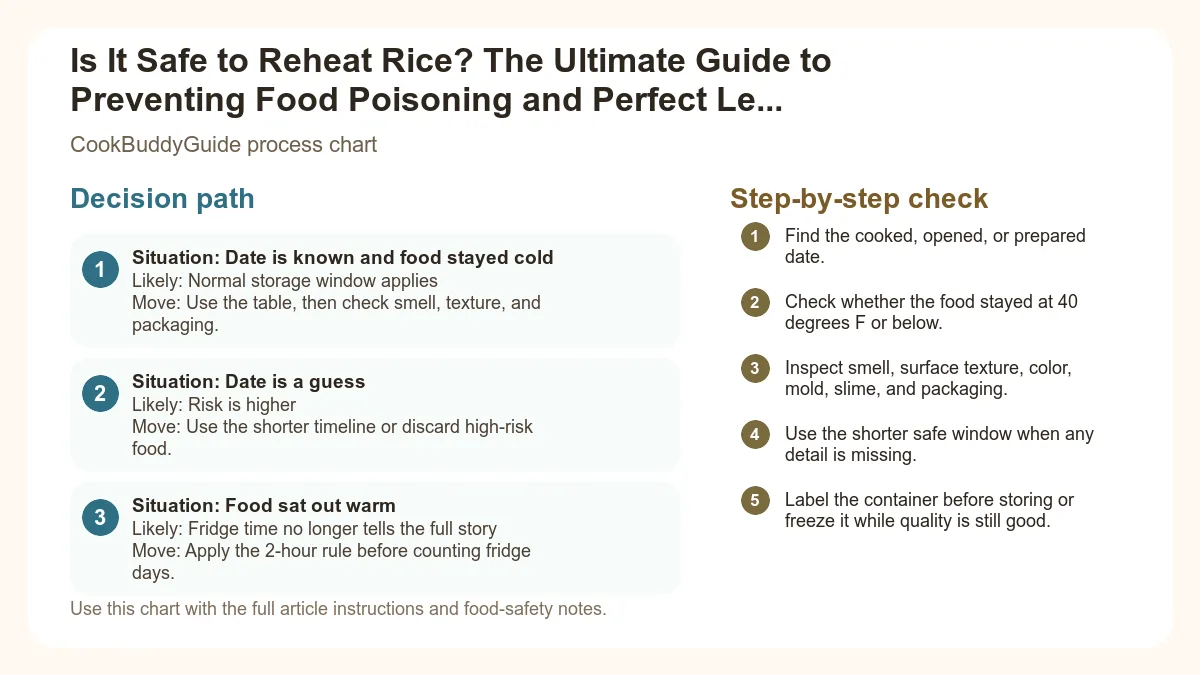
| Date is known and food stayed cold | Normal storage window applies | Use the table, then check smell, texture, and packaging. |
| Date is a guess | Risk is higher | Use the shorter timeline or discard high-risk food. |
| Food sat out warm | Fridge time no longer tells the full story | Apply the 2-hour rule before counting fridge days. |
Step-by-step fix
- Find the cooked, opened, or prepared date.
- Check whether the food stayed at 40 degrees F or below.
- Inspect smell, surface texture, color, mold, slime, and packaging.
- Use the shorter safe window when any detail is missing.
- Label the container before storing or freeze it while quality is still good.
Common mistakes
- Counting fridge days from the day you noticed the container instead of the day it was made.
- Ignoring time spent on the counter, in a lunch bag, or on a serving table.
- Trusting smell alone when the date or temperature history is unknown.
- Putting warm food into a deep container that cools slowly.
Related topic hubs
Table of Contents
The Science of Bacillus Cereus: Why Rice is Different
Most home cooks assume that if you cook food thoroughly, you kill all the bacteria. While that’s true for many pathogens, rice plays by its own rules. The primary culprit behind rice-related illness is Bacillus cereus, a type of bacteria that produces toxins.
Spore-Forming Bacteria: Why Boiling Isn't Enough
The Danger Zone: 40°F to 140°F
The USDA Food Safety and Inspection Service defines the "Danger Zone" as the temperature range between 40°F and 140°F. This is the sweet spot where bacteria thrive. When rice sits in a warm rice cooker on the "keep warm" setting for six hours, or sits on the counter while you finish a movie, you are essentially inviting "fried rice syndrome" into your kitchen.
There are actually two types of Bacillus cereus illness:
- Emetic (Vomiting) Toxin: Often linked to starchy foods like rice, where the toxin is produced in the food itself before you eat it. Symptoms usually start within 1 to 5 hours.
- Diarrheal Toxin: Produced in the intestines after eating contaminated food. Symptoms usually appear 6 to 15 hours later.
The Golden Hour: Proper Cooling and Storage
The 60-Minute Rule
According to food safety guidelines, you should aim to cool rice within one hour of cooking. Once the steam has stopped billowing off the rice, it needs to be moved toward refrigeration. Never leave rice out overnight; if it has been at room temperature for more than two hours (or one hour on a hot day), it should be discarded immediately.
Speed-Cooling Techniques for Busy Cooks
If you are doing heavy meal prep safety, you don't have time to wait for a gallon of rice to cool naturally. Here is my "Flash-Cool" method:
- Spread it out: Transfer the cooked rice onto a large, clean baking sheet. Use a spatula to spread it into a thin layer. This increases the surface area and lets the heat escape instantly.
- Increase airflow: Place the baking sheet in a clean, cool area with good airflow, then refrigerate promptly. Do not leave rice at room temperature while waiting for it to become completely cold.
- Portioning: Once the rice is no longer steaming, move it into shallow airtight containers. Shallow containers are better than deep bowls because they ensure the rice in the middle cools quickly once inside the fridge.
Pro-Tip: Never put a massive, steaming pot of rice directly into the fridge. Not only will the rice stay warm too long, but it will also raise the internal temperature of your refrigerator, potentially compromising your milk, eggs, and meat via cross-contamination or temperature spikes.
How Long Does Cooked Rice Last?
Even when stored correctly, rice doesn't have the shelf life of a sturdy stew. Because of the moisture content and the nature of starch retrogradation (the process where starch molecules realign as they cool, making the rice hard), the quality and safety decline quickly.
Refrigeration Timelines
Freezing Cooked Rice: The Best Way to Preserve Quality
If you’ve made a huge batch for breakfast meal prep, freezing is your best friend. Frozen rice actually maintains its moisture better than refrigerated rice.
- Freeze rice in individual portions in freezer-safe bags.
- Flatten the bags so they stack easily and thaw quickly.
- Label with the date! Frozen rice is best used within 2 months.
Signs of Spoilage: When to Toss It
If you notice any of the following, do not taste the rice—just throw it away:
- Slimy Texture: If the rice feels "slick" or slimy to the touch, bacteria have taken over.
- Off-Odors: Rice should smell neutral. Any sour or fermented smell is a red flag.
- Discoloration: Yellowish or fuzzy spots indicate mold or advanced bacterial growth.
- Hardness: While some hardening is normal due to starch retrogradation, if it’s extremely dry and brittle after only a day, it may not have been sealed properly in an airtight container.
How to Reheat Rice Safely: Step-by-Step Methods
When it comes time to eat, the goal is twofold: safety and moisture retention. To ensure safety, the USDA Food Safety and Inspection Service mandates that all reheating leftovers must reach an internal temperature of 165°F (74°C). Consider using a digital food thermometer to check.
Method 1: The Microwave "Ice Cube" Trick
- Place rice in a microwave-safe bowl.
- Place a single ice cube on top of the rice (don't worry, it won't melt completely!).
- Cover the bowl tightly with a microwave-safe lid or a damp paper towel.
- Microwave on high for 1 minute per cup of rice.
- The ice cube creates a "steam room" effect. Remove the remaining ice, fluff with a fork, and check that the temperature has reached 165°F.
Method 2: The Stovetop Steaming Method
Best for restoring the fluffy texture of Jasmine or Basmati rice.
- Add rice to a small saucepan.
- Add 1-2 tablespoons of water or broth per cup of rice.
- Cover with a tight-fitting lid and turn the heat to low.
- Let the rice steam for 3-5 minutes. Do not stir immediately; let the moisture penetrate the grains.
- Once the rice is steaming hot throughout, fluff and serve.
Method 3: The Fried Rice Technique
Cold, day-old rice is actually better for fried rice because the grains have dried out slightly, preventing a mushy result.
- Heat a wok or large skillet over high heat with a tablespoon of neutral oil.
- Break up the cold rice clumps with your hands before adding to the pan.
- Stir-fry constantly. The high heat will quickly bring the rice up to a safe temperature.
- Add your aromatics and soy sauce. Ensure the rice is steaming and hot to the touch before serving.
For more detailed culinary tips on these techniques, you can check out this guide on the best methods for reheating rice.
CookBuddy Test Practical notes: Texture and Taste
White Rice vs. Brown Rice vs. Sticky Rice
- Brown Rice: Because it contains the bran and germ, brown rice holds its structure better but can become "chewy." It needs a slightly longer reheating time to soften the outer layer.
Common Reheating Mistakes to Avoid
Another mistake is not checking the internal temperature. Just because the edges of the bowl are hot doesn't mean the center is safe. Always stir the rice halfway through the reheating process to ensure even heat distribution.
How to Fix Hard, Crunchy Reheated Rice
Frequently Asked Questions
A: No. It is recommended to only reheat rice once. Multiple rounds of cooling and heating provide too many opportunities for Bacillus cereus to produce toxins.
A: If the rice was cooled rapidly (within one hour) and stored in an airtight container for less than 3 days, it is generally safe to eat cold. However, reheating to 165°F is the safest practice.
A: Yes! The ice cube doesn't actually melt much; it acts as a heat sink that creates localized steam, which rehydrates the rice without making it soggy. It’s a helpful shortcut for office lunches.
A: It is a colloquial term for food poisoning caused by Bacillus cereus. It earned this name because fried rice is often made using rice that has been left at room temperature for long periods to "dry out," which is a major safety risk.
Conclusion: Safe Rice is Delicious Rice
So, is it safe to reheat rice? Absolutely. The fear surrounding leftover rice is valid, but it shouldn't stop you from meal prepping your favorite grains. By understanding the behavior of Bacillus cereus and respecting the "Golden Hour" of cooling, you can enjoy leftovers with total peace of mind.
Remember the CookBuddy workflow: Cool it fast, store it airtight, and heat it hot (165°F). Whether you’re using the microwave ice cube trick or tossing a fresh batch of fried rice in the wok, these steps ensure your kitchen remains a safe place for delicious food. Now that you're a pro at rice safety, why not try your hand at some of our favorite Instant Pot recipes to start your next batch?
Happy (and safe) cooking!