Quick Answer
This guide explains how to host Thanksgiving with our complete Thanksgiving hosting guide. From turkey logistics to oven management, learn to host a stress-free holiday meal.
Practical note
For How to Host Thanksgiving, this guide centers on The "Safe" Assignments, The "Specific" Assignments, The "No-Go" Zone. Those are the checkpoints we would use first in a normal home kitchen before making a bigger change.
Decision table
| Situation | Likely cause or meaning | Best move |
|---|---|---|
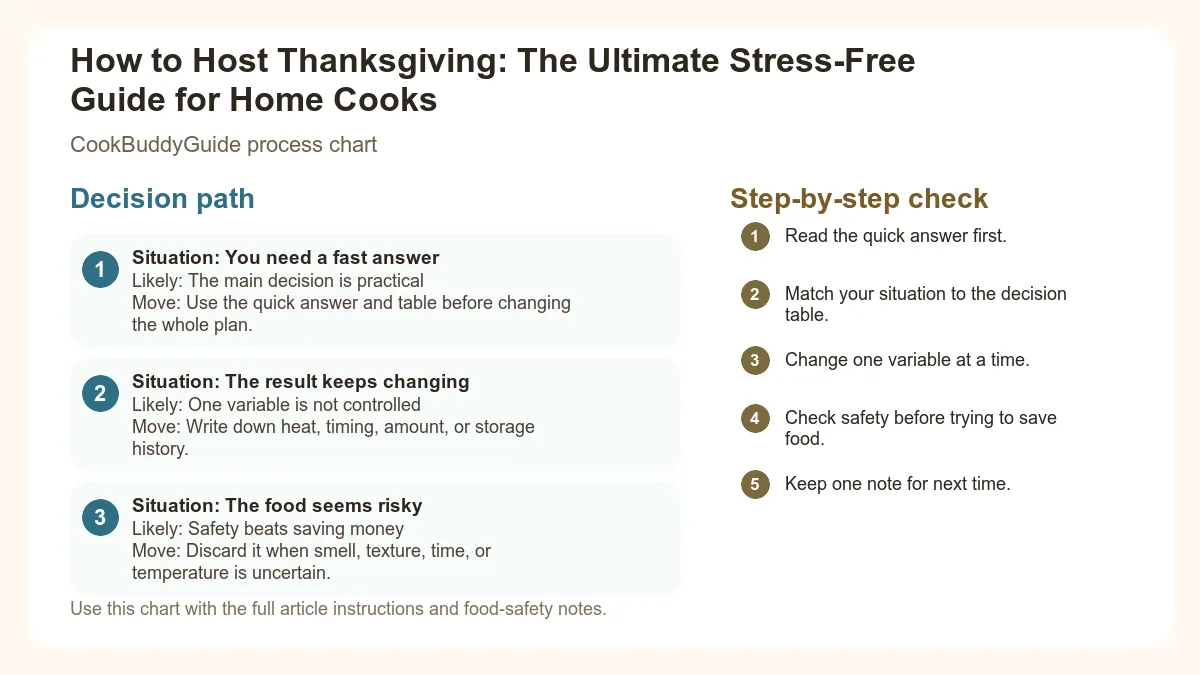
| You need a fast answer | The main decision is practical | Use the quick answer and table before changing the whole plan. |
| The result keeps changing | One variable is not controlled | Write down heat, timing, amount, or storage history. |
| The food seems risky | Safety beats saving money | Discard it when smell, texture, time, or temperature is uncertain. |
Step-by-step fix
- Read the quick answer first.
- Match your situation to the decision table.
- Change one variable at a time.
- Check safety before trying to save food.
- Keep one note for next time.
Common mistakes
- Skipping the quick answer and changing too much at once.
- Treating quality problems and safety problems the same way.
- Not writing down the detail that caused the repeat problem.
Related topic hubs
Hosting Thanksgiving dinner doesn't have to be a gauntlet of stress. It is, at its heart, a massive project management task disguised as a dinner party. If you can manage a calendar and follow a timeline, you can deliver a spectacular holiday meal planning success. In this guide, we’re going to move past the "Pinterest-perfect" illusions and focus on the practical logistics of feeding a crowd without losing your mind.
- The Golden Rule: Planning Over Performance
- Menu Engineering: Balancing Homemade and Store-Bought
- A Practical Thanksgiving Shopping Strategy
- Turkey Logistics: Thawing, Brining, and Roasting
- Oven Tetris: Managing Kitchen Real Estate
- The Countdown: A Detailed Prep Timeline
- Setting the Scene: Practical Tablescapes
- Gracious Hosting and Self-Care
- Frequently Asked Questions
The Golden Rule of Hosting: Planning Over Performance
Why Most Hosts Get Stressed (and How to Avoid It)
Defining Your Hosting Style: Formal vs. Buffet
Menu Engineering: Balancing the Homemade and the Store-Bought
The "Must-Have" Traditional Core
The Art of Delegation: What to Assign to Guests
Dietary Restrictions Without the Headache
A Practical Thanksgiving Shopping Strategy
Three Weeks Out: The Non-Perishables and Frozen Goods
One Week Out: The Fresh Produce and Dairy
The "Host's Sanity" Shopping List
- Aromatics: 3 lbs yellow onions, 2 heads garlic, 1 large bunch celery.
- Herbs: 2 bunches flat-leaf parsley, 1 pack "Poultry Mix" (Sage, Rosemary, Thyme).
- Dairy: 4 lbs unsalted butter, 1 quart heavy cream, 2 cartons chicken bone broth.
- Essentials: 1 bag of high-quality sea salt, 1 tin of black peppercorns, 1 bottle of kitchen bouquet (for that deep brown gravy color).
The 48-Hour Final Dash: Herbs and Bread
The final trip is for the delicate items: fresh herbs, salad greens, and the bread for your stuffing recipe. If you are using fresh bread for stuffing, buy it now and leave it out on the counter to stale; dried-out bread absorbs the stock much better than fresh, soft bread.
Turkey Logistics: Thawing, Brining, and Roasting
The Math: How Much Turkey Per Person?
The Great Thaw: Safe Methods and Timelines
Food safety is paramount. Never, ever thaw a turkey on the counter. The safest method is the refrigerator thaw. You need 24 hours for every 4 pounds of turkey. A 16-pound bird needs a full 4 days in the fridge. For more details, consult the USDA's safe methods for thawing turkey to ensure your bird stays out of the "danger zone" for bacterial growth.
Wet Brine vs. Dry Brine: Which is Best for Beginners?
The reliable Herb-Roasted Turkey
Ingredients: 12-14 lb turkey (thawed), 1/2 cup softened butter, 2 tbsp chopped fresh herbs (sage, rosemary, thyme), 1 tbsp kosher salt, 1 tsp cracked pepper.
- Pat the turkey completely dry with paper towels. (Dry skin = Crispy skin).
- Mix herbs, salt, and pepper into the butter. Rub half under the skin of the breast and half over the outside.
- Place the bird on a rack in a roasting pan. Do not stuff the cavity with dressing; instead, use an onion, an apple, and a bunch of herbs for aromatics.
- Roast at 325°F until an instant-read thermometer hits 160°F in the thickest part of the breast (it will rise to 165°F while resting).
- The Resting Secret: Let the bird rest for at least 45 minutes before carving. This allows the juices to redistribute. If you cut it too soon, the juice runs out and the meat turns to sawdust.
Oven Tetris: Managing Limited Kitchen Real Estate
The Cold Side Strategy
You only have one oven, but you have six dishes that need it. The solution is the "Cold Side Strategy." Not everything needs to be piping hot from the oven. Cranberry sauce should be served cold or at room temperature. Salads are cold. Even your stuffing recipe can be made ahead and kept warm. If you find yourself overwhelmed, consider using convenient crockpot meal ideas for your side dishes to free up oven space.
Slow Cookers and Toaster Ovens: Your Secret Weapons
A slow cooker is the perfect vessel for mashed potatoes. Once they are mashed and seasoned, put them in the slow cooker on the "warm" setting with a splash of extra cream. They will stay perfect for up to 4 hours. A toaster oven can be used to toast the nuts for the green beans or to keep the dinner rolls warm. For more advanced logistics, check out these tips on managing your oven on Thanksgiving.
The Reheating Schedule
Most side dishes (sweet potato casserole, corn pudding, stuffing) can be baked fully on Wednesday. On Thursday, while the turkey is resting for those crucial 45 minutes, you turn the oven up to 350°F and slide all the sides in for a 20-minute "refresh." This is the only way to ensure everything hits the table at the same temperature.
The Countdown: A Detailed Prep Timeline
T-Minus 3 Days: The Prep Work
This is "Sauce and Soup Day." Make your cranberry sauce today; the flavors actually improve after sitting in the fridge. If you are making a homemade stock from the giblets, do it now. Chop your onions, celery, and carrots and store them in airtight containers. This "Big Chop" saves you hours of board time on the big day.
T-Minus 1 Day: The 'Big Chop' and Baking
Thanksgiving Day: The Hour-by-Hour Schedule
Working backward from your "Sit Down" time (let's say 4:00 PM):
- 10:00 AM: Remove turkey from fridge to take the chill off.
- 11:30 AM: Turkey goes in the oven.
- 1:00 PM: Prep the "last minute" veggies (green beans, etc.).
- 2:30 PM: Check turkey temp with your meat thermometer.
- 3:15 PM: Turkey comes out to rest. Side dishes go into the oven.
- 3:30 PM: Make the gravy in the roasting pan drippings.
- 3:45 PM: Mash the potatoes.
- 4:00 PM: Carve the bird and serve!
Setting the Scene: Practical Tablescapes and Ambiance
The Functional Centerpiece
Drink Stations: Keeping Guests Out of the Kitchen
The "Kitchen Lurker" is a real phenomenon. Guests want to be where the action is, but a crowded kitchen is a dangerous kitchen. Set up a self-serve drink station in the living room or dining area. Include wine, a signature cocktail in a pitcher, and plenty of water. This keeps guests occupied and out of your "work zone" while you're handling hot pans.
Essential Serving Pieces: Do You Have Enough Large Spoons?
Gracious Hosting and Self-Care
The Host's Uniform: Comfort Meets Style
Managing the 'Kitchen Lurkers'
If someone insists on helping, give them a specific, contained task away from the stove. "Could you please put the butter in this dish?" or "Could you fill the water glasses?" are perfect "helper" tasks that don't interfere with your flow.
Handling Disasters with Grace
If the turkey is dry, drown it in gravy. If the gravy is lumpy, run it through a blender or a fine-mesh strainer. If the rolls are burnt, scrape off the bottoms and don't mention it. Most importantly, remember food safety. If something has been sitting out for more than two hours, toss it. Check the guidelines for safe food handling if you're unsure about leftovers.
Frequently Asked Questions
A: Don't worry! A large turkey will stay hot for up to an hour if you tent it loosely with foil and a clean kitchen towel. This "resting" time is actually better for the meat.
A: Measure your oven before you buy the pan! If you're in a pinch, you can use a heavy-duty disposable foil pan, which can be slightly bent to fit the space.
A: Use a whisk constantly, and add your stock slowly. If lumps form, don't panic—just pour the gravy through a sieve into the serving boat.
Conclusion: You've Got This!
Learning how to host thanksgiving is a journey, not a destination. Your first one might have a few hiccups, but by following this complete thanksgiving hosting guide, you are already miles ahead of where I started. Focus on the people, keep your instant-read thermometer handy, and remember that at the end of the day, it's just dinner. The memories made around the table—even the ones involving slightly lumpy gravy—are what truly matter. Happy hosting!