Quick Answer
This guide explains to make creamy risotto without arborio rice using regular rice. Our guide covers sushi rice, long grain tips, and starch secrets for perfect results.
Practical note
For How to Make Creamy Risotto Without Arborio Rice, this guide centers on Sushi Rice, Short-Grain White, Long-Grain Rice. Those are the checkpoints we would use first in a normal home kitchen before making a bigger change.
Decision table
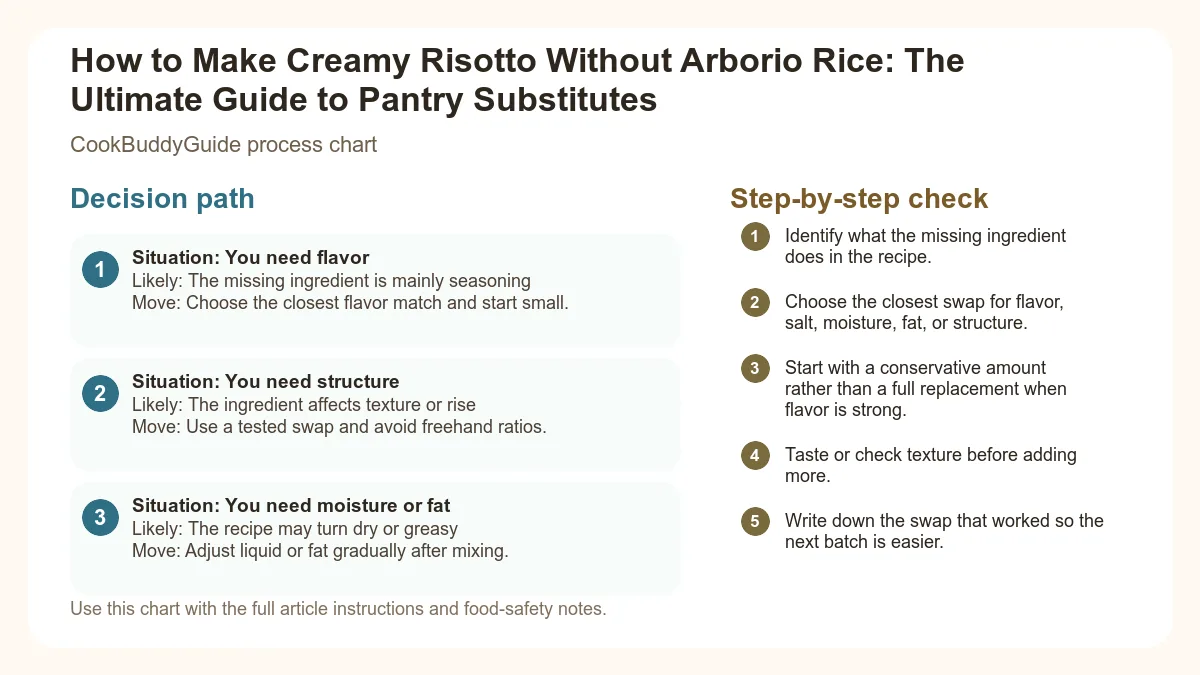
| Situation | Likely cause or meaning | Best move |
|---|---|---|
| You need flavor | The missing ingredient is mainly seasoning | Choose the closest flavor match and start small. |
| You need structure | The ingredient affects texture or rise | Use a practical swap and avoid freehand ratios. |
| You need moisture or fat | The recipe may turn dry or greasy | Adjust liquid or fat gradually after mixing. |
Step-by-step fix
- Identify what the missing ingredient does in the recipe.
- Choose the closest swap for flavor, salt, moisture, fat, or structure.
- Start with a conservative amount rather than a full replacement when flavor is strong.
- Taste or check texture before adding more.
- Write down the swap that worked so the next batch is easier.
Common mistakes
- Replacing a strong ingredient 1:1 before tasting.
- Choosing a flavor match when the recipe actually needs structure.
- Forgetting that salty swaps can change the whole dish.
- Adding extra liquid before the batter, dough, or sauce has time to hydrate.
Related topic hubs
It’s 6:30 PM on a Tuesday. You’ve already softened the shallots in butter, the kitchen smells like heaven, and you reach into the pantry for that signature blue box of Arborio rice—only to find it’s empty. We’ve all been there. For years, culinary "purists" have insisted that making risotto without arborio rice is a fool’s errand, claiming you’ll end up with either a mushy porridge or a plate of dry, separate grains.
Table of Contents
- The Science of Creaminess: Why Arborio is Traditional
- Best Substitutes: Ranking the Best Rice for Risotto
- Risotto Using Regular Rice: Can Long-Grain Work?
- The Master Technique: Step-by-Step for Any Grain
- Adjusting Ratios and Cooking Times
- Common Mistakes When Using Substitutes
- Recipe: The "Emergency" Pantry Risotto
- Beyond Rice: Non-Grain Alternatives
The Science of Creaminess: Why Arborio is Traditional
The Role of Amylopectin Starch
To understand how to substitute rice, we first have to understand what makes risotto "risotto." It isn't just a rice dish; it's an emulsion. The classic creaminess comes from a specific type of starch called Amylopectin. Traditional Italian rices like Arborio, Carnaroli, and Vialone Nano are classified as "superfino" because they are incredibly high in this starch.
When you cook these grains, the friction caused by stirring rubs the Amylopectin off the surface of the rice and into the cooking liquid. This creates a thick, velvety sauce while the center of the grain remains Al dente. According to the science of risotto starch release, it is this specific ratio of starch-to-liquid that defines the dish's success.
Why Texture Matters in a Classic Risotto
In Italy, the ideal consistency is described as all’onda, which translates to "wavy." If you shake the plate, the risotto should ripple like a wave, not sit in a stiff clump or run off like soup. When you swap the grain, you are essentially gambling with that starch release. Short-grain rice varieties typically have more Amylopectin, while long-grain varieties (like Jasmine or Basmati) are high in Amylose, a starch that keeps grains separate and fluffy—the exact opposite of what we want for risotto.
Best Substitutes: Ranking the Best Rice for Risotto
Sushi Rice: The Secret MVP
Short-Grain White Rice (Pudding Rice)
Often sold simply as "short-grain white rice" or "pudding rice," this is the closest botanical cousin to Italian varieties. It has a high starch content but can become mushy if overcooked. When using this variety, consider reducing the cooking time by about 3 to 5 minutes compared to standard Arborio recipes to ensure the grains don't lose their structural integrity.
Medium-Grain Calrose Rice
Calrose is a medium-grain rice developed in California and is widely available in most supermarkets. It’s a fantastic budget friendly dinner option. While it doesn't have the same "pearl" center as Arborio, it strikes a great balance between starch release and grain separation. It is a very forgiving variety for those new to the risotto technique.
Risotto Using Regular Rice: Can Long-Grain Work?
The Challenge with Basmati and Jasmine
Long-grain rices are bred to stay separate. They are high in Amylose, which does not dissolve into a creamy sauce. If you try to cook Jasmine rice like a traditional risotto, you’ll end up with a pot of wet rice that never quite thickens. You can learn more about these differences in this understanding different rice varieties guide from the University of Illinois.
The "Starch Hack": How to Fake the Creaminess
Adjusting Your Stirring Technique
With long-grain rice, do not stir as vigorously as you would with Arborio. Long grains are more fragile and prone to breaking. Instead of a heavy-handed stir, use a wooden spoon to gently move the rice in a figure-eight motion to encourage the liquid to absorb without turning the grains into a paste.
The Master Technique: Step-by-Step for Any Grain
Regardless of the rice you choose, the technique remains the same. This is the foundation of Italian cooking, and mastering these steps will make you a better cook overall. For a visual guide, you can refer to this step-by-step risotto cooking technique.
The Soffritto: Building the Flavor Base
Every great risotto starts with a Soffritto. This is the aromatic base of finely diced shallots or onions sautéed in butter or olive oil. Choose shallots for their delicate sweetness. Sauté them over medium heat until translucent but not browned. If you brown them, the final color of your risotto will be muddy rather than ivory.
Tostatura: Why Toasting the Grain is Non-Negotiable
Once your aromatics are soft, add the dry rice to the pan. This step is called Tostatura. You want to toast the rice for exactly 2-3 minutes until the edges of the grains become translucent while the center remains white. This "seals" the grain, helping it maintain its shape during the long cooking process. This is also when you perform the white wine deglazing. Add about a half-cup of dry white wine and stir until it is completely absorbed. The acidity is crucial for balancing the richness of the butter and cheese later on.
The Gradual Addition of Liquid
This is where the magic happens. You must add your stock or broth (Use a high-quality chicken bouillon for depth) one ladle at a time. Do not add more liquid until the previous ladle has been almost entirely absorbed. This constant cycle of adding liquid and stirring creates the friction necessary for starch release.
Adjusting Ratios and Cooking Times
- Sushi Rice: 3.25:1 ratio. It absorbs liquid quickly. Expect a 18-20 minute cooking time.
- Short-Grain White: 3:1 ratio. It can turn mushy fast. Check for doneness at the 15-minute mark.
- Long-Grain Rice: 2.5:1 ratio. Since it doesn't release as much starch, it requires less liquid to reach a "cooked" state.
Always trust your teeth over the timer. You are looking for Al dente—the grain should have a slight "bite" or resistance in the center, but no crunch. If it sticks to your teeth, it’s not done. If it’s soft all the way through, you’ve gone too far.
Common Mistakes When Using Substitutes
Over-stirring Long Grain Rice
Using Cold Stock
Skipping the Mantecatura
Mantecatura is the final, most important step. Once the rice is cooked, remove the pan from the heat. Add a large knob of cold butter and a generous handful of parmesan cheese. Use your wooden spoon to beat the rice vigorously for 30-60 seconds. This final burst of energy emulsifies the fats with the remaining starchy liquid, creating that famous glossy finish.
Recipe: The "Emergency" Pantry Risotto
This recipe is specifically calibrated for risotto using regular rice (medium or long-grain) when you don't have Arborio on hand.
Ingredients
- 1.5 cups regular white rice (Calrose or Long-grain)
- 5 cups stock or broth (Chicken or Vegetable), kept warm
- 2 tablespoons chicken bouillon (if using water instead of stock)
- 2 tablespoons olive oil
- 2 tablespoons unsalted butter (plus 1 tbsp for the finish)
- 2 medium shallots, finely minced
- 2 cloves garlic, grated
- 1/2 cup dry white wine (Sauvignon Blanc or Pinot Grigio)
- 1/2 cup parmesan cheese, freshly grated
- Salt and black pepper to taste
- Optional: 1 cup sautéed mushrooms or frozen peas
Instructions
- Warm the Liquid: In a medium saucepan, bring your stock to a gentle simmer. Keep it on low heat throughout the process.
- The Soffritto: In a large, heavy-bottomed skillet, heat the olive oil and 2 tbsp of butter over medium heat. Add the shallots and cook for 3-4 minutes until soft. Add the garlic and cook for 1 minute more.
- The Tostatura: Add the rice to the skillet. Stir constantly for 2-3 minutes. You want to hear the rice "click" against the pan and see the edges turn translucent.
- Deglaze: Pour in the white wine. Stir until the wine has evaporated completely.
- The Gradual Add: Add one ladle of warm stock. Stir gently but frequently. Once the liquid is mostly absorbed (you should be able to drag your spoon through the rice and leave a trail that fills slowly), add another ladle.
- Monitor Texture: Continue this for 18-22 minutes. If using long-grain rice, remember to stir more gently. Taste the rice frequently starting at 15 minutes.
- Mantecatura: When the rice is Al dente and the consistency is slightly looser than you want (it will thicken as it sits), remove from heat. Stir in the final tablespoon of cold butter and the parmesan cheese. Cover and let sit for 2 minutes.
- Serve: Give it one final vigorous stir. If it's too thick, add a splash of warm stock. Serve immediately on warmed plates.
Beyond Rice: Non-Grain Alternatives
Sometimes the best substitute for Arborio rice isn't rice at all. If your pantry is truly bare of short-grain options, consider these alternatives which I’ve ranked based on their ability to mimic the best rice varieties for risotto.
Pearl Barley (Orzotto)
Pearl barley is a phenomenal substitute. It has a naturally high starch content and a wonderful chewy texture. The cooking time is longer (about 35-40 minutes), but the results are incredibly nutty and satisfying. Unlike rice, barley is very hard to overcook, making it a great choice for dinner parties where timing might be loose.
Farro and Spelt
These ancient grains are excellent for a more rustic, "earthy" version of risotto. They don't release as much starch as rice, so Consider adding a splash of heavy cream or a bit of mascarpone at the end to help achieve that creamy texture.
Orzo Pasta
If you are in a massive rush, Orzo (the rice-shaped pasta) can be cooked using the risotto method. It takes only 8-10 minutes. Because it is pasta, it releases plenty of starch into the water, creating a very convincing "cheat" risotto. I’ve served this to guests who couldn't tell the difference!
Frequently Asked Questions
Yes, but it won't be as creamy as Arborio. Use the "starch hack" mentioned above (blending a small portion of the rice) and add extra parmesan to help the sauce emulsify.
NO! Never rinse your rice when making risotto. Rinsing removes the surface starch (Amylopectin) which is exactly what we need to create the creamy sauce.
You can substitute the wine with a tablespoon of lemon juice or white wine vinegar mixed into your first ladle of stock. The acidity is necessary to cut through the fat.