Quick Answer
The safe storage window for cooked pasta depends on temperature, handling, and how quickly it was refrigerated. Keep it at 40°F (4°C) or colder, follow the specific time limits below, and discard it sooner if its storage history is uncertain.
Practical note
For cooked pasta storage, the home-kitchen check is not only the number of days. We look at the start date, fridge temperature, container seal, serving time, and spoilage signs. If one of those facts is missing, the safer move is to use the shorter window.
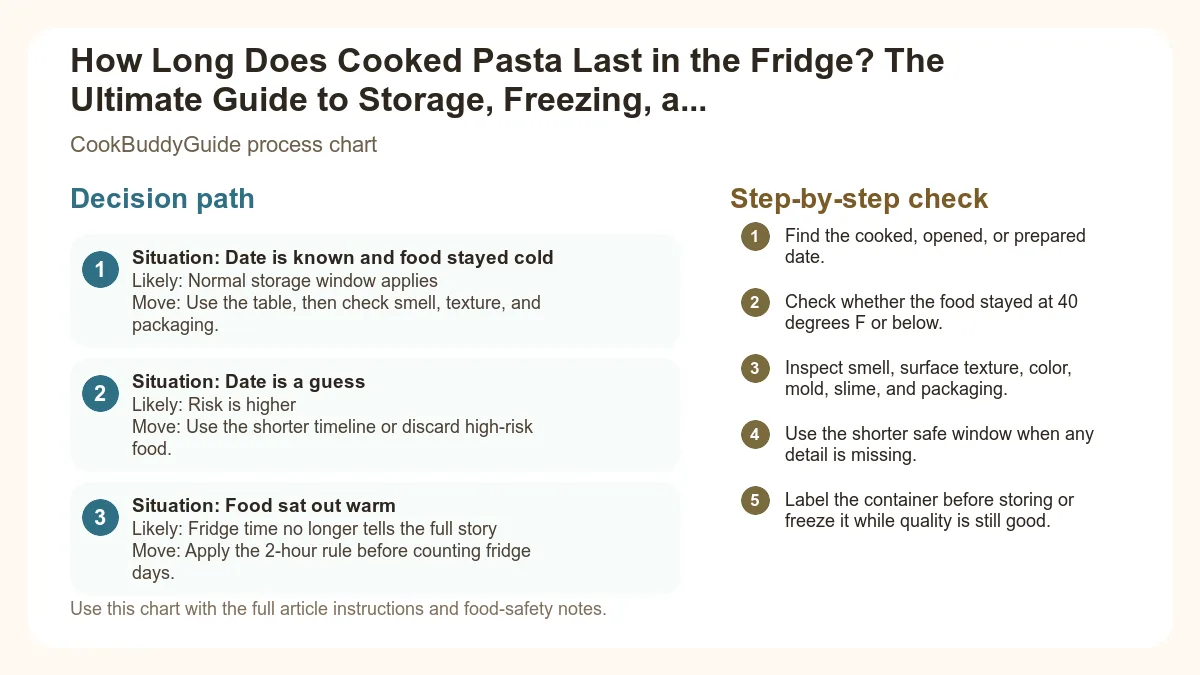
Decision table
| Situation | Likely cause or meaning | Best move |
|---|---|---|
| Date is known and food stayed cold | Normal storage window applies | Use the table, then check smell, texture, and packaging. |
| Date is a guess | Risk is higher | Use the shorter timeline or discard high-risk food. |
| Food sat out warm | Fridge time no longer tells the full story | Apply the 2-hour rule before counting fridge days. |
Step-by-step fix
- Find the cooked, opened, or prepared date.
- Check whether the food stayed at 40 degrees F or below.
- Inspect smell, surface texture, color, mold, slime, and packaging.
- Use the shorter safe window when any detail is missing.
- Label the container before storing or freeze it while quality is still good.
Common mistakes
- Counting fridge days from the day you noticed the container instead of the day it was made.
- Ignoring time spent on the counter, in a lunch bag, or on a serving table.
- Trusting smell alone when the date or temperature history is unknown.
- Putting warm food into a deep container that cools slowly.
Related topic hubs
It’s 6:30 PM on a Tuesday. You’re exhausted, the kids are hungry, and you remember that container of spaghetti tucked away in the back of the refrigerator. You reach for it, but then you pause. When did you make this? Was it Sunday? Or maybe Saturday? You open the lid, give it a sniff, and wonder: how long does cooked pasta last in fridge before it becomes a health hazard?
- The Science of Starch and Spoilage
- How Long Does Cooked Pasta Last? (By Type)
- The Best Cooked Pasta Storage Methods
- How to Tell if Cooked Pasta Has Gone Bad
- Can You Freeze Cooked Pasta? A Shape-by-Shape Guide
- How to Reheat Without Losing Texture
- Creative Ways to Use Leftover Pasta
- Frequently Asked Questions
Introduction: Why Proper Pasta Storage Matters
The Science of Starch and Spoilage
When pasta cools, the starches undergo a process called retrogradation. This is why leftover pasta often feels firmer or "rubbery" the next day. While this change in structure is normal, it also affects how the pasta holds onto moisture retention during storage. If stored incorrectly, the starch molecules will push water out, leading to that dreaded pool of liquid at the bottom of your container.
Why 'Al Dente' Matters for Longevity
How Long Does Cooked Pasta Last in the Fridge?
Plain Pasta (No Sauce)
Pasta with Tomato-Based Sauce
Shelf Life: 2–4 Days
The acidity in tomato sauce can actually help slightly with preservation, but the high water content will eventually cause the noodles to break down. After day three, you'll notice the pasta starts to absorb the sauce, becoming very soft. For the best experience, consider eating sauced spaghetti storage items within 48 hours.
Pasta with Cream or Dairy-Based Sauce
Shelf Life: 2–3 Days
Dairy is the "wild card" here. Alfredo, carbonara, or cheesy mac and cheese spoil faster than oil or tomato-based dishes. Furthermore, cream sauces tend to "break" or separate when refrigerated. If you see pools of oil or a grainy texture, the quality has likely peaked. If you're looking for healthy lunch ideas for work, consider oil-based pastas over cream-based ones for this very reason.
Fresh Homemade Pasta vs. Store-Bought Dried
The Best Cooked Pasta Storage Methods
Pro-Tip: The "Golden Standard" Storage Routine
- Drain and Rinse (Optional): If storing plain, rinse quickly with cold water to stop the cooking process and remove excess starch.
- The Olive Oil Trick: While the pasta is still slightly warm but not steaming, toss with 1 teaspoon of olive oil per pound of pasta. This is prevent pasta from clumping and keeps the strands individual.
- Cool to Room Temp: Spread the pasta on a baking sheet for 15 minutes. Never put steaming hot pasta into a sealed container; the condensation will lead to rapid mold growth.
- Seal Tight: Transfer to a glass airtight container.
Choosing the Right Airtight Containers
The 2-Hour Rule: Cooling Your Pasta Safely
One of the biggest mistakes home cooks make is leaving the pot of pasta on the stove while they eat dinner, only to put it away two or three hours later. To avoid food poisoning, your fridge temperature should be set at or below 40°F (4°C), and your pasta should be inside it within two hours of cooking. If your kitchen is particularly hot (above 90°F), that window shrinks to just one hour.
How to Tell if Cooked Pasta Has Gone Bad
Sometimes, the calendar lies. Maybe your fridge door was left ajar, or perhaps the pasta was contaminated during serving. You must know the signs of spoiled pasta to protect yourself and your family.
The Smell Test
Freshly cooked pasta should smell like grain or nothing at all. If you detect a sour, yeasty, or "vinegary" odor, throw it out immediately. This is especially true for dairy-based sauces, which will take on a pungent, "off" cheese smell when they expire.
Visual Cues (Mold and Discoloration)
Look for white, green, or black fuzzy spots. However, spoilage isn't always fuzzy. Sometimes, spoiled pasta will develop a dull, greyish hue or white "chalky" spots. This is a clear sign that bacteria have begun to colonize the starch.
The 'Slimy' Texture Warning: Bacillus cereus
This is the most dangerous sign. If the pasta feels slimy or "goopy" to the touch, do not taste it. This texture is often caused by Bacillus cereus, a bacterium that produces toxins that are not destroyed by reheating. This is a common cause of "fried rice syndrome," but it affects pasta just as easily. Cross-contamination during the cooling process often introduces these spores, so if it’s slimy, it goes in the trash.
Can You Freeze Cooked Pasta? A Shape-by-Shape Guide
Best Shapes for Freezing (Penne, Fusilli, Rigatoni)
Thick, sturdy shapes are your best friends. Penne and rigatoni have structural walls that hold up well to the expansion of ice crystals. When you properly freeze cooked pasta, these shapes retain their "bite" much better than delicate strands.
Shapes to Avoid Freezing (Angel Hair, Thin Spaghetti)
The Flash-Freeze Method
To prevent your pasta from becoming a solid block of ice, follow this method:
- Toss cooked, cooled al dente pasta with a little oil.
- Spread the noodles in a single layer on a parchment-lined baking sheet.
- Place in the freezer for 1–2 hours until frozen solid.
- Transfer the "frozen pebbles" into freezer-safe bags. Squeeze out as much air as possible to prevent freezer burn.
- Label: Mark the date! Frozen pasta is best used within 3 months.
How to Reheat Cooked Pasta Without Losing Texture
The goal of reheating is to restore moisture without continuing the cooking process. If you just stick a bowl in the microwave, you'll end up with "crunchy" edges and a cold center. There is a best way to reheat pasta for every scenario.
The Microwave Method: The Water Splash Trick
For a quick lunch, the microwave is fine if you use my "steam" technique. Place the pasta in a microwave-safe bowl and add 1–2 tablespoons of water (or extra sauce). Cover the bowl with a damp paper towel or a microwave-safe lid (leaving a small vent). This traps steam, which rehydrates the starch. Microwave in 30-second increments, stirring in between.
The Stovetop Method: Bringing Back the Sauté
This is a practical method for sauced pasta. Heat a skillet over medium heat with a splash of water, milk, or olive oil. Add the pasta and toss gently. The direct heat helps the sauce emulsify again, and the extra liquid prevents sticking. For plain noodles, you can actually drop them into a pot of boiling water for exactly 30 to 60 seconds—just enough to warm them through without overcooking.
The Oven Method: Best for Baked Dishes
For lasagna or baked ziti, the oven is king. Preheat to 350°F. Cover the dish tightly with aluminum foil to prevent the cheese from burning before the center is hot. If the pasta looks dry, add a tiny bit of water around the edges before sealing the foil. Bake for 15–20 minutes.
Creative Ways to Use Leftover Pasta
The Italian Frittata (Pasta Omelet)
In Italy, this is a classic "peasant" dish. Whisk 4–6 eggs with some parmesan cheese, salt, and pepper. Stir in about 2 cups of leftover spaghetti (sauced or plain). Pour the mixture into a hot, oiled skillet and cook until the bottom is golden, then flip or finish under the broiler. It’s a fantastic, dense, and savory breakfast or lunch.
Cold Pasta Salad Transformations
Crispy Pan-Fried Pasta
Frequently Asked Questions
A: Avoid it. While it might look okay, the risk of bacterial growth increases significantly after day 5. Stick to the 3–5 day rule for safety.
A: This is a sign of fermentation. Yeasts have begun to break down the sugars in the pasta. Do not eat it; discard it immediately.
Conclusion: Mastering Your Meal Prep
Understanding how long does cooked pasta last in fridge is a helpful shortcut for any busy home cook. By following the cooked pasta storage rules—using airtight containers, the olive oil trick, and respecting the 5-day limit—you can save money and time without sacrificing quality.
Remember: your eyes and nose are your best tools, but when in doubt, throw it out. Whether you’re turning last night’s spaghetti into a morning frittata or freezing a batch of penne for a rainy day, proper handling ensures that every meal is as delicious as the first. Happy cooking, and even happier (and safer) eating!