Quick Answer
Boost your digestion with these delicious high fiber meals. Explore easy high fiber dinner recipes for gut health, practical tips, and fiber-rich food lists.
Practical note
For High Fiber Meals, this guide centers on Soluble Fiber, Insoluble Fiber, Pasta Alternatives. Those are the checkpoints we would use first in a normal home kitchen before making a bigger change.
Decision table
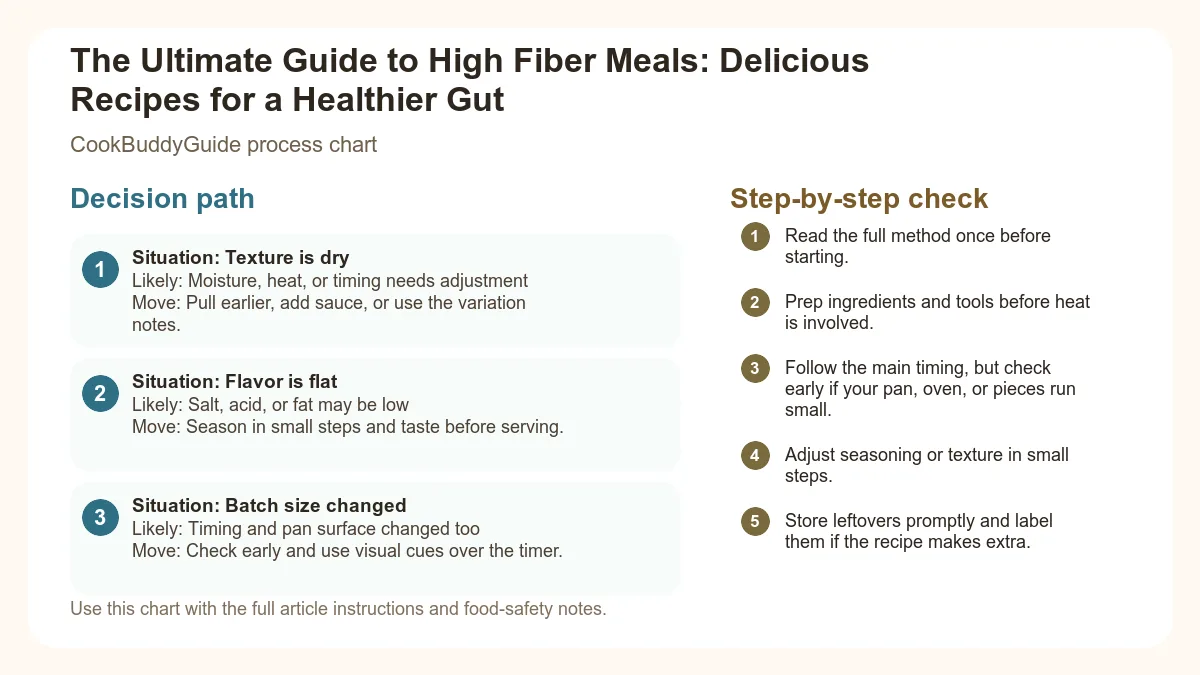
| Situation | Likely cause or meaning | Best move |
|---|---|---|
| Texture is dry | Moisture, heat, or timing needs adjustment | Pull earlier, add sauce, or use the variation notes. |
| Flavor is flat | Salt, acid, or fat may be low | Season in small steps and taste before serving. |
| Batch size changed | Timing and pan surface changed too | Check early and use visual cues over the timer. |
Step-by-step fix
- Read the full method once before starting.
- Prep ingredients and tools before heat is involved.
- Follow the main timing, but check early if your pan, oven, or pieces run small.
- Adjust seasoning or texture in small steps.
- Store leftovers promptly and label them if the recipe makes extra.
Common mistakes
- Changing the recipe before trying the base method once.
- Measuring casually when texture depends on ratios.
- Waiting until the end to fix seasoning.
- Ignoring carryover heat or resting time.
Related topic hubs
Table of Contents
- Why High Fiber Meals are the Secret to Long-Term Health
- How to Increase Fiber Without Digestive Discomfort
- Top Fiber-Rich Foods to Keep in Your Kitchen
- High Fiber Breakfasts to Kickstart Your Digestion
- Satisfying High Fiber Lunches for Busy Workdays
- High Fiber Dinner Recipes for Gut Health
- Smart Swaps: Turning Classics into High-Fiber Favorites
- Meal Prep Strategies for a High-Fiber Week
- Troubleshooting: What to Do if You Feel Bloated
Why High Fiber Meals are the Secret to Long-Term Health
When we talk about high fiber meals, we aren't just talking about preventing constipation. We are talking about feeding the trillions of bacteria living in your gut. These bacteria ferment fiber to produce short-chain fatty acids (SCFAs), which are essential for reducing inflammation and maintaining the lining of your digestive system.The Link Between Fiber and the Gut Microbiome
Soluble vs. Insoluble Fiber: Why You Need Both
To master high-fiber cooking, you must understand the two main types of fiber:- Soluble Fiber: This dissolves in water to form a gel-like substance. It’s found in oats, peas, beans, and apples. It is crucial for blood sugar regulation and lowering cholesterol.
- Insoluble Fiber: This "bulks up" the stool and helps food pass more quickly through the stomach and intestines. Think of it as the "broom" of the digestive tract. You’ll find insoluble fiber benefits in whole wheat flour, nuts, beans, and vegetables like cauliflower and green beans.
The Golden Rule: How to Increase Fiber Without Digestive Discomfort
The "Low and Slow" Approach
Your gut bacteria need time to adjust to a higher workload. If you currently eat 10g of fiber a day, don't try to hit 30g tomorrow. Instead, aim to add 3-5g of fiber per day each week. This gradually increasing your fiber intake strategy allows your enzymes and microbiome to adapt.Hydration: Fiber’s Essential Partner
Top Fiber-Rich Foods to Keep in Your Kitchen
Building a high-fiber kitchen starts with your pantry. When you have these staples on hand, hitting your daily goals becomes effortless.Legumes and Pulses
Lentils, chickpeas, and black beans are the heavy hitters of the fiber world. According to the fiber content in common foods, a single cup of cooked lentils provides about 15.5g of fiber—nearly half of the daily recommended intake for many adults.Whole Grains and Ancient Grains
Seeds, Nuts, and Berries
High Fiber Breakfasts to Kickstart Your Digestion
Breakfast is the easiest time to front-load your fiber. If you start the day with 10-12g, you aren't playing catch-up at dinner.Steel-Cut Oatmeal with Flaxseed and Mixed Berries
- 1 cup steel-cut oats
- 3 cups water or unsweetened nut milk
- 2 tbsp ground flaxseed
- 1 cup fresh or frozen raspberries
- 1/4 tsp cinnamon
- 1 tbsp almond butter
- Bring water/milk to a boil in a medium saucepan.
- Add oats and a pinch of salt. Reduce heat to low and simmer for 20 minutes, stirring occasionally.
- Once the oats are creamy, stir in the ground flaxseed and cinnamon.
- Top with berries and almond butter.
Testing Note: If you're short on time, use the "overnight soak" method. Bring the water and oats to a boil for 1 minute at night, turn off the heat, cover, and let them sit on the stove overnight. In the morning, they’ll only need 5 minutes to reheat!
Savory Quinoa Breakfast Bowls
Satisfying High Fiber Lunches for Busy Workdays
Hearty Lentil and Vegetable Soup
Lentils are a nutritional powerhouse. For this recipe, Choose French Green (Puy) lentils because they hold their shape and provide a sophisticated "bite." If you want a softer, creamier soup, use red lentils which break down during cooking. For more inspiration, check out our healthy lunch ideas for work.
Ingredients:- 1.5 cups dried green lentils (rinsed)
- 1 large onion, diced
- 3 carrots, sliced (keep the skins on!)
- 2 stalks celery, chopped
- 4 cups vegetable broth
- 1 tsp cumin and 1 tsp smoked paprika
- 2 cups chopped kale
- Sauté onion, carrots, and celery in a large pot for 5-7 minutes until soft.
- Add spices and lentils, stirring for 1 minute to toast the spices.
- Pour in broth. Bring to a boil, then simmer for 25-30 minutes. Learn how to cook dried lentils perfectly every time to avoid mushiness.
- Stir in the kale during the last 5 minutes of cooking until wilted.
Classic Split Pea Soup with Smoked Paprika
High Fiber Dinner Recipes for Gut Health
Dinner is where people often fall into the "meat and potatoes" trap. By shifting the focus to high fiber dinner recipes for gut health, you can enjoy comforting meals that don't leave you feeling bloated or sluggish.Zesty Black Bean Tacos with Cabbage Slaw
- 2 cans black beans, drained and rinsed
- 1 tsp chili powder and 1/2 tsp cumin
- 6-8 corn tortillas
- 2 cups shredded purple cabbage
- 1 avocado, sliced
- Lime juice and cilantro for garnish
- Warm the black beans in a skillet with a splash of water and the spices. Mash a few of the beans with a fork to create a "creamy" texture without adding fat.
- Toss the cabbage with lime juice and a pinch of salt.
- Char the corn tortillas over an open flame or in a dry pan for 30 seconds per side.
- Assemble tacos with beans, a generous heap of slaw, and avocado.
Creamy Chickpea and Spinach Curry
Roasted Vegetable and Farro Grain Bowls
Smart Swaps: Turning Low-Fiber Classics into High-Fiber Favorites
You don't have to give up your favorite comfort foods; you just need to upgrade the ingredients.- Rice Swaps: If you find brown rice boring, try farro or bulgur wheat. They have a chewy, nutty texture that holds up much better in meal prep than rice, which can get mushy.
Meal Prep Strategies for a High-Fiber Week
Consistency is the hardest part of maintaining a high-fiber diet. These two strategies changed the game for me.Batch Cooking Grains and Beans
Pro Tip for Beans: If you use dried beans, soak them for at least 12 hours with a pinch of baking soda. This helps break down the complex sugars (oligosaccharides) that cause gas, making them much easier on your digestive system.The "Fiber Jar" Hack
Troubleshooting: What to Do if You Feel Bloated
Even with a "low and slow" approach, you might occasionally experience "fiber overload." This usually happens when you eat a very high-fiber meal without enough water or movement afterward.Common signs include a distended stomach, cramping, and increased flatulence. If you feel "plugged up" despite eating fiber, you likely aren't drinking enough water.
A 15-minute brisk walk is the most effective way to stimulate the digestive system. Additionally, sipping peppermint tea can help relax the muscles in your gut.
Yes. Raw cruciferous vegetables (broccoli, cauliflower) are much harder to break down than cooked ones. If you have a sensitive stomach, always steam or roast your veggies rather than eating them raw.