Quick Answer
Chocolate chip cookies can be made without butter by using neutral oil, coconut oil, or a plant-based baking fat. Because each substitute changes spread and texture, use the ratios below and bake one test cookie before adjusting the whole batch.
Practical note
For Chocolate Chip Cookies Without Butter, the most useful home checks are temperature, measuring, resting time, and visible texture. Those details tell you more than guessing, especially before adding extra flour, liquid, heat, or leavening.
Decision table
| Situation | Likely cause or meaning | Best move |
|---|---|---|
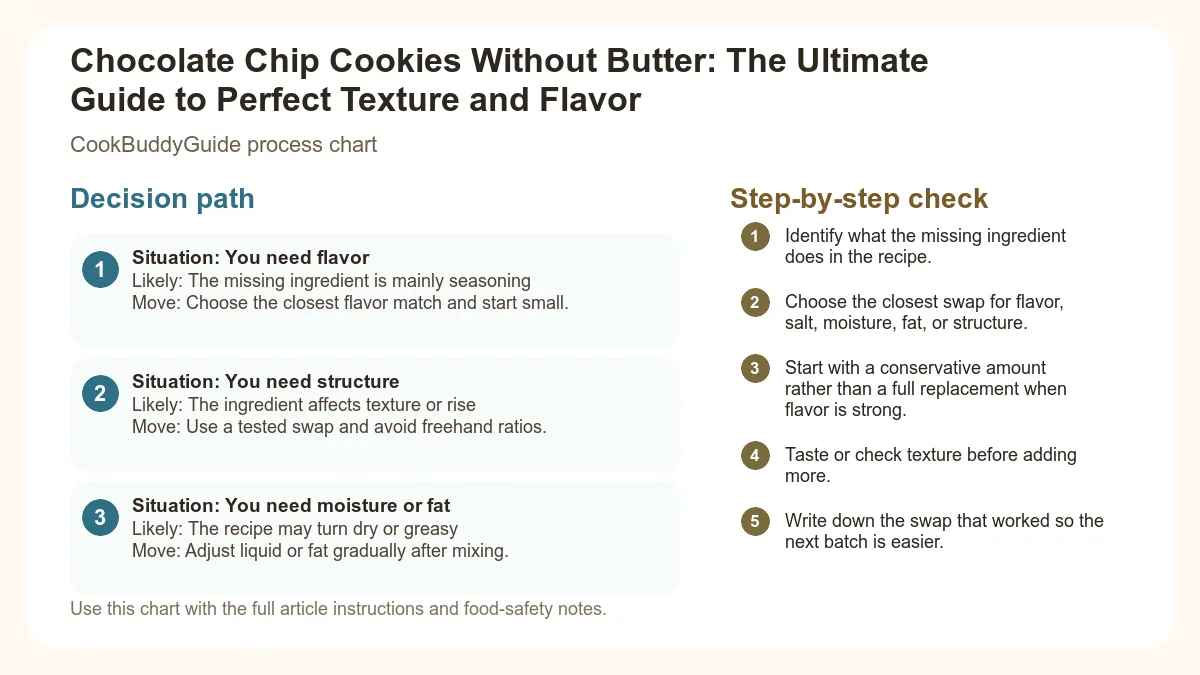
| You need flavor | The missing ingredient is mainly seasoning | Choose the closest flavor match and start small. |
| You need structure | The ingredient affects texture or rise | Use a practical swap and avoid freehand ratios. |
| You need moisture or fat | The recipe may turn dry or greasy | Adjust liquid or fat gradually after mixing. |
Step-by-step fix
- Identify what the missing ingredient does in the recipe.
- Choose the closest swap for flavor, salt, moisture, fat, or structure.
- Start with a conservative amount rather than a full replacement when flavor is strong.
- Taste or check texture before adding more.
- Write down the swap that worked so the next batch is easier.
Common mistakes
- Replacing a strong ingredient 1:1 before tasting.
- Choosing a flavor match when the recipe actually needs structure.
- Forgetting that salty swaps can change the whole dish.
- Adding extra liquid before the batter, dough, or sauce has time to hydrate.
Related topic hubs
- Why Bake Chocolate Chip Cookies Without Butter?
- The Science of Fat in Baking
- Top 5 Butter Substitutes for Cookies
- The Testing Lab: Spread, Crunch, and Color
- The Golden Conversion Ratios
- Recipe: A Practical Butter-Free Cookies
- Practical Tips for Success
- Troubleshooting Common Issues
- Storage and Freezing Tips
Why Bake Chocolate Chip Cookies Without Butter?
Dietary Restrictions and Allergies
When I first started writing for CookBuddyGuide.com, I received countless emails from parents of children with dairy allergies. They wanted a cookie that didn't feel like a "diet" food. By using high-quality oils or nut butters, you can create a treat that is safe for those with dairy sensitivities while still satisfying the most hardcore cookie traditionalists.
The "Empty Fridge" Scenario
We’ve all been there. It’s 9:00 PM, the kids are finally asleep, and you have a desperate craving for something sweet. You check the fridge, and there’s not a stick of butter in sight. Learning to use neutral oil or pantry staples like applesauce turns a potential disappointment into a baking win. It’s about the convenience of using what you have, much like my approach to 5-ingredient dinner recipes—simplicity often leads to the best results.
Health-Conscious Baking Swaps
The Science of Fat in Baking: What Butter Actually Does
To successfully bake butter free chocolate chip cookies, we have to understand what we’re replacing. Butter is a complex emulsion of roughly 80-82% milk fat, 15-18% water, and 1-2% milk solids. Each of these components plays a vital role in the final product.
Flavor Profile and the Maillard Reaction
The milk solids in butter are responsible for the Maillard reaction—the chemical reaction between amino acids and reducing sugars that gives browned foods their distinctive flavor. When you bake a standard cookie, those milk solids toast in the oven, providing a nutty, rich aroma. When we remove butter, we lose those solids, so we have to find other ways to encourage browning and depth of flavor, such as increasing the brown sugar vs white sugar ratio to boost molasses content.
Aeration and Leavening
When you cream room temperature butter with sugar, the sharp sugar crystals carve tiny air pockets into the solid fat. These pockets expand in the oven, aided by baking soda vs powder, to create lift. Liquid fats, like vegetable oil, cannot hold these air pockets. This is why oil-based cookies are naturally denser and fudgier. According to the science of the best cookies, the lack of aeration in oil-based dough leads to a more compact crumb structure.
Texture: Tenderness vs. Structure
Fat coats the flour proteins (gluten), preventing them from bonding with water. This limits gluten development, which is what makes a cookie tender rather than bread-like. Butter contains water, which actually encourages some gluten to form. Pure oils contain 100% fat and 0% water, meaning they are even more effective at tenderizing the dough, often leading to a melt-in-your-mouth quality that butter can't quite replicate.
Top 5 Butter Substitutes for Cookies: Pros and Cons
1. Coconut Oil: The Best Solid Fat Alternative
Coconut oil is unique because, like butter, it can exist in both solid and liquid states. This allows you to cream it with sugar for better aeration.
- Refined vs. Unrefined: Consider refined coconut oil if you want a neutral flavor. Unrefined (virgin) oil will make your cookies taste like a tropical vacation—which is great, unless you’re aiming for a classic Toll House vibe.
- Texture: It produces incredibly crispy edges and a very tender center. Because it has a lower melting point than butter, the cookies will spread quickly.
2. Vegetable and Canola Oil: For Ultimate Chewy Texture
3. Applesauce: The Low-Fat, Cakey Alternative
Replacing butter with applesauce is a classic "health swap," but it changes the cookie's identity.
- The Result: You will get a "muffin-top" style cookie. It’s soft, puffy, and moist, but it will lack the chewy texture of a traditional cookie.
- Pro Tip: Only replace half the fat with applesauce if you still want some "snap." For a full guide, check out how to substitute applesauce for butter.
4. Vegan Butter: The Closest 1:1 Match
Modern plant-based sticks are engineered to mimic the water-to-fat ratio of dairy butter.
- Performance: This is the easiest swap for beginners. You can use it exactly like butter (creaming it while at room temperature).
5. Nut Butters (Tahini, Almond, or Peanut)
Using tahini or almond butter adds a sophisticated, savory depth to butter free chocolate chip cookies.
- Texture: These are high in moisture content and protein, leading to a dense, rich cookie.
- The Trade-off: They will significantly alter the flavor. Almond butter is the most neutral, while tahini provides a beautiful "grown-up" bitterness that pairs perfectly with dark chocolate.
The Testing Lab: How Each Substitute Affects Your Cookie
Spread and Diameter Comparison
The Crunch Factor: Crispy Edges vs. Soft Centers
If you live for a crunchy cookie, coconut oil is your winner. It has a high saturated fat content (even though it's plant-based), which allows the edges to fry slightly against the pan, creating a beautiful "snap." The vegetable oil cookies were the softest, remaining flexible even after cooling rack time. This is due to the lack of water; without water to evaporate and leave behind a dry structure, the oil keeps the flour particles lubricated and soft.
Color and Browning Analysis
Butter-based cookies brown beautifully thanks to milk solids. Without them, my oil-based cookies looked a bit pale at the 10-minute mark. To fix this, I increased the oven temperature by 15 degrees and added a teaspoon of molasses. This encouraged the Maillard reaction and gave the butter free chocolate chip cookies that golden-brown hue we all crave. For more on these nuances, refer to this breakdown of the best butter substitutes for baking.
The Golden Conversion Ratio: How to Swap Fats Like a Pro
Oil to Butter Conversion Table
When using liquid oils (Vegetable, Canola, Olive, Avocado):
- 1 cup Butter = 3/4 cup Oil
- 1/2 cup Butter = 6 tablespoons Oil
- 1/4 cup Butter = 3 tablespoons Oil
Applesauce and Puree Ratios
Fruit purees (Applesauce, Mashed Banana, Pumpkin):
- 1 cup Butter = 1 cup Puree (but reduce other liquids in the recipe by 2 tablespoons).
- Note: You may need to add 2-3 extra tablespoons of flour to compensate for the high moisture content of the fruit.
Adjusting Dry Ingredients for Liquid Fats
Recipe: A Practical Butter-Free Chocolate Chip Cookies
Ingredients
- 3/4 cup neutral oil (Canola or Grapeseed work best)
- 1 cup packed light brown sugar (essential for chewy texture)
- 1/2 cup granulated white sugar
- 1 large egg + 1 egg yolk (at room temperature ingredients)
- 2 teaspoons pure vanilla extract
- 1/4 teaspoon almond extract (my "secret" for buttery depth)
- 2 ¼ cups all-purpose flour
- 1 teaspoon baking soda
- 1/2 teaspoon sea salt
- 1 ½ cups high-quality semi-sweet chocolate chips or chunks
Step-by-Step Instructions
- Emulsify: In a large bowl, whisk the oil and both sugars vigorously for 2 full minutes. You want to see the mixture lighten slightly in color. This process helps with emulsification, ensuring the oil doesn't leak out during baking.
- Wet Ingredients: Add the egg, egg yolk, vanilla, and almond extract. Whisk again until the mixture looks like thick caramel.
- Dry Ingredients: Sift in the flour, baking soda, and salt. Use a spatula to fold the dough together until just combined. Do not overmix, as this triggers gluten development and makes cookies tough.
- The Fold: Fold in your chocolate chips. The dough will feel softer and "oilier" than butter dough—this is normal!
- The Chill: Cover the bowl and refrigerate for at least 2 hours (24 hours is even better). This allows the flour to fully hydrate and prevents excessive spread.
- Bake: Preheat oven to 350°F (175°C). Line a baking sheet with parchment paper. Scoop rounded tablespoons of dough 2 inches apart.
- Cool: Bake for 9-11 minutes until the edges are just golden. Let them sit on the pan for 5 minutes before transferring to a cooling rack.
Practical Tips for Success When Baking Without Butter
The Importance of Chilling the Dough
Emulsifying Liquid Fats with Eggs
Because oil and water (from the eggs) don't naturally mix, you must force them into an emulsion. Use a whisk and some elbow grease. When you whisk the oil, sugar, and eggs together, you are creating a stable structure that will hold the flour and chocolate in place. If you see oil pooling at the bottom of your bowl, you haven't whisked enough!
Choosing the Right Chocolate
Without the creamy notes of butter, the flavor of your chocolate becomes the star of the show. Consider using chocolate with at least 60% cacao. The slight bitterness of dark chocolate offsets the sweetness of the brown sugar vs white sugar mix perfectly. Also, using "chunks" instead of "chips" creates pools of melted chocolate that help improve the overall mouthfeel of butter free chocolate chip cookies.
Troubleshooting Common Butter-Free Baking Issues
This usually happens if the dough wasn't chilled long enough or if the oil wasn't properly emulsified with the sugar and eggs. If your first batch comes out oily, try adding 2 tablespoons of flour to the remaining dough and chilling it for another hour.
Cakiness is caused by too much air or too much moisture. If you used applesauce, this is expected. If you used oil, you might have used too much leavening. Stick to baking soda for a flatter, chewier cookie and avoid over-beating the eggs.
Without milk solids, browning is harder to achieve. Ensure you are using plenty of brown sugar, which contains molasses. You can also try a "hot start" by preheating your oven to 375°F and then dropping it to 350°F as soon as you put the cookies in.
Storage, Freezing, and Make-Ahead Tips
One of the hidden benefits of chocolate chip cookies without butter is their longevity. Because oil is liquid at room temperature, these cookies don't get "stale" and hard as quickly as butter cookies do.
How to Keep Butter-Free Cookies Soft
Freezing Raw Dough Balls
You can freeze this dough! Scoop the dough into balls, place them on a tray, and "flash freeze" for one hour. Once they are hard, transfer them to a freezer bag. You can bake them straight from the freezer—just add 2 minutes to the total baking time. This is perfect for when you want just one or two fresh cookies without making a whole batch.
Reheating for that 'Freshly Baked' Feel
If your cookies have been sitting for a few days, pop them in a 300°F oven for 3 minutes. Avoid the microwave if possible, as it can make the oil-based dough turn slightly gummy. The oven will recrisp those crispy edges and melt the chocolate perfectly.
Conclusion: The Joy of the Butter-Free Bake
Mastering chocolate chip cookies without butter is a milestone for any home cook. It proves that baking isn't just about following a rigid set of rules, but about understanding the "why" behind every ingredient. Whether you’re baking with coconut oil for that perfect snap or using a neutral oil for a fudgy, chewy center, you now have the tools to create a masterpiece regardless of what’s in your fridge.
The next time you find yourself out of butter, don't panic. Embrace the opportunity to experiment with plant-based fats and discover a new favorite texture. After all, the best recipes in my 15-year career haven't come from perfection—they’ve come from the creative solutions found in a busy, real-life kitchen. Happy baking!