Quick Answer
Raw flour can contain E. coli and Salmonella — it's not just about eggs. Here's why it's dangerous and how to heat-treat flour safely at home.
Practical note
For Can You Eat Raw Flour? The Surprising Truth About Flour Safety and How to Heat-Treat It, this guide centers on Crucial Step, Heat-Treat the Flour, Cream the Fats and Sugars. Those are the checkpoints we would use first in a normal home kitchen before making a bigger change.
Decision table
| Situation | Likely cause or meaning | Best move |
|---|---|---|
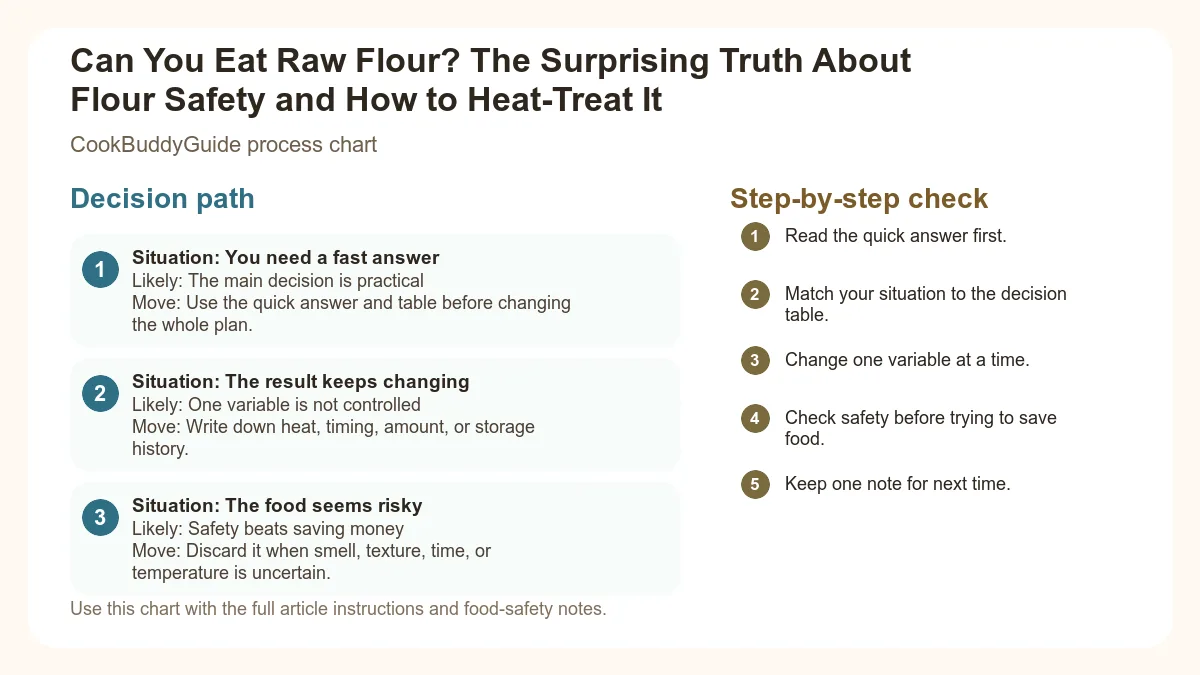
| You need a fast answer | The main decision is practical | Use the quick answer and table before changing the whole plan. |
| The result keeps changing | One variable is not controlled | Write down heat, timing, amount, or storage history. |
| The food seems risky | Safety beats saving money | Discard it when smell, texture, time, or temperature is uncertain. |
Step-by-step fix
- Read the quick answer first.
- Match your situation to the decision table.
- Change one variable at a time.
- Check safety before trying to save food.
- Keep one note for next time.
Common mistakes
- Skipping the quick answer and changing too much at once.
- Treating quality problems and safety problems the same way.
- Not writing down the detail that caused the repeat problem.
Related topic hubs
Table of Contents
- The Temptation of the Spoon: Can You Eat Raw Flour?
- The Science of Contamination: Why Raw Flour is Dangerous
- A History of Flour Recalls: Lessons Learned
- Heat-Treating Flour: The Secret to Safe Edible Dough
- Baking with Children: Essential Safety Tips
- A Practical Safe Edible Cookie Dough Recipe
- Beyond Flour: Other Raw Dough Risks
- Frequently Asked Questions
The Temptation of the Spoon: Can You Eat Raw Flour?
The Common Misconception: It’s Not Just the Eggs
Why Flour is Considered a "Raw" Food
The Science of Contamination: Why Raw Flour is Dangerous
From Field to Bag: How Bacteria Enters the Supply Chain
The journey of a wheat berry begins in vast open fields. During wheat harvesting, the grain is exposed to various environmental factors. Animals, including birds and deer, wander through the fields, leaving behind waste. Flooding or heavy rain can wash animal feces from nearby livestock farms into the wheat crops. Because flour is not cooked during the milling process, any bacteria present on the wheat berries remains in the final bag of uncooked flour you buy at the store.
E. coli and Salmonella: The Hidden Risks in Your Pantry
The primary reason why raw flour is dangerous involves two specific pathogens: Escherichia coli (E. coli) and Salmonella. These aren't just names on a news report; they are resilient bacteria that can cause severe foodborne illness. Raw flour can contain bacteria that leads to food poisoning symptoms such as intense abdominal cramps, bloody diarrhea, and vomiting. In some cases, particularly with certain strains of E. coli (like STEC), it can lead to kidney failure.
The Survival of Pathogens in Dry Environments
A History of Flour Recalls: Lessons Learned
Major Industry Recalls and Their Impact
The danger of raw flour isn't theoretical. In 2016, a massive outbreak of E. coli linked to General Mills flour sickened 63 people across 24 states. This was a turning point for baking safety. Again in 2019, multiple brands issued flour recalls due to potential E. coli contamination. These events proved that even the most modern processing facilities cannot fully eliminate the risk of pathogens entering the supply chain from the fields.
What These Events Taught Food Safety Experts
Heat-Treating Flour: The Secret to Safe Edible Dough
The Science of Thermal Kill Steps
Bacteria like E. coli and Salmonella are killed when exposed to temperatures of 160°F (71°C) or higher. According to the FDA, risks of eating raw flour are only mitigated when the flour is thoroughly cooked. Simply "warming" it isn't enough; you need precision.
Method 1: The Oven Technique (Best for Large Batches)
- Preheat your oven to 350°F (175°C).
- Spread your all-purpose flour on a rimmed baking sheet in an even layer. Do not make the layer thicker than half an inch.
- Bake for 5 to 7 minutes.
- Crucial Step: Use a digital thermometer to check that the flour has reached at least 160°F in multiple spots.
Method 2: The Microwave Technique (Quick and Easy)
If you're just craving a single scoop of dough, how to heat-treat flour in the microwave is a vital skill. However, be warned: microwaves create hot spots.
- Place flour in a microwave-safe bowl.
- Heat on high in 30-second intervals.
- Stir thoroughly between each interval to break up clumps and redistribute heat.
- Continue until the internal temperature reads 160°F. This usually takes 1 to 2 minutes depending on the wattage.
Testing for Safety: Common Mistakes to Avoid
Baking with Children: Essential Safety Tips
Teaching 'No-Lick' Kitchen Rules
Safe Alternatives for Sensory Play
Many parents use flour for homemade playdough or sensory bins. Given that kids often put their hands in their mouths, this is a high-risk activity. Instead, use toasted flour for your playdough recipes, or better yet, use cornstarch-based playdough which is often safer if accidentally ingested in small amounts.
Cleaning and Cross-Contamination
A Practical Safe Edible Cookie Dough Recipe
CookBuddy’s "Safe-to-Spoon" Chocolate Chip Cookie Dough
- 1 cup all-purpose flour (heat-treated to 160°F and sifted)
- 1/2 cup unsalted butter, softened to room temperature
- 1/2 cup packed light brown sugar
- 1/4 cup granulated sugar
- 2 tablespoons whole milk (plus more if needed)
- 1 teaspoon pure vanilla extract
- 1/4 teaspoon fine sea salt
- 1/2 cup mini chocolate chips
- Heat-Treat the Flour: Use the oven method described above. Let it cool completely and sift out any clumps. This is the most important step for baking safety.
- Cream the Fats and Sugars: In a large bowl, beat the softened butter with the brown sugar and granulated sugar until light and fluffy (about 2 minutes).
- Add Liquids: Mix in the vanilla, salt, and milk.
- Incorporate Flour: Gradually add the sifted, heat-treated flour. If the dough feels too crumbly, add milk one teaspoon at a time until it reaches your desired consistency. *Note: Heat-treated flour absorbs moisture differently than raw flour, so you may need slightly more liquid than usual.*
- Fold in Chips: Stir in the chocolate chips by hand.
- Enjoy: Eat immediately or store in an airtight container.
Storage and Shelf Life
Since this dough contains dairy (butter and milk), it should not be left at room temperature for more than two hours. In the refrigerator, it stays fresh for up to 5 days. You can also roll it into balls and freeze them for a quick treat later; they will last up to 3 months in the freezer.
Beyond Flour: Other Raw Dough Risks
Raw Cake Batter and Brownie Mix
It’s not just cookie dough. Why raw flour is dangerous applies to boxed cake mixes, brownie mixes, and even bread dough. These pre-packaged mixes contain the same raw, untreated flour found in the bag. Never "taste-test" your cake batter before it goes into the oven. If you want a safe "batter" experience, you must heat-treat the dry mix before adding the other ingredients, though this can sometimes affect the leavening agents in the mix.
The Danger of Pre-packaged Mixes
Many people assume that because a product is in a box, it has been processed for safety. This is false. Unless the box specifically says "Edible" or "Safe to eat raw," assume the flour inside is a raw agricultural product. Always follow the food safety guidelines provided on the packaging, which almost always include a warning against eating the raw mix.
Frequently Asked Questions
A: No. Freezing does not kill E. coli or Salmonella; it simply puts them into a dormant state. Once the flour warms up, the bacteria become active again. Only heat can safely kill these pathogens.
A: Generally, nut flours like almond flour are processed differently and are often considered safer for raw consumption. However, cross-contamination can still occur at the facility. If you want to be 100% safe, a quick heat treatment is always recommended.
A: This is normal! When you toast flour, the starches undergo a Maillard reaction, giving off a nutty, popcorn-like aroma. It adds a lovely depth of flavor to your edible dough.
Conclusion: Stay Safe in the Kitchen
The culinary world is full of nostalgia, but as we learn more about why raw flour is dangerous, we must adapt our traditions. You don't have to give up the joy of cookie dough; you just have to change how you prepare it. By taking the five extra minutes to reach that 160°F internal temperature, you are protecting yourself and your family from a potentially serious foodborne illness.
Next time you're about to bake, remember: treat that bag of flour with the same respect you'd give a carton of eggs. Heat-treat it, sift it, and then—and only then—grab your spoon and enjoy every bite! Happy (and safe) cooking!